Brexit Impact Tracker – 7 November 2021 – The Wrong Kind of Brexit – and how the government wants to fix it


This was another week in post-Brexit Britain that felt like the relative calm before the storm in terms of our relationships with the EU and its members states. In terms of domestic politics, however, an autumn storm made landfall with full force.

The Paterson Case: British politics under the Brexit government

This week’s political news coverage was dominated by the chaotic handling by the government and the parliamentary Conservative Party of the parliamentary Standards Committee’s call to suspend Tory MP Owen Paterson for having repeatedly broken lobbying rules. On the face of it, the Owen Paterson corruption case (because that is what we would call “paid advocacy” if it happened in any other country than our own) does not seem to be Brexit-related. Brexit did not cause Paterson to take half a million pounds from two companies to use his public office to try and influence the Food Standards Agency in their favour. At one level, however, what Paterson did and the way the Tory party and the Prime Minister defended him is very much in line with a broader pattern of behaviour that has everything to do with Brexit. In fact, the case reminds us that Brexit was fundamentally a means in the pursuit of a broader political end, which rallies a heterogenous elite of kleptocrats and plutocrats around the objective of reshaping the British political system in a way that better serves their interests. Making corruption harder to control is in line with that.

In an extraordinary move, the government not only issued a three-line whip to Tory MPs to vote against the suspension of Paterson, but to support an amendment put forward by Andreas Leadsom that turned the vote into an attack on the Standards Committee instead. Indeed, rather than suspending their colleague, the majority of Tory MPs voted to subject the standards regime to a review by a new, conservative majority Select Committee.

Many Tory MPs reportedly voiced concerns and had personal misgivings about being instructed to vote for the amendment.  Still, a majority followed the party whip allowing Paterson to avoid suspension. Yet, less than 24 hours later, Johnson performed one of his trade mark U-turns when he realised the public backlash against his support for a corrupt colleague. Johnson’s change of heart led to Paterson’s resignation and wide-spread condemnation; not just from the usually toothless opposition, but also from senior Tories such as former conservative PM John Major.

There are many possible explanations of what moved Johnson to initially support Paterson and the Leadsom amendment. Thus, some sources suggest the PM was simply distracted by the COP26 summit, or gave in to the staunch lobbying in favour of Paterson by Tory grandees like Ian Duncan Smith. Yet, it seems difficult to ignore the parallels between the behaviour of the government and senior Tories in this case and other recent governmental initiatives. Thus, Dominic Raab’s attack on judicial independence and human rights, for instance, seems perfectly in line with what increasingly looks like a plan by the government to not just ‘unchain’ Britain from EU rules, but also liberate the governing elite in the UK from any responsibility and accountability.

In light of this, it is difficult to avoid the conclusion that the Leadsom amendment was a conscious attempt by the PM and senior Tories to weaken the Standards Committee and its head Commissioner Kathryn Stone. Of course, it may be exaggerated to see Johnson’s actions in this case as part of a well-crafted and thoroughly thought-through plan. Rather, it becomes increasingly clear that whenever Johnson has to make a decision his instinct leads him to undermine liberal democracy in order to maintain his grip on power or benefit his allies.

LBC’s James O’Brien in a truly brilliant comment on the Paterson case explained the strength of public backlash by the fact that after 11 months of real existing Brexit, the promise of ‘getting Brexit done’ can no longer be used as a trump card that excuses any level of wrongdoing and corruption in the name of saving the country from the EU – as Business Secretary Kwasi Kwarteng was still trying to do on Thursday morning after the Paterson vote and just hours before Johnson’s U-turn.

It increasingly looks like rather than banking on the promise of getting Brexit done, the government puts all its effort into making sure it comes undone.

Fishing licences row

Regarding the row over fishing rights with France, early in the UK government was still ratcheting up the rhetoric, warning France that it will not ‘roll over’ and Foreign Secretary Liz Truss issuing an ultimatum for France to suspend the threatened retaliatory action. More licences to French fishing boats were eventually issued by Jersey and France did suspend the threatened retorsion measures against UK boats. The pro-Brexit press talked about Liz Truss’s ‘masterstroke’ and a ‘sensational’ climb-down by Macron.
As Chris Grey’s Brexit & Beyond blog this week shows in its usual thorough and nuanced way, the fishing licence row is more complicated than what meets the eye. What does seems clear, however, is that – with all due respect to the fisherman and -women involved – this row over a rather trivial issue in the bigger scheme of things will not have any winners. Rather, it puts an unnecessary strain on UK-French and UK-EU relations and could have considerable implications for international politics and the negotiations over the Northern Ireland Protocol (NIP).

The Northern Ireland Protocol

In terms of the ongoing discussions between the UK and the EU over the NIP, for the first time one gets the impression that the UK government actually has a plan – albeit only a short-term one.

Indeed, it is becoming increasingly clear that the UK government is not just using the threat of triggering Article 16 of the NIP as a negotiation strategy, but is actually preparing to do so after COP26.

Triggering art. 16 does not solve anything of course. As Katy Hayward and David Phinnemore argue, art 16 was designed as a safeguard “to create a temporary breathing space to resolve serious issues arising out of the implementation of an agreement and in such a way that allows that agreement to persist.” Johnson and Frost – and the DUP – are of course not interested in seeing the NIP persist. So, all triggering art. 16 will do is require more negotiations with the EU, which of course are already ongoing and not going anywhere and are unlikely to go better in an even more acrimonious atmosphere. So, what is the government’s plan?

According to several observers it involves time travel: The UK government seems to be under the impression that triggering article 16 will allow them to “re-wind the clock” and get the chance to negotiated another Brexit deal. More specifically, the government will let the discussions with the EU over the NIP go nowhere, decry the EU’s lack of flexibility – despite considerable new proposals –, trigger article 16 and hope that this will somehow allow the government to have another go at negotiating a new Brexit deal.

Indeed, the government seems increasingly to be driven by the view that the deal that it did get is not what it wanted.  The Withdrawal Agreement and the TCA that Johnson lauded when he signed it as a ‘have our cake and eat it’ deal is now being portrayed as the basis for the ‘the wrong kind of Brexit’ that the government had no choice but to sign due to mistakes made by Theresa May (in the form of the “Joint Report” of December 2017) and Parliament (in the form of the Benn Act).

The right kind of Brexit that the government wants, of course, is having all the benefits of EU membership, but making none of the contributions; and having all the rights of a member state, but none of the duties that come with it. Needless to say, that outside the Brexiters’ fantasy world, everyone would agree that getting such a deal is an illusion. Most observers seem to agree that triggering art. 16 in the hope of renegotiating an new deal is a massive miscalculation with no chance of success.

This seems to be supported by EU member states’ reaction to the UK’s intransigence. Even rather placatory ones like Belgium openly support strong EU action including suspending the TCA. That will not put off the Johnson-Frost duo who probably see such threats only as a hardball tactic that the EU will not be able to follow through with. Even if it were, the suspension of the TCA seems like a price the government is willing to pay in the hope for a chance to ‘get Brexit done’ a second time.

So, we risk getting trapped in a dystopian Brexit groundhog day where the government continues to pursue the impossible, settles for a deal that it first sells as prove that having your cake and eating it is possible, but when reality kicks in starts blaming external forces for the very same deal, proceeds to renege, undermine, and torpedo it in the hope of having better luck next time.

The economic impact

While the government is busy pursuing its ‘Brexit undone’ strategy, the economic impact of Brexit continues to look grim.

The government finally unveiled the new Shared Prosperity Fund (SPF) which will replace the EU’s structural fund supporting poor areas in April next year. Considered as part of the so-called ‘levelling up’ agenda, it seems increasingly likely that the areas who previously benefitted from EU funding will take a financial hit. Thus, the Welsh government complained that instead of receiving at least £375m annually the announcement seems to confirm that Wales will receive just £46m.

Regarding trade, a recent article published in the Byline Times cites government figures that show a decline in trade with top European trading partners equivalent to £515m a week. These figures need to be treated with caution as they do not clearly distinguish between the impact of Covid and the impact of Brexit and include trade with non-EU member states like Switzerland. Still, there seems to be an increasing acknowledgement by officials and government bodies that the UK will take a hit due to Brexit which the Free Trade Agreements (FTAs) with non-EU partners will do very little to compensate for.

Brexit’s economic impact does not look pretty in other respects either. Ryanair has announced that it considers delisting from the London Stock Exchange to comply with Brexit. Meat producers have started exporting carcasses to Ireland and the Netherlands for processing, before reimporting the meat for sale into the UK. This increases costs for producers and means that pork for instance cannot be labelled as ‘British pork’ after reimporting; but producers see it as the only way to get around the labour shortages in the UK and take advantage of the plentiful workforce in Ireland and the Netherlands.

Given the negative impact of the current post-Brexit arrangement, it is perhaps understandable that the government is doing everything it can to undermine the agreements it has signed with the EU in the hope of rectifying the ‘wrong kind of Brexit’ in a second attempt. The problem, of course, is that triggering art. 16 and risking the suspension of the TCA is hardly the ‘right kind of Brexit.’

BIT 31 October 2021 – On the Path to Self-Destruction

In the shadow of the autumn budget and the preparation for the COP26 climate summit, the past week’s Brexit-related news were dominated by the escalating row with France over fishing rights. In the meantime, as expected, things have been relatively quiet around the Northern Ireland Protocol (NIP). In the past few days, the EU seems to have made its stance on the European Court of Justice (ECJ) issue very explicit by reportedly stating that the ECJ’s role under the NIP was not up for negotiation. This would make it more likely for the UK government to trigger Art. 16 of the protocol that would allow it to partially suspend certain provisions. It is very unlikely that such a move would lead to anything else than a further hardening of the positions on both sides.

There were also rather worrying, although less high-profile news items that suggest that the worse is still to come in terms of Brexit. Importantly, the EU’s grace periods on the ‘rules of origin’ which need to be met for UK products to qualify for tariff-free exported to the EU will end in two months’ time. Most British businesses are reportedly not ready for the change, which could have a major impact on UK exports. Similarly, the slow return to some kind of normality as the pandemic is waning in many European countries – although not in the UK -, means that other Brexit-induced problems that we have largely been spared so far, are starting to rear their ugly heads. These include the problems that touring artists and musicians are facing.

So, everything suggests that we have not seen the worst of Brexit yet. Indeed, the Office for Budget Responsibility (OBR) now expects the long-term impact of Brexit on GDP growth to be around twice as bad as the impact of the pandemic. All this is happening in front of the backdrop of a government that increasingly looks like a typical populist government that is stuck in its ideology and unable to develop any coherent strategy.

The (painful) return of live music

Now that live concerts and festivals are back on, voices from the music industry are growing stronger, warning about the catastrophic impact that the new post-Brexit rules for touring musicians have on the industry. A recent EU-UK Forum event on the impact of Brexit on the cultural industry illustrated that in this respect the devil truly is in the detail. Some of the issues that make UK artists’ life difficult include the cost of visas (in excess of £180 per performer in Spain for instance), the fact that value added tax (VAT) has to be accounted for in each single country where merchandise is sold rather than just once for a multi-country tour, but also much more subtle issues such as the fact that transporting across international borders instruments that contain ivory requires special certificates. Another issue is that while the Trade and Cooperation Agreement (TCA) does not cover services and hence the music industry, the rules about road transport still apply. Here, the TCA does not distinguish between moving someone else’s goods as a haulier and moving goods on one’s own account. That means that the cabotage rules apply to musicians touring the EU in their own van with their own instruments. The cabotage rules – recently relaxed in the UK in order to address the lorry driver shortage – imply that the number of unloads in the EU is limited to three in ten days, after which the truck has to return to the UK before being allowed to re-enter the EU. Besides the environmental impact of such a policy, it adds to the costs of tours.

Many of these issues certainly are the result of the Johnson government’s reckless approach to exiting the EU without a plan and at any cost. In a message to a panel on the impact of Brexit on the music industry organised this week by West Country Bylines composer Howard Goodall called the omission of services from the TCA ‘not only […] an act of gross negligence, it was an act of economic madness for the UK’ that does enormous damage ‘to the livelihoods of the many, many thousands of people working in the creative industries.’

However, not all these issues can be attributed to negligence, recklessness, or lack of interest in details. Mark Pemberton, Director of the Association of British Orchestras, speaking at the EU-UK Forum event, underscored that on the cabotage rules, the UK side had been aware of the problem during the negotiations of the TCA and had asked for a different rule. Yet, that request was refused by the EU. No doubt, Brexiters will see that as EU ‘punishment.’ Yet, the fact is that the UK has chosen to break free from the EU and enter the post-Brexit world in which – as Chris Grey aptly puts it – “the currency is relative power.” Outside of the legal order of the EU, the UK negotiates with the bloc and its members states in the space of international politics where everything is political and hence subject to differential power relations and ultimately force. And that brings us to the fishery row with France.

The shape of things to come: Fishing rights and new British vulnerabilities

The row over fishing licences for French boats that want to fish in UK waters is interesting in many respects. For one, it illustrates that Brexit and all the problems it brings with it are not just problems that opposes the UK to the EU, but that potentially opposes the UK to each one of the member states as well. Indeed, in the case of fishing licences, the conflict is partly spurred by France’s internal political logic. With a tight presidential election contest looming next year, President Macron will be wary to show that he supports French fishermen who have been tempted to vote for far-right challengers of the President in the past. In this context, the escalation of the situation is not too surprising. Still, the very openly confrontational language used on both sides does seem unusual. Thus, the French Secretary of State for European Affairs Clément Beaune stated that “[n]ow we need to speak the language of force because, unfortunately, that seems to be the only thing this British Government understands.” Similarly, French Minister of the Sea Annick Girardin characterised the situation [FR] as ‘not war, but a battle.’ Perhaps this was meant as a conciliatory note, but even just being in a battle with your neighbour sounds bad enough. The UK government in turn signalled its readiness for a tit-for-that approach that may be ensuing, with George Eustice saying ‘two can play at that game.’

Another interesting aspect of the row, is the contrast between the confrontational language used by top politicians on both sides and what RTE’s Tony Connelly reported to be a ‘very technical, non-political, non-controversial exchange of information’ between French and UK officials in the EU-UK Specialised Committee for fisheries set up under the TCA. This contrast illustrates a point that for our, post-war generation may not seem of much importance, but is arguably one of the EU’s greatest achievements. Namely, to pacify the interactions between European countries in various areas by making them questions of technicalities rather than leaving them in the realm of politics where they become questions tied in with national identity, pride, and power.

Of course, that function or effect of the EU is also one of the most widely-shared critiques – both on the left and the right – of ‘Brussels’ as a huge technocratic machine that somehow usurps democratic power by subtracting important issues of daily life from direct democratic scrutiny and subjecting it to technocratic governance instead. That is to some extent a fair and understandable criticism. But the fishery row precisely provides an example that ‘technocratising’ and subtracting certain questions from the political realm is not always a bad thing. One of the great benefits of bureaucratisation is precisely to take the passion and emotion out of important issues and thus subject them to more rational policy-making. Brexit has moved these issues back into the realm of politics, which implies that at every turn the political logic may dominate rational policy-making. In that respect, Clément’s statement that force is the only language the UK government understands is shocking, but spot on.

Finally, the fisheries row also reveals the position the UK has manoeuvred itself into. Brexit was meant to be a great liberation. Instead, as the French reaction shows, the UK has become vulnerable and exposed to retaliation measures from its neighbours. Indeed, what is remarkable about the list of retaliatory measures set out by the French government is that some of them are actually nothing more than strictly enforcing the customs checks that have been agreed in the TCA. In other words, the post-Brexit arrangement that the UK has signed up to provides the EU and its member states with new leverage and power over the UK. That was inevitable and a simple fact of leaving the Single Market and not a result of the fact that the TCA is a suboptimal agreement for the UK. But the fact is that ‘taking back control’ seems to have conferred new means of control to the UK’s neighbours.

Of course Johnson threatens to retaliate – but just like you cannot defeat gravity, so there is no denying that any ‘trade war’ between the UK and the EU will damage the UK far more than the members of the much larger Single Market. The UK’s vulnerability will further increase with the entry into force of the full range of export rules on January 1st, 2022.

The Hugo Chavez path to self-destruction

Given that dark Brexit clouds are gathering once again, it is crucial to understand what the UK government is seeking to achieve. We are closing in on two years of Johnson government, but it remains difficult to understand what that is. This is partly due to the fact that there are no consistent policies in any area, as Chris Grey convincingly argued this week. The lack of a consistent policy does not concern just Brexit-related issues, but virtually every policy area. For instance, the Commons’ decision to let water companies dump raw sewage into rivers and the sea at a time when the government portrays itself as a world leader of the green transition ahead of the COP26 summit perfectly illustrates the lack of coherence. Moreover, once again, the government ultimately had to make a U-turn on the issue in face of the public backlash. The image of the out-of-control shopping trolley smashing into aisles left, right, and centre springs to mind once again.

It is not just inconsistent individual policies the government is adopting that leave one puzzling though. It is not easy to figure out what the ultimate goal – if any –  the UK government’s actions (to avoid the term strategy) are meant to achieve. Many attempts at explaining the government’s behaviour try to rationalise the government’s actions by identifying some overarching goal. Thus, Chris Grey has repeatedly advanced the mad-man strategy whereby the government wants ‘the other side’ to believe that it will not shy away from even the most extreme and harmful course of action in order to get what it asks for. Similarly, I have repeatedly referred to the ‘chaos theory of Brexit’ which surmises that the government’s actions can be understood as a strategy to inflict maximum damage in the believe that weakening the EU is somehow good for the UK. One reader of my blog commented that a simpler explanation is that this government only has one goal, which is to remain in power. That is another plausible explanation, but it does not sit comfortably with some of the most self-destructive and harmful actions the government has undertaken. Thus, rising living costs due to the stubborn insistence on self-harming immigration rules that induce labour shortages, cuts to welfare spending, and sacrificing farmers’ livelihoods to be able to claim a rare ‘Brexit dividend’ by signing reckless trade deals are hardly conducive to achieving that mid-term, selfish goal.

So, there must be a more fundamental explanation of the behaviours and actions we observe that does not have to rely on the assumption that there is some sort of goal or ultimate strategy. It may be hard to believe that Johnson and his government actually believe in anything other than their own interests. As such, the most likely behaviour we would expect from the government is that of cynical opportunism – and we certainly have plenty of examples of that sort of behaviour by Johnson and his fellow Brexiters. Yet, there may be another layer to it that is of the order of deep convictions and values. And this may be what makes this government particularly dangerous for the country.

I have repeatedly pointed out the parallels between the UK government’s policies and Victor Orbàn’s illiberal or post-liberal transformation of Hungary. There is one important difference between Johnson and Orbàn, however. Namely, Orbàn has a coherent and quite successful industrial strategy. For my research project, we interview German business leaders working in Hungary, who often tell us that for a company that is active in the right sector (i.e. a sector that does not threaten Orban’s interests or his nationalist strategy), working with the Orbàn government is a very smooth and beneficial experience. There is a clear strategy that has allowed the regime to attract a lot of foreign direct investment to the country and thus provides jobs. Orbàn does enrich himself and people close to him, but in parallel there seems to be a genuine concern and strategy for the economic development of the country. It is hard to detect any similar concern for the common good in the actions of the Johnson government. The haphazard, bombastic, three-word-slogan driven policies hardly amount to an industrial strategy.

The only consistent trait of the Johnson government’s behaviours is the agonistic and confrontational understanding of politics that underlies everything it does. Domestically, it is the ‘real,’ ‘little,’ ‘authentic’ people against the ‘woke,’ ‘intellectuals,’ or ‘urban elites.’ Internationally, it’s Britannia against the EU, the Anglosphere against China etc. Partly this may be a strategy that helps to explain in simple terms to core voters what Johnson stands for (the ‘us’). However, I increasingly feel attributing too much strategic intent to this government may be giving it too much credit. The ‚us v. them’ approach may not be a carefully calculated electoral strategy, but more just an instinct. It may not be a means to an end, but simply the reflection on Johnson’s and other Brexiters’ worldview. They see the world as a neat opposition of black and white (in some cases literally), good and bad, in and out, us and them. This Manichean world view leaves no room for compromise and no need for reasoned public discussion, because there are only two sides to the coin and these sides are established and immutable. There is no need for expertise either, because ‘the real people’ intuitively know through their ‘common sense’ what is right. There is no need to listen to the ‘other’ who is irredeemably ‘not one of us.’

It is this worldview that makes the Johnson government not so much resemble Orbàn’s Hungary (although Orbàn does adhere to some of these views too), but more the suicide mission that Hugo Chavez embarked Venezuela on. Indeed, experts of left-wing populism in Latin America have shown that a key feature of that type of populism is a fundamentally and irredeemably conflict-centred view of politics. This view sees the political process not as one of reasoned argumentation with a view to solve problems or find agreement or compromises amongst a multitude of legitimate interests and preferences in society. Rather, politics is about establishing political distinctions between friends and enemies in order to unify and reaffirm popular demands against the dominance of elites. It is by ‘affirming difference and separating actors, [that] political identities come into being.’ Worryingly, this approach to politics that necessarily leads to division and strive is not only characteristic of left-wing populists like Hugo Chavez, but has close affinities – albeit with inverted signs – with the theories of right-wing thinker and Nazi-jurist Carl Schmitt.

Concretely, in the case of the Johnson government, this worldview has two consequences: Firstly, it leads to a very high pain barrier: Given the high stake of the battle between the absolute good and the absolute evil, adherents to this ideology are willing to sacrifice a great deal. An illustration of this came this week in the form of Environment Secretary George Eustice’s claim that he was “quite happy to live with the consequences” of Brexit after the Office for Budget Responsibility (OBR) forecast that the economic impact of Brexit would be double that of the pandemic. Of course, one can legitimately argue that Eustice is not the one who will be struggling paying their bills, finding a job, putting food on the table as a result of the Brexit-induced economic decline. But I think there is a more fundamental truth in what he said, which is precisely that we are engaged in an eternal battle that – like any war – requires sacrifices.

The other, consequence is that any political interaction and any international negotiation necessarily has to have a winner and a loser. Compromise and ‘meeting in the middle,’ do not exist in the black-and-white world of absolutes. If you win, I lose. Therefore, the only reasonable stance to take in a negotiation is to ask for everything. Not in order to get as much as possible after negotiation and compromise, but because it is the only thing that makes sense.

In his message to the West Country Bylines panel, Sir Howard Goodall asked: ‘What kind of person goes into politics with this grim, two-fingers-to-the-neighbours gesture as their legacy?’ The answer is the ideologically blinded, Manichean populists that currently occupy the highest spheres of the Tory party and of British politics.

This interpretation implies that the Johnson government’s approach is not some sort of elaborate strategy that eventually can be changed into something more conciliatory. Rather it is the only game in town as long as this government is in power. Or, as Emma de Souza writes in the Irish Times, as long as Johnson and his fellow Brexiters are in power, there will be a ‘forever war with the EU.’

Brexit has moved our relationships with our neighbours back into the realm of international politics where problems are ultimately solved based on power and (threat of) force. In that realm realism and pragmatism are key. It does not look like this government is capable of providing that.

A rude awakening is still awaiting many Brexiters who dream of Global Britain, but will have to come to terms with the reality of power relations in today’s global economy. The writing is on the wall both in terms of the NIP, fishing rights, and yet more border disruptions to come. This will potentiall be painful, but it increasingly looks like a rude awakening is the only thing that can move the country away from the Hugo Chavez path to self-destruction that it has embarked on.

Brexit Impact Tracker 23 October 2021 – Moving on…From what and where to?

This has been a quite normal week in Brexit news terms, in the sense that it was characterised by a steady stream of news of mostly low-level impacts of Brexit in all sorts of areas, that cumulatively will still fundamentally transform the British economy, politics, and society. For instance, there are signs that the relative limited impact Brexit has had on jobs in the City of London – which has been triumphantly proclaimed by the pro-Brexit media as proof that ‘Project Fear’ was wrong – may not be the end of the story. The Financial Times reports that the ECB is now starting to pushe UK-based banks to relocate more staff to the offices they set up inside the EU after Brexit.

Remainers and Rejoiners to face reality

On the other hand, there were also the now customary calls from Brexiters and people resigned to Brexit because they are ‘truly sick of the subject’ telling us (Rejoiners strictly speaking, but as a Remainer I feel targeted) that we should ‘face reality’ and ‘move on.’ That’s an interesting proposition, because it is not clear to me what we can move on from and what we will move on to.

What is that reality we need to face? The reality is that Brexit is not going to go away and that it will never be ‘over’ or ‘done.’ Brexit is not an event, it is a permanent process. A state of permanent negotiations with the EU and its member states in all areas that were previously regulated by EU law.

Of course, the negotiations do not have to take place in an atmosphere of aggressive nationalist rhetoric, lack of realism, and bad faith. And alternatives to membership – such as joining the EEA or joining the single market in some other way – would mean that negotiations would be less permanent. Certain things would be settled in a more extensive agreement than the Trade and Cooperation Agreement (TCA). Also, moving on from the spiteful rhetoric that brought us the Brexit vote and then Brexit itself is certainly important to start building a more positive and cooperative relationship with the EU. But it is hardly the Remainers’ (or Rejoiners’) fault that the UK-EU relationship is currently moving in the opposite direction.

The claim that we all need to move on from Brexit is a cheap way for Leavers and Brexiters to deflect any criticism of ‘actually existing Brexit’ (‘Yes we messed up. But let’s talk about something else now!’). The reality is that advocating re-joining is at least a proposition that would solve many of the problems Britain is currently facing. The Brexiters’ plan for post-Brexit Britain, on the other hand, still seems to cause more than it solves.

I personally do not think re-joining is a realistic solution for at least a decade. So, in the short- medium term, the focus should be on other things. But the fact that Remainers/Rejoiners are accused of preventing the country from moving forward is rich. If anyone needs to move on from Brexit, it is the Brexiters.

Brexit: Milking it or moving on?

For Boris Johnson, Brexit has never been a goal in itself, but rather a means to an end. Namely, his life-long goal of becoming Prime Minister. His strategy of sitting on the fence on Brexit, before choosing which side to join during the referendum campaign illustrates that to perfection. Johnson did not think Brexit was good for the country. He thought it will help his political career. He will milk it as long as it is electorally interesting to do so, but then will want to move on to other issues that will allow him to posture in front of cameras pretending to be a great statesman or a ‘man of the people.’

The point where Brexit is becoming an electoral liability, rather than an instrument for electoral success, may be drawing closer. A recent Ipsos-Mori poll shows that half of the people surveyed think that leaving the EU is having a negative impact on the UK. That is a remarkable increase of 7% within a month. It indicates that Brexiter’s best attempts to portray the recent variety of crises as being unrelated to Brexit may not convince everyone. Indeed, even 24% of Leave voters share the opinion that Brexit is having a negative impact on the country.

What is interesting though, is that if people are asked how they would vote in a re-run of the Brexit referendum of 2016, the vast majority states that they would vote the exact same way. This seems contradictory at first glance but indicates the persistent divide between reality and ideology. The two different poll results suggest that people who now feel Brexit did not deliver the promised positive outcomes, still consider it was the right decision. The key to interpreting this contradictory results may be that these people feel like they have ‘taken back control’ and – just like our fish – are now ‘better and happier for it’ regardless of material consequences.

Yet, as Brexit-induced problems continue to pile up and Brexit dividends remain evasive, people may remain pro-Brexit in principle or in theory, but they will start blaming the government for having made a mess of it.

The PM is hence in a tricky position where keeping the Brexit divide alive can provide him with a welcome target for his scapegoating strategy of blaming everything that’s not going well on the EU. On this blog, I have often argued that keeping relationships with the EU tense helps Johnson using his jingoistic politics of symbols to garner support amongst the pro-Brexit English public.

If Brexit reality gets too dire, this strategy may stand in the way of solving the actually existing Brexit-related problems, of which there are many: Most obvious is the unresolved situation of the Irish Sea border, but also visa- and immigration rules (which according to the director of the Road Haulage Association currently are ‘designed to fail’), still to-be-introduced additional border checks, fishing rights, an agreement on trade in services, visa rules for touring musicians etc. etc. etc.

Without any clear Brexit dividends on the horizon and a large number of Brexit wounds, eventually Johnson will have to start addressing these real-world issues. As the need for realism becomes increasingly urgent, Johnson will be dragged off his home turf of symbolism onto the turf of competent problem-solving. It is an open question how the public will judge his performance on that criterion.

Good news – muted reactions

Another sign that Brexit may lose some of its political potential is the remarkable change the way pro-Brexit media outlets report on positive news.

For instance, Ford’s announcement this week to invest £230m in its Merseyside plant in Halewood was hardly picked up by the pro-Brexit press. The Sun did not mention Brexit in its report on the announcement and the Express only mentioned in the sub-heading that Ford ‘has shown faith in post-Brexit Britain.’ This contrasts quite starkly with the typical headlines that would have accompanied such an announcement a few months ago when undoubtedly a big, fat headline would have read ‘Project Fear smashed!’ or something to that effect.

The recent government decision to rename the planned ‘Festival of Brexit’ into Unboxed, further lends credence to the hypothesis that Brexiters are slowly losing confidence. Brexit ultras like ERG deputy chair David Jones – who sees Brexit as “rebirth of the UK as an independent nation” – were of course outraged by the decision. But outside the circle of Brexit ultras, calls to celebrate Brexit may sound increasingly hollow.

The return of FTAs: The UK-NZ trade deal

The hypothesis that even amongst pretty staunch Brexiters jubilation about having won the Brexit battle is giving way to the hangover of Brexit reality, seems hence plausible. Another piece of evidence supporting it comes from the announcement of an agreement in principle on – yet another ‘historic’ – trade deal with New Zealand.

During the first months of actually existing Brexit Free Trade Agreements (FTAs) were probably the most important symbol brandished by the tabloid press and the government to illustrate the benefits of the new-found freedom of post-Brexit ‘Global Britain.’ ‘Super Liz’ Truss’s promotion to Foreign Secretary in the recent cabinet reshuffle and her popularity are very closly related to her claim to have concluded 68 FTAs in her time as Trade Secretary.

In the last few months, however, it went a bit quiet around FTAs. Presumably because the low hanging fruits – i.e. the simple roll-over of trade deals that the UK were part of as a EU member – had been reaped and the more ambitious deals promised as Brexit dividends morphed into very underwhelming investment partnerships (with India) or are all but dead in the water (with the USA).

Then this week, the new Trade Secretary Anne-Marie Trevelyan could announce a deal in principle with New Zealand. Interestingly, though, this time round the announcement did not make many of the front pages. Perhaps this is due to the fact that UK-NZ trade really is small beer even by the government’s own standards: A report by the Department for International Trade estimates the impact of the deal to be virtually negligible (of the order of +/- 0.01% of GDP). A finding that the Mirror brilliantly summarises as “New Zealand trade deal could boost UK economy by between 0.01% and minus 0.01%.”

The relative silence around the agreement could also be due to the fact that it comes shortly after another ‘Brexit dividend’ is failing to materialise, namely the FTA with Australia. Despite an agreement in principle with Australia back in June, negotiations about the final legal text seem to progress more slowly than expected. The Australian trade minister Dan Tehan left the UK last week having failed to secure a deal. Politico reports that the deal is now likely to be signed only in the summer of 2022.

Still, the government continues its reckless approach to trade deals agreeing to very far-reaching liberalisation – for ideological reasons or to prove that ‘Brexit works’ – without any regard for UK farmers or businesses.

In the NZ case, the best Brits can hope for is to get a bottle of NZ Sauvignon blanc 20p cheaper. But that diffuse benefit for consumers is offset by very concentrated losses for UK farmers. Indeed, beef and sheep farmers will face – in 10 and 15 years’ time respectively – stiff, tariff-free competition from a country producing at a larger scale and to lower standards than Britain. Even the DIT’s own report expects a decrease in the output and employment in farming in the UK as a result of a NZ tariff-free deal.

Unsurprisingly, farmers especially in Scottland and Wales are worried. The Scottish Herald quotes SNP MP Deidre Brock’s as pointing out the fundamental contradiction in the government’s talk about “high food and environmental standards” while ignoring “that farmers will be forced to reduce those standards when they're competing against tariff-free goods produced to lower standards from countries like Australia, New Zealand and now, as these trade deals have set a precedent, all the other countries to follow.”  Equally telling is Trevelyan’s response to challenges in the Commons, which amounts to little more than hot – in fact lukewarm – air: "I am very confident that the deal we have struck will provide the opportunity for our wonderful food producers to continue to sell their goods across the world and, as we make more trade deals, creating new markets for them also."

The NZ trade agreement – just like the Australia one if it comes off – is another example where Brexiters’ overconfidence and hubris leads them to create trade terms that benefit the other party more than Britain. Rather than a symbol of Brexit dividends, the NZ FTA is the perfect symbol of the self-harm Brexit has meant all along.

That’s it for the ‘good’ news. In less positive news, the relationship with countries closer to home continue to deteriorate. Most importantly, the one with France and possibly soon with Spain.

Permanent Opportunism: Strains on the Franco-British (and Spanish) relationship

In a witty comment for euradio, my colleague Prof. Helen Drake summarises the current dire state of Franco-British relationship. Her comment underscores that the relationship has soured to the point where the usual diplomatic restraint on both sides does not apply anymore. A French minister accusing the UK of ‘permanent opportunism’ following the signing of the Aukus agreement goes some way in showing just how tense relationships are. French newspapers doubt Johnson’s good faith and consider the UK government’s demands over the NIP inacceptable. In the meantime, tensions continue to mount over the rights of French fishermen to fish in British waters. The spat over fishing rights start impacting other aspects of the UK-EU relationships. Thus, French politicians have threatened to veto UK access to EU research programmes if the fishing rights issue is not solved.

Tensions are also growing with Spain. The issues over Gibraltar has been somewhat diffused when EU members states decided that the border with Spain should be policed by members of the EU-wide Frontex force rather than the Spanish police. Yet, the pro-Brexit press continues to pile pressure on the Johnson government regarding visas and residence permits for UK ‘expats’ (i.e. immigrants) in Spain who own property there. UK citizens who bought a house in Spain prior to Brexit without having a residence permit now face a situation where they are only allowed to reside in the country for 90 days in any 180 days period.

It is beyond ironic to see the Express whining about Brexit having deprived ‘Britons’ of their fundamental rights. It is even more ironic – or rather cynical – to see them invoke the European Convention on Human Rights (ECHR) to protect the interest of Brits living in Spain, when the ECHR has been a long-term target of Brexiteers, Tories and is now under serious threat from the new Justice Secretary Dominic Raab.

Moving on from Brexit: The next frontier for the Tory’s postliberal project

In some important respects Brexiters have moved on from Brexit. While Brexit-induced issues will continue to keep the government busy for a long time, they have now started to set their its sight on other political goals. Having ‘unchained Britannia’ from the bonds of the EU, the goal now is to break the domestic shackles by reforming the UK’s legal order. A few months ago, I wrote about the worrying similarities between some of Johnson’s policies and those of Hungary’s Victor Orbàn. At the time, I still had some doubts about the real motives and goals of the Johnson government. Sadly, recent developments have made it clear that the illiberal Hungary path, is indeed what the Johnson government has in mind for the UK. Most strikingly, in a Sunday Telegraph interview, the new Justice Secretary Dominic Raab set out his plans for a judicial reform. While Johnson and Frost have launched an attack of the European Court of Justice (ECJ) oversight of the NIP, the Justice Secretary has moved on to the next target: the European Court of Human Rights in Strasbourg, which interprets the ECHR.

Beyond Raab’s promise to stop the Strasbourg Court from ‘dictating us’ and from judging ‘British soldiers,’  there is also a domestic agenda. The insightful comments by professor Mark Elliott reveal that Raab’s attack does not stop at foreign courts, but also questions the legitimacy of domestic ones. Most worryingly, the judicial review reform that Raab hinted at includes the introduction of a mechanism that would essentially allow Parliament to ‘correct’ politically inconvenient court rulings. This plan has striking similarities with the Polish disciplinary chamber of the Supreme Court that has the power to discipline judges whose rulings were considered politically problematic by the government.

Under the pressure of the EU, the Polish government has now agreed to eliminate that disciplinary chamber. In the UK, there is no counter power left that could prevent the government from going ahead with its plans. As professor Elliott points out in a video recording, while the official justification of these reforms is ‘Parliamentary sovereignty,’ a much more likely outcome – and goal – of the reforms is to enhance executive supremacy – moving us closer still to an elective authoritarian system with very few checks and balances.

The decline of liberal democratic culture

There is little hope that people will be outraged by such attacks on the country’s constitutional order. Indeed, people seem to have gotten used to a government that disrespects any principles of good governance in the name of sovereignty. A rather shocking piece of news this week was the decision by the Labour Party to tune down its attacks on the government’s use of levelling up funds to secure electoral support in the North of England, because they realise that voters are fine with it. There are scientific studies that show that the Towns Fund is being used by the Tory government to channel public funds to enhance electoral support in certain parts of Northern England. In other words, the governing party uses the control it has over taxpayers’ money to advance the party’s private interests. You cannot get much closer to the definition of corruption as abuse of public office for private gain. Equally shocking are the defences of such behaviour one can read in the press. Will Tanner, director of a right-wing think tank, for instance, defended the government by simply stating that “I don’t think the way in which the government is distributing these funds suffers from pork barrel politics.” The fact is that there is actual scientific evidence to the contrary. But in post-truth Brexit, the unfounded opinion of a think tank director matters as much – or more – than solid scientific evidence.

The normalisation of corruption and the spread of post-truth arguments in the press signals a decline of political culture, which will prove difficult to reverse even after the Johnson government is gone. Or in Chris Grey’s words Brexit has bequeathed us “a government and a form of governing which are irredeemably dishonest.” The former can be corrected at the next General Election, the latter will haunt us for a long time. That is what will make moving on after Brexit difficult.

Brexit Impact Tracker 16 October 2021 – Northern Ireland Protocol: One move away from checkmate…and then what?

The Northern Ireland Protocol (NIP) has been the all dominating Brexit-related topic this week. The key development was the EU Commission’s response to the UK government’s command paper published this summer and proposing far-reaching changes to the NIP.

Some experts consider that the EU is overselling the extent of the concessions, others point out the lack of detail, still others considering the EU has ‘caved.’ There is hence some disagreement about the significance of the proposals. Yet, most observers do seem to consider the proposal to constitute pretty major concessions by the EU to solve the problems by removing a large part of the regulatory and customs check between Great Britain and Northern Ireland.

Many commentators have provided excellent overviews of the proposals (e.g. the Institute for Government’s summary and Chris Grey‘s most useful list of Brexiter NIP excuses, myths, and lies). There is hence no need to summaries the proposals in any great detail again. In a nutshell, though, the proposals aim to reduce border checks and customs controls notably by reducing – although not removing – the need for checks on goods moving from GB to NI that are destined for NI rather the Republic of Ireland (ROI). To limit the risk that such goods end up inside the EU single market in the absence of extensive border controls, the EU suggests that some conditions need to be met, e.g. the introduction of a ‘UK only’ label for GB goods sold in NI. To me, this seems like a major concession, because it does imply that Great British producers could export food and other goods to NI without the UK having to agree to an alignment of its sanitary and phytosanitary standards (SPS) on EU standards. Indeed, the proposals mean that the EU is moving somewhat closer to the UK’s favoured ‘risk-based approach’ whereby border checks would only apply to goods for which there is a real risk they may enter the single market.

Yet, the UK government’s immediate reaction to the proposals was to reject them as not going far enough and to bring into play a new demand, namely the removal of the European Court of Justice from overseeing the withdrawal agreement (WA) and hence the NIP.

We are now at the beginning of a short period of intensive talks between the EU and the UK based on the proposals the two sides have put on the table. Based on what we have seen this week, it is hard to imagine that they will end well. Indeed, Brexit minster David Frost, who rejected the proposals before they were published, set the tone in a bellicose speech that many found insulting and counter-productive. It seems to me, that we are one move away from ‘checkmate’ and it is the UK which is in the process of checkmating the EU.

Back against the wall: The EU’s limited options

Going into the talks it seems obvious that the UK government is going to ask for more. How can the EU react to these additional claims? Let’s first look at the new demand to remove ECJ oversight of the WA. How likely is the EU to concede on this issue?

ECJ oversight

It is very unlikely that the EU will concede on the role of the ECJ under the NIP. Indeed, the ECJ’s supremacy in interpreting EU law is increasingly becoming one of the EU’s most stubbornly defended – but also disputed – fundamental principles. A recent ruling by the Polish supreme court, found that the Treaty of the European Union (TEU) is incompatible with the Polish Constitution, putting ‘effectively […] an end to primacy of EU law in Poland.’ Some observers have considered this ruling as equivalent to de facto triggering of Art. 50, although others contradict that interpretation. In parallel, this week also saw the ECJ deliberate a legal challenge brought by Hungary and Poland against the so called ‘Rule of Law mechanism,’ which makes payment of EU subsidies conditional on the respect of the Rule of Law. The EU’s fundamental legal order – and the status of the ECJ – are hence facing very serious challenges from within, which makes it even less likely for the EU to compromise on this issue in its talks with the UK.

That said, the question of supremacy of EU law is giving the EU considerable headache not just regarding Northern Ireland and some of its member states, but also with other neighbours such as Switzerland. Coming up with a creative solution that reassures the EU of the supremacy of ECJ jurisprudence over EU law, while accommodating the worries of countries that are not willing to accept it, could be in the EU’s interest too.

What could such a creative solution look like?  Several commentators this week have referred to arrangements in other international agreements between the EU and third countries that essentially consist in making the ECJ disappear into the background, rather than removing it completely. Katya Adler, for instance referred to the Swiss model, while the Financial Times mentioned the EU-Ukraine Association Agreement.

The Swiss model

Switzerland’s close relationship with the EU is the result of a more than 100 sectoral, ‘bilateral agreements.’ Dispute settlement under these agreements is subject to a two-pilar system based on the national courts in each country as one pillar and so-called ‘joint committees [GER]’ as a second pillar. Yet, this dispute settlement procedure is a diplomatic and political not a legal one. It can only settle disputes in amicable manner, and they are not legally binding on the contracting partners. Nevertheless, some legal experts [GER] consider this political and diplomatic procedure as equivalent to legal dispute settlement, because it is subject to the principle of ‘sincere cooperation’ stated in art. 4 §3 of the Treaty of the EU (TEU).

The reason why the EU accepts this solution, however, is because it only applies to those agreements that are international in nature and not to those which imply supranational integration. The agreements on civil aviation and membership of Schengen, are of the latter type. Here the application of ECJ jurisprudence in Switzerland is potentially more direct. However, this becomes rarely obvious to Swiss citizens due to another ‘trick:’ The Swiss Federal Tribunal – Switzerland’s supreme court – applies a doctrine whereby it proactively interprets EU law in accordance with ECJ jurisprudence. This approach means that very few disputes emerge to begin with, which means ECJ jurisprudence acts mostly in the background.

Even so, in the past decade the EU has made it clear that it is not willing to accept this type of arbitration-based dispute settlement any longer without the ECJ having the ultimate oversight over the agreements. From 2013 Switzerland and the EU were therefore negotiating an institutional framework agreement that was meant to settle these governance issues. The issue of ECJ oversight remained one of the key sticking points, which led the Swiss government to reject the draft framework agreement earlier this year and end the negotiations after eight years. The future of the bilateral way is hence uncertain to an important extent precisely because the EU insist on a legal dispute settlement procedure not a political one.

The Ukrainian model

Another model that has been mentioned by some observers as a possible alternative to ECJ oversight is the Ukrainian model: The association agreement between the EU and Ukraine contains a similar dispute settlement procedure to the Swiss ‘joint committees’ in the form of the EU-Ukraine Association Council. However, if an amicable agreement cannot be reached in the council, the agreement provides an additional arbitration procedure. The two parties can establish an ‘arbitration panel’ with three arbitrators chosen from a list of 15. Each party can nominate five independent arbitrators and the two parties together choose another five who cannot be nationals of either Ukraine or an EU member state. The chair of the panel is chosen from the latter five. The composition of the panel is decided consensually or by lot if the parties cannot agree. The three arbitrators settle the dispute – either consensually or by majority vote –, and their decision is binding on both parties. This procedure therefore goes beyond a diplomatic-political dispute settlement procedure.

However, here too the EU accepts this solution without ECJ involvement only as long as the dispute does not involve interpretation of EU law. In the latter case, the arbitration panel is obliged to submit the matter to the ECJ, which remains the ultimate arbiter of EU law.

In short, it is unlikely that either of these solutions would satisfy the UK government. Conversely, it seems clear that the EU will not accept any other instance than the ECJ as ultimate instance in the interpretation of EU law.

The only hope for the talks to go anywhere, would hence seem to be that the EU manages to persuade the UK that the issue of ECJ oversight of the WA should be dropped. It is not certain that this will happen. As David Allan Green put it "The European Court of Justice is a sham issue – it is a contrived, bad faith attempt to find something – anything – to open up the protocol. If the ECJ issue is indeed just an excuse to torpedo the NIP rather than an actual concern for the UK government, there is little hope the talks will get past this stage. Yet, there may be some hope. Lord Frost did signal after his Lisbon speech that the ECJ issue was not a red line.

Side-stepping the ECJ issue and conceding more on border checks

If the ECJ issue can be taken of the table, the EU would probably need to concede more on other issues to get the UK to sign up to any proposals. A little more leeway exists in terms of further reducing border checks. Here, the EU’s proposals may hint at an increased openness to a solution that comes close to a ‘trusted trader scheme’, that some UK food and retail groups have advocated for. Under such a scheme, food businesses’ supply chains would be certified according to EU standards. Accredited traders could then self-certify rather than providing health certificates for each shipment, further reducing non-tariff trade barriers. The EU’s proposals this week regarding packaging and labelling of goods for sale in NI only, may indicate that there is some room here to think further in that direction and combine the two approaches.

Yet, even such an arrangement is based on the assumption that the UK government is interested in finding a solution. Brexiters clearly feel that their hardball tactics are working and are hence unlikely to accept anything short of their maximal demands. Even if the UK government were inclined to think about solving the concrete issues around trade, the DUP has made it clear that the NIP is not about frictionless trade, but about constitutional issues regarding the place of NI in the Union. As such, it is unlikely that they will accept even the faintest whiff of a border in the Irish Sea. Hardcore Brexiters inside and outside the government will use this as an excuse to continue opposing any solution short of abolishing the NIP. The not very surprising, but still rather shocking, revelations by Dominic Cummings and Ian Paisley jr that the Johnson government never intended to adhere to the protocol, support this view. Therefore, however much (or little) the EU is ready to further concede, it now seems all but certain that the UK’s next move will be to trigger art. 16. In which case, it is checkmate for the NIP.

 Break down of talks and triggering of article 16

What can the EU do if the UK does go ahead and invokes article 16 to partially suspend the NIP, or simply continuous to refuse the implementation of the protocol?

The widely expected reaction is for the EU to initiate (or rather restart) legal action against the UK and impose punitive tariffs on products moving from the UK to the EU. Indeed, EU members states reportedly have started lobbying the Commission to develop a tough retaliation strategy, including not just legal action and tariffs, but also rescinding the Trade and Cooperation Agreement (TCA) and even threats of cutting energy supply to the UK (We should pause for a moment and let this sink in: Due to Brexit, the relationship between the UK and its European neighbours has soured so much that there is now serious talk of cutting off the UK’s energy supply! An important time, perhaps, to remember that the initially impetus for the European integration project was to secure peace on the continent).

What would such a robust EU response achieve? Legal action will take months or even years and therefore not provide any solutions on the ground in the short term. Punitive tariffs, on the other hand, will hurt UK exporters – and possibly EU customers and importers –, but it is difficult to imagine that either legal action or tariffs would achieve their goal of forcing the UK to implement the NIP. This is a government that defines international diplomacy as a zero-sum game and compromise as a sign of weakness. A tough reaction by the EU would also spur nationalistic tendencies in Britain and would encourage the UK government to ride that wave rather than backing down.

More practically, tariffs and legal action alone would simply not stop goods from entering the EU single market unchecked via the Irish Sea border. It is unlikely that the EU could accept such a situation. This is partly as a matter of principle, but partly due to a genuine worry that sub-standard goods might be sold inside the EU single market once the UK starts diverging from EU standards (e.g. through the agreement in principle on a trade deal with Australia). The new EU regulation on market surveillance (see below) strongly suggests that the EU is indeed very much concerned about such matters.

Therefore, if the UK continuous to refuse to carry out the regulatory and customs checks it agreed to, there is only one thing the EU can do: carrying them out itself. Unless some miracle technological solution can be found (which Brexiters dream of), there are two places where the EU’s own customs checks can take place: First, the border between the Republic of Ireland (ROI) and Northern Ireland; second the border between the ROI and the rest of the EU.

Avoiding the former border was of course the whole point with the NIP and imposing it is considered to be an almost certain return to sectarian violence in NI. It may be what the UK government seeks to achieve, as forcing the EU to impose that land border would certainly be a major victory for Eurosceptics who have been making a living of vilifying the EU. But this option is most certainly not going to be seriously considered.

The other place where checks could be introduced is between the Republic of Ireland and the rest of the EU. This option has been mentioned before, but it would constitute a major betrayal by the EU of one of its member states and could be perceived by the Irish side as an annexation by Britain. Therefore, this option is equally unviable from the EU perspective.

Market surveillance

If border checks are impossible for the EU to carry out, one alternative could be a recent new tool in the EU’s toolbox, namely market surveillance. The EU’s market surveillance regulation entered into force in July 2021 and considerably increases both the member states’ duties to police product compliance with EU standards and their powers to do so. This tool could open up an additional possibility for the EU on the Island of Ireland. Rather than using border check to police any violation of the single market, it could be policed in supermarkets and at companies south of the NI-ROI border. While this system may be costly and less efficient than proper border controls, it would be a second-best alternative to avoid violations of the single market. Indeed, experts consider increased market surveillance as a likely outcome if the NIP is suspended. Politically, however, this outcome would mean a complete capitulation of the EU.

A ‘Madman'-’ or ‘Chaos Theory’ of Brexit?

The above analysis is based on the assumption that the UK government is hellbent on destroying the NIP rather than making it work. The question whether that assumption is correct.

Chris Grey has advanced the madman theory to explain what is going on: Could it be that Frost pretends to be mad enough to stop from nothing – including pushing the ‘red button’ (i.e. triggering art. 16) – to get what he wants? This is a possible explanation. The problem, of course is that – as Prof. Grey notes – none knows if Frost and Johnson’s intransigent and extremist positions are really just part of a strategy or whether they are indeed mad – or just immature? - enough to suspend the protocol and thus accept a significant deterioration of relationships with the EU and probably much damage to the UK economy and peace in NI.

There is an alternative explanation to madness though, which is that the damage the madmen in Johnson’s government are threatening the EU with is not a means to an end, but rather the end itself. This is what my chaos theory of Brexit would suggest: Namely, that Brexit has been ‘project chaos’ from the beginning and its goal is simply to inflict as much damage on the EU as possible – even if the UK too gets hurt in the process. If that theory is right, there are dark days ahead of us indeed.

A happy ending?

This is a very sinister outlook on where we are headed. Is there any hope that somehow things may look up soon? To me, the only hope for that to happen would be major political change in the UK. The recent electoral defeat of Czech PM Andrej Babiš has shown that entrenched populists can be defeated and has led to some commentators to hope similar things could happen elsewhere in Europe. However, the UK reality with its first-past-the-post electoral law makes this very unlikely. A possible solution could come from the people in NI themselves. Prof. Chalmers draws a bleak picture as to how the UK government could use the triggering of art. 16 to get people in NI to vote against the NIP during the first democratic consent vote in late 2024. Yet, before then, elections to the NI assembly are scheduled for May 2022, but could take place earlier if the DUP makes true its threat to collapse the Stormont executive if the NIP is not abolished. Such elections could provide a way out of the protracted and politically toxic situation, whether art. 16 is triggered or not.

According to a recent poll for the Belfast Telegraph, Northern Irish opinion is quite evenly split about whether the NIP is appropriate for NI or not and the people of NI are divided over whether border should be in the Irish Sea or on the Island of Ireland. Yet, if given a chance, they may also be inclined to vote for a resolution rather than continuing tensions and uncertainties. Moreover, 56% of respondents consider that the protocol provides unique economic opportunities for NI. Especially with some additional improvements, the NIP has considerable potential to provide many northern Irish businesses with the best of both worlds: frictionless trade with the EU and unfettered access to the UK market. Therefore, people in NI may very well come to support it. Depending on the outcome of the next NI Assembly election – currently the DUP is at a historic low and Sinn Fein likely to become the largest party – the NIP could be saved by popular support.

Lord Frost proclaimed this week that he was a populist who is ‘doing what people want.’ If we take him at his word, perhaps there is hope for a solution to the issues on the Island of Ireland.

Brexit Impact Tracker 10 October 2021 – CPC2021: All the right questions … and all the wrong answers?

It has been a fascinating week not only in terms of Brexit impact, but in terms of the transformation of the British political landscape. The conservative party conference 2021 (CPC2021) in Manchester was indeed so rich in rhetoric, that analysing what happened there could easily fill several weeks’ worth of my BIT blog. For me the CPC2021 may be remembered as the moment where the transformation of the Tory party from the party of business and commerce into the party of plutocrats has been completed.

A party drunk on rich donors

Senior Tories’ attack on British business was probably the most remarkable thread through various speeches and statements during the conference. The PM himself decried the ‘old broken model with low wages, low growth, low skills and low productivity, all of it enabled and assisted by uncontrolled immigration.’ Various minsters and cabinet members backed the PM’s attempt to shift the blame for the severe supply chain issues from their own handling of Brexit onto businesses themselves; variously accusing businesses of not having prepared for Brexit, relying on too few suppliers, and even of ‘being drunk on cheap labour.’

The confrontation with British business may be interpreted as a very personal pre-emptive strike to make sure any fuel, labour, and food shortages that may affect British people during the winter will not be blamed on them. Yet, the continuous tensions between Johnson’s ‘new Tories’ and businesses – illustrated by Johnson’s famous ‘F**k business’ remark when he was still Foreign Secretary – may reveal a deeper reality about the Tory party, namely that it has now unquestionably and openly become the party of the ‘takers’ not the ‘makers.’

This fact has become increasingly obvious over the past years. A recent investigation by the Byline Times into the largest Tory donors shows, the party is now well and truly a party of the financial industry, with hedge fund managers, bankers, and people having made their wealth in the insurance dominating the ranking of top donors. The Johnson government is planning to further increase the party’s ability to tap into that pool of money from the super-rich, by reforming the Elections Bill to allow donors registered in tax havens to fund domestic political parties beyond the current limit of 15 years of living abroad.

The bold attack on business clearly shows that top Tories do not feel they very much depend on what business leaders think of them. The Byline Times investigation into who funds the party provides a clue why that is so. From this perspective, what appears at first glance like an extraordinary row between the Tory party and UK businesses, makes perfect sense for a party that is increasingly drunk on its rich donors.

All the right questions….

Another take away from the CPC2021 was that many Tories provided a – for conservatives – refreshingly bold assessment of the ills afflicting the British economic model. Regional inequalities, low wages, low skills, and low productivity all featuring in many speeches. As such, I think Tories are asking all the right questions. The problem is that laying the blame squarely at the feet of businesses reveals a very simplistic understanding of the workings of the British economy.

While underinvestment by employers in training and the workforce more generally is certainly an issue, the problem is that no individual employer is likely to be able to solve that issue on their own. This is due to a simple collective action problem, whereby the ‘poaching’ of well-trained workers by competitors who do not invest in training themselves, is not the only, but still an important concern, as I explained in last week. To overcome that part of the problem, what businesses would need is either strong unions that can force employers to invest in their workforce, or state intervention that forces all employers to invest in vocational training. Regarding the former, there is little hope in the UK. Regarding the latter, the incoherence and frequency of policy changes in the area of vocational training themselves are considered by businesses to be part of the problem rather than the solution (see last week’s blog).

So, the issue of the low wage-skill-productive equilibrium is indeed a problem, the issue is that moving to a high skill, high productivity, high wage model that the Tories want requires fixing many different issues with the British economic model simultaneously and as such a complex plan. That’s where nothing that was said at the CPC2021 inspires any confidence that we will eventually get there. In fact, the proposed solutions that various top Tories hinted at presage a return to Thatcherism – Thatcherism 2.0 – once the pandemic is over, which will reinforce the root causes of the broken economic model rather than alleviating them.

…all the wrong answers

It was interesting to see how all the major figures in the Johnson government used their speeches seemingly not only to prepare the ground for the case Brexit leads to a ‘winter of discontent,’ but also for their future in the party after Johnson. One common thread in leading Tories’ rhetorical strategy was to try and ride the Johnsonite national-populist vague, while also starting to prove their more traditional conservative – indeed often strikingly Thatcherite – credentials of free-marketerism and fiscal austerity. This may also be driven by the fact that the new brand of populist Toryism championed by Johnson starts attracting criticism from within the party. Former Brexit minister, Steve Baker, for instance, was quoted as criticising recent tax rises and spending increases by saying "We're all socialists now." Some senior Tories seem therefore to be keen to prepare for the time after Johnson and their own future within the party, by reaffirming more traditional Tory values and policies. The result is that the answers that senior Tories suggest for current economic problems are likely to make the things that made people vote for Brexit worse rather than better.

1. Austerity

In terms of public finances, the writing has been on the wall for some time that Rishi Sunak’s uncharacteristically public spending policy would not last for ever. In the run up to the October 27 budget, he now clearly starts hinting at austerity. In fact, the return of austerity was ushered in with last week’s uncompromising and brutal cut to the universal credit uplift, which risks pushing millions of families into poverty. It is likely that more is to come, as Sunak tries to guide public finances into more orthodox conservative territory sooner rather than later, so that he has leeway to then loosen the purse strings in the run up to the next GE.

Yet, according to scientific research, austerity was arguably one of the main drivers of the Leave vote. Districts that experienced an average ‘austerity shock’ since the Coalition government came to power in 2010 saw the UKIP vote share – and consequently support for Leave – increase to higher levels than districts with little exposure to austerity. Austerity measures were hence partly responsible for the economic grievances that made people vote against EU membership. Sunak’s policies will not address the underlying issues, but rather will make them worse.

2. Free trade

In her ‘network of liberty’ speech, Liz Truss, now Foreign Secretary, continued to praise the benefits that free trade agreements (FTAs) will bring to the UK economy. Her popularity with voters is in no small part due to her role in concluding FTAs with a number of countries when she was Secretary of State for International Trade. (She claims her tally is 68 FTAs, which is misleading as all but a handful were roll-over deals of previously existing deals between the EU and the countries in question). Yet, like I argued before, the content of the FTAs is not what seems to matter to Truss or the current government. Rather, FTAs are mainly used as a mediatic reification of the promised ‘Brexit dividends.’ Substantively, the government’s hope seems to be based on a blind trust in free trade and on the assumption that any kind of trade deal will automatically benefit the UK economy.

That, of course, is a naïve hope and a policy that will reinforce, rather than solve, the issues that led many people in the country to vote for Brexit. Academic studies have indeed shown that the so-called “China Shock” – i.e. declining living standards due to an increase in imports of cheap goods from China that contributed to deindustrialisation in certain regions –  is a stronger predictor of the level of Leave support than the level of immigration. The Foreign Secretary’s speech, which contained not just Thatcherite under-, but overtones, hints at an uncompromising free-trade stance, which may very well add an ‘India shock’ and an ‘Australia shock’ to the China shock. This all suggests that in this area too, things will be made worse rather than better for the British people.

The alternative to a blind belief in free trade is not protectionism or even autarky, but rather ‘embedded liberalism,’ i.e. a system where those exposed to higher levels of competition due to opening up of markets to foreign competitors are given the means to compete (for workers that typically means skills and productivity), or at least compensated them for losses through welfare policies that provide a safety net and thus reduce economic anxieties.

3. Foreign policy

In the area of foreign policy, Liz Truss, our new Secretary of State for Foreign, Commonwealth and Development Affairs, set out her vision for ‘Global Britain,’ which consist in creating a ‘positive, proactive, and patriotic foreign policy’ that will lead to establishing a ‘network of liberty’ among countries that share our values. Conversely, she promised to ‘be tough on those who don’t share our values and don’t play by the rules.’ While the last sentence seems to be primarily directed at China and Russia, it is interesting that the Gulf States and the ‘Visegrad 4’ (two of which have hardly made headlines for their liberal democratic credentials in recent years) are on the list of ‘friends and allies,’ but the EU is not. This may have some worried about how the new Foreign Secretary defines ‘our values.’

At the same time, Lord Frost continuous bumping his chest and threatening all sorts of people – including US President Biden – in all sorts of ways about the Northern Ireland Protocol. While Frost talks about a ‘robust response’ in case of EU retaliatory actions should the discussions around the implementation of the NIP fail, the EU has recently shown signs of diffusing tensions not just in Northern Ireland – where Commissioner Šefčovič has announced new proposals will be tabled next week – , but also concerning Gibraltar and by trying to calm the tensions between France and the UK over fishing licences.

The new EU proposals to solve the NIP issues will require a separate blog, but at first glance they seem genuine and go further than I would have thought the EU would be willing to go. The EU accepts now the principle of removing border controls for some goods that are destined for the Northern Irish market alone. This may illustrate the EU’s genuine concern over peace on the island of Ireland, but also the realisation that the EU’s tools to force the UK to implement the protocol are actually limited. One could have expected that this would be celebrated as a major victory by Frost and Johnson, but – as Chris Grey has argued in a recent tweet – the pattern amongst Brexiteers has been to use any concession by the other side to ask for still more rather than settle for a compromise. This pattern does seem to reproduce itself here. Lord Frost has already made it clear that he does not consider the proposals to go far enough. With a solution for the ‘sausage war’ on the table, he now shifts his attacks onto the governance arrangements and in particular the role of the European Court of Justice in overseeing the protocol. Keeping the tensions with the EU alive seems to have become a key string to the Brexit government’s foreign policy bow.

4. ‘Levelling up’

The promise of addressing the regional inequalities afflicting the UK is the one policy in Johnson’s repertoire that would address a real grievance that led people to vote Leave. People living in areas that have experienced long-term economic decline were much more likely to vote Leave not only when they were personally affected by that decline (through declining income or unemployment), but even when they were personally quite well off. The phenomenon that voters’ preferences are determined not by their own circumstances, but that of other people living nearby is referred to a ‘sociotropic voting,’ and illustrates the importance not just of individual but regional determinants of Brexit.

While asking about regional inequalities is the right question, the answer here too is wrong. As many have noted, the government’s plan seems to barely go beyond slogans and – worse still – seems to be used mainly as a tool to buy support in marginal conservative seats. But there is another problem with the government’s levelling up strategy: While the regional inequalities in the UK are real and serious (in fact amongst the worst in any developed country), we should not forget inequalities within regions. The South East of England, and London in particular, are often presented as the boom regions that contrast with the declining North of England. Yet, the number of Londoners who live in poverty despite having a job has increased dramatically in the past decades. For those people, ‘levelling up’ defined in purely geographical terms will hardly make a difference.

The reason why the government’s ‘levelling up’ strategy is the wrong answer is a result of the fact that rather than a policy driven by a genuine concern for the country, it is an electoral strategy – or rather a slogan – aimed at generatog support for Johnson in previously labour-voting constituencies. As such, it is part of Johnson’s obsession with power for the sake of power, rather than a genuine intention to solve the country’s problems. This leads to haphazard and opportunistic policies that will not address the root causes of people’s grievances.

Electoral consequences – The rise of tribalism?

Despite all the economic problems the country is facing and despite all the broken Brexit promises, the Conservatives maintain a solid 8% lead over Labour in voting intentions. 39% of people still intend to vote Conservative at the next GE. That’s only roughly 5% down from their vote share during the December 2019 GE. To many, the high level of electoral support –  despite more than 137,000 deaths from Covid and the petrol chaos – will come as a surprise.

According to party-leader evaluation theories, support for a party leader usually depends crucially on voters’ evaluation of their “competence (intelligence, leadership) and character (trustworthiness, integrity).” Competence, in turn, is typically assessed – rightly or wrongly – in terms of how the economy is doing. Party leaders who are in power will be particularly harshly judged on these two dimensions. On neither of them would one expect Johnson to score particularly highly at the moment. So, why do 39% of Brits still intend to vote for Conservatives?

It may well be that it is simply too early for shortages to really bite and lead to a change in voting intention. Yet, a more worrying explanation may have some traction here, namely that Brexit has led to such a deep divide between Remainers and Leavers that it is increasingly resembling a tribal society. Studies of societies with strong tribal cleavages have shown that people show a much higher level of tolerance towards incompetence and corruption by politicians from the same tribe than would be rationally expected. This is explained by the fact that identity and loyalty to one’s tribe trump any other consideration. To me, this could constitute a pretty convincing – albeit deeply troubling – explanation of Johnson’s continuing popularity.

Whether or not Johnson benefits from unfaltering tribal support, Johnson’s populist Toryism is certainly not the end of history of British politics. Yet, for now Johnson does not have to be overly worried about the electoral impact of his botched Brexit for two other reasons: Firstly, as a skilled campaigner he will probably manage to steer people’s attention away from the economy, by further spurring international and cultural tensions with his stance on Northern Ireland, fishing rights, and – domestically – the ‘war on woke’ rhetoric. As such, recent signs that Johnson is not keen on continuing his culture war strategy may soon prove to be premature. Secondly, and more importantly, the opposition is still very much struggling to develop an alternative electoral strategy to the Tories’ new populism. Here, events this week and the CPC2021 provide further opportunities that the opposition would do well not to squander.

Time to open the Pandora’s box

Despite electoral success in formerly firmly Labour-voting working-class constituencies and despite all the populist discourse of Johnson’s government, Tory policies are becoming increasingly orthodox Tory policies that will hurt those constituencies. The Tory party dropping the mask during CPC2021 and revealing itself as the party of the ‘takers,’ means another golden opportunity is opening up for the opposition to regain ground in former working-class constituencies without adopting the ill-advised strategy of out-competing the Tories on nationalism.

The revelations in the so-called Pandora Papers investigation this week once again make for grim reading. Lady Green’s house buying spree weeks before BHS collapsed and Tony Blair’s name appearing in the papers, may have been the more shocking revelations in these papers from a British perspective. But generally speaking, the new leaks just remind us of one fact: that the British economic model is broken not so much – or not only – because of ‘the makers,’ but because of ‘the takers.’

Without denying that low wages are of course a problem, the fact remains that the bigger problem for Britain is that its economic model has become increasingly tilted towards the interests of the rentiers at the expense of both businesses and working people. The underinvestment in education due to constant pressure on government spending for instance hurts businesses as much as people relying on state schools for their education. And those pressures on government spending stem to an important extent from the fact that the government is shying away from taxing the rich and closing tax loopholes. Successive Tory governments bear an important part of the responsibility for these policies.

Electorally, this is not a problem for the Tory party, because British people have become very tolerant towards excessive money and wealth. This was illustrated this week by Newcastle United fans celebrating the takeover of their club by a Muhamed bin Salman, a despot and murderer. People do not seem to care but celebrate what the money will do for the club’s sporting successes. This is not a natural, immutable feature of human nature, but the result of decades of indoctrination in popular fiction, TV shows, and education that ‘greed is good’ and that wealth is the result of hard work and merit rather than privilege and extraction.

British people easily get upset about immigrants ‘stealing our jobs’ or ‘benefit thieves’ living off the welfare state. And yet, the government estimates the amount of overpayments of benefits for 2020 due to fraud and errors at £8.4bn. That is a lot of money that the state should not be spending. However, that amount compares to an estimated £31bn ‘tax gap’ for 2018/19. The term ‘tax gap’ designates the ‘difference between tax that is collected and that which is “theoretically due.”’ It arises because of tax evasion and tax avoidance schemes.

Putting it bluntly: The damage that ‘the super-rich’ do to the public purse is nearly four times as bad as the damage that ‘the poor’ do. And yet, the public does not seem to have taken much notice of the Pandora Papers. In fact, the Express even found a way of making the revelations sounds like another problem of the EU rather than one that afflicts most countries in the age of footloose capital.

Given the Tory’s close association with the rentiers and their confrontation with UK business, an alternative narrative explanation for what broke the UK model would provide a policy platform that could unite both workers and businesses.

That narrative could go something like this: The UK economic model has shifted away from a country of makers and workers to a rentier economy, where honest work does not pay off anymore and producing things is becoming more and more difficult, due – among other things – to underfunding of public infrastructure, education, and skill formation. This shift is not the fault of immigrants. In fact, as we now realise, immigrants made an important contribution to our economy. Instead, we now live in a country governed by plutocrats who have no stake in the country or in work anymore. This is illustrated by Farage’s famous admission that he would not hesitate to leave the UK were Brexit to go wrong. Governed by an elite who feels the country needs them more than they need the country, goes a long way in explaining the recklessness of Tory policies in the past two decades. Fixing the broken UK economic model will require removing the plutocrats from power so that the haemorrhage of money flowing into offshore tax havens can be stopped and country can recover its capacity to reform itself by investing in public goods.

Creating a narrative around the damage that rentiers are doing to the UK is not without political dangers of course. Recent examples of discursive political strategies aimed at rentiers include Victor Orban’s campaign against George Soros, which smacked of anti-Semitism. More generally, anti-finance political strategies have often been associated with anti-Semitism notably in Nazi Germany (the critique of the so-called ‘Hochfinanz’ [DE]). But the critique of finance has also been a hallmark of the progressive movement in the US, illustrated by Supreme Court Justice Louis Brandeis’s ‘Other People’s Money.’

The Pandora Papers show just how widespread the problem of rentierism has become and that we can no longer ignore it as a root cause of many of the ills afflicting our country. Convincing the public that this is where our problems start can become an electorally powerful strategy now that the Tory’s have dropped their mask. Such an alternative discourse will take years and years to influence people’s perceptions, just like the toxic discourse of ‘greed is good’ took decades to crowd out moral behaviours in people’s minds. But it is a crucial task that the opposition needs to lead on and its is time that a courageous opposition leader dares opening up that Pandora’s box.

Brexit Impact Tracker 2 October 2021 – It’s the Wages – Stupid!

Brexit is a shambles and everyone knows it. Journalists around the world, from New York to Hamburg, know it. People in the UK know it: the latest YouGov polls show that a majority of people now believe Brexit is not going well (53% in September up from 38% in June), while the percentage of people who consider Brexit is going well dropped from 25% in June to 18% now. The government knows it too, as is illustrated by the U-turn regarding its initial refusal to grant HGV drivers exemptions from strict new immigration rules and the fact that the Army has now to be brought in to deliver fuel to petrol stations.

The strongest evidence that everyone knows that Brexit is not going well, however, is that rather than trumpeting about ‘Brexit dividends’ the right-wing press and Brexiteers now spend the bulk of their time trying to convince the public – and probably themselves – that Brexit has nothing to do with any of the problems we are facing.

An often mentioned argument is that other countries too have lorry driver shortages. Germany’s SPD Chancellor candidate Olaf Scholz’s comments that Brexit caused the UK’s lack of lorry drivers, was met with anger and Brexiteers pointing out that Germany too is 60,000 lorry drivers short. The big difference, of course, is that in Germany that lack does not seem to lead to anywhere near as disastrous consequences as in Britain. No empty shelfs, no lack of fuel at petrol stations there – presumably, because inside the single market, it is easier to deal with such issues. As such, Brexit may not be to blame for the fact that lorry drivers and other low-skilled workers left the UK during the Covid pandemic. It certainly is to blame that they are not coming back.

There is still some reporting on Brexit victories and dividends of course. Some pro-Brexit media seem to celebrate the involvement of the Army in fuel delivery like a good thing. But reports of Brexit victories are increasingly vague, unconvincing, and irrelevant to the population. Thus, in its desperation the Express turns to comparing the aggregate size of the financial industry in the UK in comparison with Germany, France, and Italy to claim that Brexit is working. The overall size of the financial industry, however, may be of little consolation to people who are facing increasing energy and food prices, increasing national insurance (NI) contributions, and cuts to universal credit.

In this situation, without reading too much into the results of just one poll at one point in time, it is interesting that the percentage of people who still considering Brexit is going well (18%), is moving closer to the 14% of people who define Englishness as a racial concept, which I wrote about before. This may of course just be a coincidence, but it may also hint at the fact that Brexit increasingly only appeals to a hard-core of unapologetic nationalists in the English population.

Brexit - The man-made foot-and-mouth disease 

Stuck in its self-imposed ideological straitjacket, the government continuous to struggle providing any solutions to the labour and supply chain issues the country is facing. Its only answer is to loosen visa rules for poultry workers and lorry drivers ever so slightly. It is not clear what the government is hoping to achieve with this move, when industry experts clearly reject the measures as too little too late. With the temporary visas, Johnson acknowledges the problem and has blinked, but without any real policy plan. Given his ideological red-lines, all he can provide are fake solutions, which then need to be revised continuously. Thus, the initial temporary visa scheme was meant to be strictly limited until Christmas Eve and came with a warning from Defra that “[t]hese measures are specific, time-limited and one off.  This scheme is not a medium or long-term solution for labour supply issues and they will not be replicated in future years.” Only a few days later, the Johnson was force to extend the scheme until March, to then announce on the first day of the Conservative conference in Manchester that the extension will remain under review and further extensions could not be ruled out. The temporary visa scheme is yet another fake solution to very real Brexit-induced problems, and indirectly Johnson seems to know it.

The impact of labour shortages on the poultry and pig industry are potentially huge. One farmer comparing what might be coming – i.e. a massive cull of pigs who cannot be processed – to the foot-and-mouth disease of 2001. This time, the disease is called Brexit and is entirely self-inflicted.

In the meantime, Polish and French Turkey producers – not facing any labour shortages or able to deal with them effectively – are gearing up production to increase exports to the UK market ahead of Christmas, replacing domestically produce Turkey with imported one. This is an increasingly familiar shift in trade patterns between post-Brexit Britain and EU countries: Exports from the UK to the EU collapsing – especially in the food and drink industry – but the EU’s exports to the UK holding up or even increasing (They need us more than we need them anyone?).

Wages not Sovereignty

The truly remarkable change in recent weeks, however, is a shift in Brexiteer discourse away from sovereignty to wages. The combination of labour shortages, supply chain problems, increasing inflation and the simultaneous tax raises and reduction in universal credit mean that the Brexit impact is now becoming very concrete for people. As a result, it seems like the government’s line of defence has shifted from sovereignty to wages. While a few months ago, any negative impact of Brexit on people was shrugged off by arguing the supposed regain in ‘sovereignty’ was worth it, it would seem that Brexiteers are aware that this argument will not cut it anymore when increasing numbers of households may be facing very concrete economic grievances and tough choices, e.g. between heating and eating.

In this context, wages have become the new sovereignty. Increasing wages for British workers is the Brexit dividend Brexiteers are now trying to sell to the public as having been part of the plan all along. The new importance of wages for the Brexit narrative is illustrated by two interviews the PM gave this week. In one of them, he was tempted into dismissing cancer death rates and declining life expectancy insisting on the priority of wage increases instead: “I’ve given you the most important metric. Never mind life expectancy. Never mind cancer outcomes. Look at wage growth.” In the other one, he insisted that real wages are going up for the first time in a decade. That claim is misleading as Andrew Marr pointed out to the PM. Indeed, the Office of National Statistics (ONS) cautioned against 2021 pay growth figures, because they are compared to the lower base rate of 2020 due to Covid.

Regardless, quite ironically, after decades of Tory governments undermining trade unions – the single most important factor keeping working conditions and wages at decent levels – a Tory government now desperately needs wage increases. The hope is that the rationing of labour supply will mean market forces are going to drive wages up without any change to the anti-union, liberal labour market regulation.

In the process, it is the haulage industry and other companies relying on immigration who are now portrayed as the villains for having relied on immigration. The PM blamed the "mass immigration approach" for having made the haulage sector less attractive by reducing wages and "the quality of the job".


Incoherence and contradictions

All the talk about improving the conditions of low-paid workers contrasts – in another sign of the utter incoherence of this government’s strategies – with the fact that with the increase in NI, the end of furlough, and the unprecedented cut to universal credit, living conditions of those on low incomes are about to be made a lot worse.

Moreover, if the plan was to increase low skilled workers’ working conditions and wages, the nuclear option of exiting the EU, causing massive disruption to trade patterns and supply chains, and ending free movement of people were certainly not necessary conditions to achieve that goal. Like Samuel Earl pointed out in his NYT essay, EU countries like the Netherlands have managed to improve working conditions in the haulage industry simply by legislating in favour of employees. But that, of course, does not fit with a Tory government that is populated with people subscribing to the libertarian ‘Britannia unchained’ ideology.

Most importantly, however, the reason to be sceptical about Johnson’s plan for better wages and working conditions for low skilled workers is that it is based on a fundamental misunderstanding of the link between the nature of skills in different sectors, and the real issues that have been afflicting the UK vocational training system for decades.

Skilling up the workforce

In his conference speech in Manchester, Johnson rejected what he called the ‘mass immigration’ model, by stating instead that people " […] want us to be a well-paid, well-skilled, highly productive economy and that's where we're going."

It is unclear, how, a policy trying to achieve that would address the shortages of lorry drivers – or indeed shortages in any other low-skilled jobs. Johnson seems to confuse two things here: One is providing enough British workers with the skills they need to drive a lorry – or pick fruit and vegetables for that matter – to replace the decline in immigrant work force; the other one is to fundamentally change the nature of the UK economy away from a low wage, low skill, low productivity economy to one that specialises in higher-value added activities. Training people to enter the latter type of jobs may actually make it more difficult to fill current shortages in low-skilled workers in services, farming, gastronomy with domestic workers more difficult. An increase in the skill levels of the domestic workforce, will reduce the domestic supply of low-skilled workers.

Even if the upgrading of the UK economy is the overarching – and certainly laudable – goal, what the Johnson government has to propose in this respect, goes hardly beyond a slogan (‘skilling up the workforce’) and certainly does not amount to a coherent policy plan.

The UK has been struggling for a very long time to provide manufacturing companies for instance with workers that have the necessary skills to contribute to high-value added activities. Johnson has promised to finally tackle this problem, after several governments before him have failed to do so. However, his plan for vocational training is mainly based on measures that seek to encourage young people to choose apprenticeships and vocational further education over university education. The way in which Johnson wants to achieve this, however, is by making it harder for certain parts of the population to go to university. Two measures in particular are being discussed: introducing minimum requirements for grades to enter university and reducing the salary threshold at which student loans have to be paid back. Both measures are expected to disproportionately hurt young people living in poorer areas of the country – where educational achievement and salary levels are lower.

So, the government’s plan for skills is mainly to force people into apprenticeships, rather than making apprenticeships more attractive and fit for purpose by properly funding them and thus allowing providers to develop programmes that lead to skills that employers value. The government does promise some additional spending, but this seems to be mainly geared towards improving dilapidated buildings of further education colleges, rather than allowing providers to improve the content of the courses and thus actually improve the skills that are being taught.

The policy is also based on a misunderstanding of what is actually wrong with the UK vocational training system.

A recent academic study by Chiara Benassi of King’s College London and colleagues shows that the British vocational training system suffers from at least three big problems, which hurt small and medium-size companies (SMEs) in particular. Firstly, there is a lack of coordination and trust amongst employers, which creates disincentives to invest in training of employees, as they may be ‘poached’ by others. The lorry driver shortages provides an example of this happening even in low-skilled sectors, with haulage groups accusing supermarkets of poaching drivers. In higher skilled industries, this risk leads to underinvestment in training.

Secondly, and more importantly according to the study, frequent government reforms have made the training system complex and opaque, so that it is difficult for both trainees and employers to navigate the complexity and understand the quality of different training offerings.

Thirdly, the vocational training system in the UK is organised as a quasi-market, in which providers competed for funding from the same ‘pot.’ This has led to a proliferation of qualifications and a focus on completion rates, rather than the quality of training and the adequacy of skills provides.

None of these issues with vocational training in England are being addressed by Johnson’s plan, which simply focusses on forcing young people down that path by preventing them from going to university. It is unclear how such an approach will lead to happier and more productive workers.

Only the desperate….

In some sense, though, Johnson’s plan for further education and training is consistent with his other policies. The visa exemptions for lorry drivers and low-skilled workers are granted on a basis that makes taking up these jobs extremely unattractive and hence only likely to be taken up by the most desperate workers. Similarly, the plan for further education is based on the idea that when people are desperate enough or do not have any other option, they will do the job employers need them to do. That’s not a recipe for productivity or happiness. But then, Johnson’s political career was not propelled by happy and content voters, but by the angry and frustrated ones. So, perhaps, there is more strategic thinking in his plans for the economy than I give him credit for.

Labour and wages

To be fair with the Tories, they are not the only party struggling to come up with a coherent plan regarding wages and working conditions. In a widely publicised move, Andy McDonald quit his position as shadow secretary of state for employment rights and protections in protest over labour leader Keir Starmer’s alleged opposition to a £15 minimum wage pledge. The motion was accepted in a vote by Labour Party members.

During the Labour Party conference in Brighton, Starmer also promised a hiring spree at NHS to reduce waiting times for treatment of mental health conditions. Part of the plan is to hire an additional 8,500 NHS staff. It is unclear, of course, how a future Labour government would be achieving that, given that the NHS has been in a staffing crisis since the Brexit vote, which is unlikely to improve without a radical change in immigration policy, which the Labour Party is not currently promising.

Johnson’s way out – Victories on the Symbolic Battlegrounds

With Brexit increasingly showing its teeth and the government having switched from claiming that Brexit was about sovereignty, to claiming that it was about wage growth and up-skilling, there is a risk that if these new, material, and measurable promises do not materialise, we will see a renewed radicalisation of the Johnson government over symbolic issues. Indeed, Brexiteers may soon need victories on the symbolic battlegrounds leading to more bad policies that will further damage the country.

One such symbolic battlegrounds is the conflict over fishing rights, which may soon be reignited. The fishing industry has provided new estimates that suggest the industry may lose more than £60m in income every year due to reduced access to EU and Norwegian fishing  waters, while France is further increasing pressure on the EU to be tough on Britain over the handling of licences for French fishermen. This provides formidable conditions for a high-profile row with the EU.

Another symbolic battle ground is Northern Ireland, where escalating the row over the Northern Ireland Protocol may very well become the main strategy to distract the UK population from the Brexit-induced economic crisis. As Chris Grey has argued, instrumentalising the NIP in this way would be highly irresponsible, but certainly not surprising from the Johnson government, especially once it has manoeuvred itself into a corner from which there is no escape.

Brexit Impact Tracker - 26 September 2021 - Supply-chain Disruptions, Energy Crisis, and Asymmetric Trade Barriers: Are Brexit damages spiralling out of control?

The past fortnight was an eventful period in terms of Brexit impact. For one, there was a major government reshuffle, that saw popular ministers moving up the ranks and unpopular ones down – most notably Liz Truss replacing Dominic Raab as Foreign Secretary and Michael Gove being put in charge of ‘levelling up’ and the planning reform, both of which are electorally important policy areas.

On the international level, ‘Global Britain’ experienced ups and downs in its relationship with the US. Last week Global Britain celebrated a first diplomatic success, by brokering an agreement between the US, Australia, and the UK that gives some substance to its ‘Indo-Pacific Tilt’ strategy, while angering the French Government. This week, however, Johnson’s visit to the US was overshadowed by the acknowledgement that a Free Trade Agreement (FTA) with the UK was not high up on Washington’s priorities list, making another big Brexit promise look like a pious wish rather than a realistic policy goal.

However, the news cycle has quickly become dominated by the energy price crisis. Six energy suppliers have already collapsed due to high wholesale prices. Moreover, BP, Tesco’s and other owners of petrol stations all have announced fuel supply issues that forced them to ration supply to customers, which led to panic buying and long queues at petrol stations. The gas and petrol crises is only the latest addition to a growing list of disruptions caused by Brexit and the pandemic and arguably other factors.

Fuel shortages and increasing energy prices feel like a qualitative change in the impact of Brexit on the UK economy.  The impact on UK consumers now goes beyond fairly minor nuisances such as the absence of milkshakes at McDonald’s, shortages of pet food, or increasing prices of garden plants. It now starts affecting more basic commodities that none can easily do without. There are of course still people posting on social media that even queuing at petrol stations is a price worth paying for ‘sovereignty,’ that things were worse in the 1970s, etc. However, the prospect of increasing numbers of families having to choose between ‘heating or eating’ in the winter months, does seem like a new, potentially politically damaging prospect facing the Johnson government.

(Still no) Solutions

Whether or not Brexit caused the shortages may be an important question to ask in order to establish honesty about and accountability for what is happening. Yet, complex social phenomena are rarely caused by just one factor. Thus, while the energy and gas price hikes and lorry driver shortages are partly a result of Brexit, geo-politics (e.g. Russia restricting supply of gas to Europe) and the pandemic certainly also played a role. Yet, what is increasingly undeniable is that “Brexit is limiting our options for solutions” as Shane Brennan of Cold Chain Federation put it.

Indirectly, the PM has now acknowledged this, by finally caving in and agreeing to grant lorry drivers and poultry workers temporary exemptions from the strict post-Brexit point-based immigration system. The government’s reaction is consistent with Johnson’s habitual pattern to dealing with problems. Namely, doggedly defending his ideology-driven policies in the face of warnings from the industries concerned; until things get so bad that some action is inevitable; which then takes the form of kicking the can down the road without actually solving the problem. In this instance, allowing 10,500 EU workers to apply for UK visas that will allow them to work in the UK until Christmas, is one such non-solution. Indeed, industry representatives see these measures as a drop in the ocean.

What would a genuine solution to the shortages of low-skilled workers, which lie at the basis of most of the current supply-chain problems, look like?

Two ways forward seem possible. One would be for the government to acknowledge that it had underestimated the reliance of the UK economy on low-skilled immigration. This acknowledgement would then have to lead to a fundamental change to Patel’s new immigration system, which essentially shuts foreign low-skilled workers out of the UK labour market. That would be a technically feasible solution, but is highly unlikely to happen, because it would force Brexiteers to jettison one of the key assumptions of the Brexit project; namely, that ‘they need us more than we need them.’

The alternative would be a fundamental change to the UK’s business model away from its reliance on low-skill, and low-wage workers towards a higher wage model. Various Brexiteers have implicitly hinted at a preference for the latter solution. Indeed, Times columnist Iain Martin, for instance, sees short-term increases of low-skilled wages due to labour shortages as proof that ‘Brexit is working.’ From this perspective, labour shortages have retrospectively become part of the plan. The crucial flaw in this argument is of course that wage increases that result purely from rationing of labour supply, will hardly lead to positive economic outcomes as economic activity will be reduced and demand may not be met.

If labour shortages are to be solved – rather than celebrated as a Brexit success – without abandoning the restrictive immigration policy, the crucial question becomes: are there enough idle British citizens that could fill the gaps left in the work force by the end of free movement of people? Truss, Kwarteng, Patel, and the other authors of ‘Britannia Unchained’ certainly seem to think so, given that in their view the country is populated by workshy freeloaders who need to be put to work. UK demographics characterised by low birth rates that lead to a ‘baby bust’ tell a different story, of course. Moreover, the regional mismatch in the distribution of available jobs (mostly in the South-East) and available workforce (mostly in the North of England and in peripheral regions), means that it is highly unlikely that the UK economy can function without considerable amount of immigration.

Regardless, increasing low-skilled workers’ wages does seem like a desirable policy. Indeed, there is a large academic literature that shows that the labour share of national income – the so-called ‘wage share’ – has declined considerably since the early 1980s. The big winners have been top earners (executives) and shareholders. In particular, the capital share of national income has increased quite dramatically in recent decades (see figure 1 p.23 here). Rebalancing that trend is important, but the point is that such a choice will have consequences – something the Johnson government is notoriously bad at accepting – and will require a strategy. It is naïve to believe that such a shift can be achieved simply by the play of the forces of supply and demand by locking out low-skilled foreigners from the work force.

In fact, the current low-wage, low-productivity equilibrium economic system is not a desirable position to be in and most certainly in itself part of the reason why some people who felt the current economic system is not working for them voted for Brexit. Yet, the reality is that the UK’s economy has greatly benefitted other groups who will not let go of their privileged position easily. Indeed, the UK economic system is strongly skewed towards the interests of shareholders – with strong shareholder rights enshrined in the Companies Act and other regulations – while labour protection is weak. It is unlikely that in such a system increasing wages will lead to a decrease in capital share of national income. Without accompanying change to the legal frameworks, shareholders have the power to resist any such trend. The consequence is that the only other options to off-set increasing costs for companies due to increasing wages will be that either the state is taking less money through taxes or companies’ pass the increasing costs onto consumers. The former will worsen the public deficit at a time where the public finances arguably are in worst shape since WW2 due to the pandemic; the latter almost certainly will lead to increased inflation, thus offsetting the benefits of increasing wages at least partially.

Whichever path policy makers choose, a shift towards a higher wage economy will require a comprehensive strategy that also addresses the issues of education, skill formation, and productivity increases and takes into account the complex knock-on effects changes in one part of the system will have on others (e.g. increasing wages on inflation and household purchasing power, but also on firms’ incentives to replace more expensive labour with automation, thus potentially destroying jobs). Of course, such a comprehensive strategy is another thing that the Johnson government has been notoriously bad at coming up with and sticking to. Indeed, rather than developing any comprehensive industrial strategy, the government continues its elusive quest of quick Brexit dividends through ‘regulatory reform.’

Symbolic Brexit Triumphs: Pounds, ounces, and the crown stamp

Last week, Brexit minister Frost published a new list of Brexit opportunities. At first glance Lord Frost’s list reads like a parody. The top four opportunities for regulatory reform listed are 1. Reintroducing the ‘crown stamp’ on pint glasses 2. Replacing paper shares of stock with electronic shares, 3. Creating a new database that repertories UK regulations 4. Removing the ban on the use of imperial measures. With the best will in the world, it is hard to see how any of these measures will make a significant difference to the fortune of the UK’s economy and the competitiveness of its companies.

Just like the list itself reads like a parody, so do the justifications. For instance, the existence of paper share certificates is considered a problem because, “[i]t is more expensive and takes longer for holders of paper shares to trade them and there is a risk of certificates going astray.” Just by how many percentage points GDP will increase thanks to the removal of these obstacles to share trade, the document does not say.

To be fair though, there are also more substantive proposals for regulatory reforms such as the proposal to change regulation to allow the spraying of ‘plant protection chemicals’ from drones. It is of course uncertain if allowing farmers to use drones to spray plants will make a whole lot of difference to their productivity or income (while the effects on the environment are still uncertain). More importantly, though, like for other items on Frost’s list, it is far from clear whether such a change in policy would have been impossible as an EU member, given that France for instance is already allowing drone spraying.


Beyond Frost’s bizarre ‘wish list’ of regulatory reforms, there are also more serious – in the sense of ‘worrying’ – attempts being discussed to generate the much-needed Brexit dividends through regulatory reforms. Most importantly perhaps, the government’s recent announcement of its intention to diverge from EU data protection regulation. Here, the possibility is being discussed to scrap the requirement of human checks on decisions made by AI and computer algorithms, as is currently the case under art. 22 of the General Data Protection Regulation (GDPR).

As so often, blinded by its ‘sovereignty first approach,’ the government is acting on the assumption that UK companies operate completely detached from the international economy. In such a world of full sovereignty, lowering data protection standards and thus diverging from EU regulations would make UK companies’ lives easier by lowering the regulatory burden and thus costs, making them more competitive compared with firms from countries with higher regulatory standards. Even in the ‘full sovereignty’ worldview, this argument is flawed, because consumers may value the security and quality provided by higher regulatory standards and thus allow companies to offset higher costs by selling at higher prices.  But the more fundamental problem with the government’s approach is that the vast majority of UK businesses do not operate in a British bubble but depend on access to other markets or trade with companies from other jurisdictions. For such companies, diverging regulations will not necessarily provide any competitive advantage, but rather double the regulatory burden by forcing them to follow a new set of additional rules rather than just one set of uniform rules.

From a Brexiteer point of view Frost’s list and a divergence for the sake of divergence approach makes sense of course. Brexit is a ‘symbolic revolution’ and as such about ideas and symbols not about substance or economic outcomes. Following the release of Frost’s list, for instance, the pro-Brexit press, unsurprisingly, focussed on the ‘crown stamp’ and celebrated its return as a ‘Brexit triumph.’

Those of us who do not value symbols of sovereignty over real economic and societal outcomes will start worry that the country may soon not just be a hostile environment for low-skill immigrants, but also an inhospitable place for anyone else to live in.

Very real Brexit losses

While Brexit dividends remain elusive, its costs are becoming increasingly clear and quantifiable. A recent study on trade tariffs estimates that customs duties paid by UK importers have increased by £600m due to Brexit in the first six month of 2021. These additional duties are currently mostly related to the ‘rules of origin’ in the Trade and Cooperation Agreement (TCA), which implies that only goods with a certain percentage of value added either in the UK or the EU can be traded tariff free. Products that fall below the threshold or that are reexported, on the other hand do incur tariffs. According to the Guardian, the complexity of the new rules has even led some companies to adapt the strategy of paying the additional duties without verifying whether their products would be exempt or not.

While small and medium-size companies will be hardest hit by these additional costs, the competitive disadvantages caused by Brexit is hitting very large companies too. Thus, M&S announced last week that it would close most of its stores in France, because they had become unviable due to new rules on trade in fresh and chilled food products.

According to the BBC there was some hope amongst UK exporters that once trade barriers on imports from the EU to the UK were in place, the EU may become amendable to renegotiating these rules and agree on easing them. Yet, the UK government has recently decided to further delay full border checks on imports from the EU until July 2022, which means the asymmetric post-Brexit trade regime will continue. As a result, BBC’s Faysal Islam BBC claims that “there is a private acceptance that after this Brexit deal, fewer sandwiches will be exported to France, and that is the price for the regulatory and trade freedom to export more elsewhere.”  The big question, of course, is: Which countries are you going to export perishable sandwiches and other chilled foods to if not to the countries right at your doorstep?

A high stakes root cause debate: Pandemic versus Brexit

From soaring energy prices, the collapse of energy suppliers, empty shelfs and supply chain problems notably in the food industry, and since this week also fuel shortages and queues at petrol stations, the government, of course, is doing all it can to downplay the contribution of Brexit to the various issues the country is facing. The government squarely blames these issues on the pandemic and the pro-Brexit press sees some of them as a self-fulfilling prophecy deliberately engineered by Remainers.

However, as the problems grow worse the government’s very successful strategy to shift the blame away from Brexit may backfire. For some time, the government has actively promoted the discourse dominant in the pro-Brexit press that Brexit may not be going quite as well as expected only because the EU is punishing the UK for exiting. Shifting the blame away from Brexit onto the pandemic, makes that line of arguments less convincing. If the pandemic further eases and a large part of the British public is convinced that Brexit is not to blame for the problems that are plaguing the country, who can you blame for the absence of Brexit dividends then?

Labour’s awakening?

Pressure on the government to justify the absence of Brexit dividends may further grow also from an unexpected side – namely the Opposition. Ahead of the Labour conference, Labour leader Kier Starmer has set out his labour strategy in a long essay for the Fabian Society. Rather surprisingly, Brexit is possibly mentioned more times in this one essay than in all his previous speeches as labour leader taken together. Indeed, it seems like labour may be smelling blood and finally muster the courage to come off the fence about Brexit. Starmer promises to ‘fix the wholes’ in the Brexit deal, which shows that the opposition starts seeing an opportunity to campaign on actual existing Brexit. More importantly, Starmer explicitly calls out Johnson’s strategy of concocting a ‘culture war,’ to consolidate his power. This shift by the opposition from either trying to avoid taking a stance on Brexit or trying to out-do the Tories on populist and nationalist rhetoric and symbolism, could be a major shift. Indeed, like I argued in previous posts, moving away from ideology and symbolism to talking about the actual economic and social problems Brexit has caused or aggravated is key to tackle the real grievances that led people to vote for Brexit in the first place.

What lies ahead?

The UK is facing an interesting few months that might very well turn into a ‘hot autumn’ for the Johnson government. While another extension of the grace periods has alleviated the border issues on the island of Ireland somewhat, the problem of course has not gone away. Lord Frost continues to invoke the possibility of triggering article 16, which would suspend the Northern Ireland Protocol (NIP) temporarily. Moreover, France’s Emanuel Macron – facing re-election next year and already Angered about the US-UK-AUS submarine deal, has increased pressure on the fishing quotas front. Tensions with the EU may therefore flare up again after a relatively quiet summer.

Adding to that the domestic problems of soaring energy bills, increasing inflation, food and petrol shortages, and the embarrassment of a continuously shrinking list of Brexit dividends from which big promises – such as the FTA with the US – are dropped, and only symbolic measures – such as the Crown stamp – remaining, things may soon become less comfortable for the PM. And that is before even mentioning the still not under control pandemic and - dare I say it? – the prospect of another circuit breaker lock down sometime during the Winter. Given all this, it is hard to see how post-Brexit Britain would remain for very long in what some commentators have seen as an emerging uneasy and unstable equilibrium either internally or externally.

Brexit Impact Tracker – 10 September 2021 –  Post-Brexit trade patterns – An opportunity for Northern Ireland?

This week, I spent my BIT time writing a piece for Encompass:

The end of the summer marked a quick return of the Northern Ireland Protocol (NIP), which governs post-Brexit trading relationships between Northern Ireland, Great Britain, and the Republic of Ireland, to the top of the UK’s political agenda and to the centre of media attention.

Since coming into force on January 1st, 2021, the NIP has made the headlines mainly for the tensions it created within NI and between the UK and the EU. UK Brexit Minister David Frost recently announced the extension of so-called ‘grace periods’ on border controls for certain goods moving from Great Britain to Northern Ireland. This is the third time the UK Government is extending the grace periods and thereby effectively refusing to fully implement the NIP. The first unilateral extension in March 2021 led the EU Commission to trigger legal action (which have since been put on hold). This time the Commission accepted the move to create space for further discussions around the implementation of the protocol. Meanwhile, the Democratic Unionist Party – the dominant force in the Stormont Assembly and Executive – continue to fiercely oppose the NIP.

Yet, recent trade figures released by the Irish Central Statistics Office (CSO) remind us of an often-neglected fact: That the NIP has the potential to provide Northern Ireland with very considerable economic advantages. [Read full article here…]

Brexit Impact Tracker -  4 September 2021 – Slogans, Shortages, and (the lack of) Solutions

 This week’s Brexit news felt like the calm before (and after) the storm. In the House of Commons, PM Tom Tugendhat and other members of the Foreign Affairs Select Committee grilled the Foreign Secretary Dominic Raab after the storm of Kabul. Neil Coyle’s – probably rhetorical – question ‘Why is Global Britain so isolated?’ once again exposed for everyone to see that Johnson’s government is fuelled by slogans, not strategies.

Also this week, unresolved issues around the Northern Ireland Protocol (NIP) start flaring up again after a relatively calm summer. At the occasion of Irish deputy PM Leo Varadkar’s visit to Northern Ireland, the Democratic Unionist Party’s reiterated its opposition to the NIP, which reminds us of the emptiness of another Brexiteer slogan, that of the ‘oven ready deal’ and the ‘easiest deal in human history.’

In the meantime, shortages continue to spread to more and more sectors of the British economy and the clouds above British consumers’ heads seem to grow ever darker, while the search for solutions continues to be hampered by Brexiteers’ continuing focus on the symbolism of Brexit rather than substance and realism.

Shortages

After Nando’s and McDonald’s last week, this week it was Wetherspoon’s, IKEA’s, and Coca-Cola’s  turn to announce shortages in their supply chains. The lack of consumers goods may still seem like minor nuisances, but there are signs that more essential services start being affected and people’s livelihoods may soon be at risk.

Thus, the next issue on the horizon is a shortage of drivers for waste management vehicles. Three councils in Devon have written a letter to Priti Patel to warn that the HGV driver shortage is affecting rubbish collection. Their plea for a relaxation of immigration rules is unlikely to be successful, with business secretary Kwasi Kwarteng ruling out this possibility once again earlier this week.

Similarly dark clouds are gathering in agriculture, with pig farmers warning that up to 70,000 pigs may have to be ‘destroyed’ due to labour shortages and lack of capacity in slaughterhouses. Rising feed prices make the situation worse, leading to an existential threat for some of the farmers.

Of course, all this can be put down to ‘teething problems,’ the pandemic, or brushed off with reference to similar issues in other countries. The problem is that in the UK, the situation may get considerably worse still due to Brexit with grace periods on food safety checks coming to an end on October 1st.

The shape of things to come: Brexit red tape and consumer prices

To get a sense what the situation may look like in the area of food and agriculture once full border checks are in place, the example of the import of household plants, where border checks came into force on January 1st, 2021, is interesting. Post-Brexit trade arrangements mean that there are no pre-notification, certification, and inspection requirements for the import of plants from the EU. The government also introduced a fee of £5.25 for documentary checks on the import of plants in June. All this new Brexit red-tape means that the cost of a £9.99 plant increases by more than £1 due to the additional administrative costs. The Telegraph quotes the chairman of the Horticultural Trades Association as saying that “[a] lot of what we're facing is self-imposed by the British Government and regulators rather than just as a result of Brexit itself. Our frustration comes in because these are issues of our own making.” Once border controls are fully implemented, many more sectors and products may very well face similar problems of increased administrative costs.

It is only a question of time before these increased costs will start hitting consumers. Indeed, as one owner of a pub chain admitted on the BBC’s Today programme this week (@ around 6:15am), it is hard to how increased costs due to shortages and additional administrative procedures will not be passed on to the consumer in the medium-term.

 Dis-united Kingdom

With shortages spreading and most likely becoming worse over the next months, the Brexit effects remain a dominant dividing line in British society. This is despite the fact that various public figures and news outlets do everything they can to move on from Brexit.

Thus, the BBC tries to avoid the B-word like the Devil avoids holy water. For instance, the title of an article on delays to rubbish collection in Wales, suggest that the pandemic and driver shortages are to be blamed. One has to read on to find a mention of Brexit. As Peter Stefanovic has pointed out on twitter, this is hardly a coincidence, but reflects BBC’s new line regarding Brexit.

When mentioning Brexit is inevitable, the BBC is keen on spinning it – in line with Government discourse – as an opportunity rather than a problem. In a report on lorry driver shortages, the boss of an EU haulage company was asked about the impact of Brexit on the industry. While he was unable to say how many of his 8000 new hires this year were formerly working in the UK, he insisted that the current situation presented an opportunity for his company (@ 6:19am). That may of course be the case, but while this may sound like a ‘Brexit dividend’ to some listeners, what is really going on is quite the opposite. The reason why the UK may become an opportunity for EU-based haulage companies is simply that due to drivers quitting the industry or moving back to Europe, the demand for drivers has gone up at the same time as supply has shrunk. This means companies can charge more for their services creating the possibility to offset increasing costs due to Brexit-red tape, work permits, and border checks. So, this is a case of a ‘Brexit dividend’ reaped by EU-haulage companies who currently find it easier than UK companies to recruit drivers, while for British consumers the bottom line is clear: increasing prices to offset the increasing costs of transportation.

To be fair with the BBC though, beyond the obvious decrease in political independence of the Corporation due to recent appointments, it increasingly finds itself caught in the middle between two factions of a British society divided by Brexit.

Thus, while left-wing publications like The Canary criticise the BBC for ‘bias by omission’ when (not) reporting on Brexit, right-wingers keep up the pressure on the Corporation when journalists do suggest that Brexit has a negative impact on Britain.

This illustrates the importance that Brexit has acquired in British society. It has literally become the most salient cleavage in British society providing a source of identity and cutting across classes and previous party allegiances, as a new study by two political scientists shows. The study shows that a considerable proportion of pro-EU Conservative voters have abandoned the party, while Eurosceptics who previously supported other parties have started to support them. What this shows is that, five years after the Referendum, voters’ attitudes toward the ‘in or out’ question dominates other, more substantive, policy preferences – such as those towards the level of public welfare spending and redistribution – as the main motivator to vote for one party or another.

Strikingly, the study also shows that once you have changed your allegiance due to your stance on Brexit, this may then affect your preference on these other substantive issues. Voters who start supporting the Conservatives over Brexit adopting their preferences on welfare spending, immigration, and others.

These finds illustrate in impressive and worrying fashion one of the potentially most devastating effects that I have blogged about many times before, namely the complete dominance of British politics by the largely symbolic issues of Brexit. Due to the symbolic battle over Brexit, the actual problems facing the country are being pushed into the background and solutions are ever more difficult to be found, because the pro-Brexit government’s priority is to maintain electoral support by insisting that Brexit is working, or denying that it is failing.

Indeed, we continue to be stuck in Brexit politics where falsehoods and lies are used to justify at any cost the choice of Brexit. Thus, Wetherspoon’s chairman Tim Martin was widely quoted in the press this week for rejecting claims that his pub chain’s beer shortages were due to Brexit. Instead, he blamed trade unions – more specifically industrial action at Heineken – for the shortages. This explanation is characteristic of Brexiteer arguments in that it defies reality, not only because the threat of industrial action at Heineken does not explain shortages of other brands of beer, but also because the industrial action he is referring to was averted. But in the absence of any real Brexit dividends and faced with increasing evidence of Brexit disadvantages, a staunch retreat into the realm of the dishonesty is all that is left. While Leavers may agree with Brexiteers that lies during the Referendum campaign can be excused by the expected advantages resulting from Brexit, it remains to be seen whether the public will remain equally forgiving when the same strategy is used to mask the fact that the promises were actually all false.

Solutions?

The opposition is starting to increase pressure on the government to finds solutions for the various issues created by Brexit. Yet, as the Business Secretary’ reaction to calls for relaxation of immigration rules, it would seem that government remains hell-bent on sticking to its guns. There are indeed few signs of movement for instance in terms of a possible alignment of UK standards on EU sanitary and phytosanitary (SPS) rules to avert any further disruption to trade after the end of the grace periods.

With the government and Brexiters digging in, it increasingly looks like we are still some way away from reality forcing those in power to start looking for real solutions for the issues created by Brexit. The current strategy – beyond kicking the can down the road when things get tricky – is to apply a Band-Aid to a gaping wound. Thus, rather than adapting the new points-based immigration system to the realities of the UK labour market (see my post from last week), make-shift solutions are preferred. This week, sausage producers were among the first ones to start using prisoners to fill the post-Brexit gaps in the labour market.

Long-term solutions also seem elusive regarding the problems that Brexit caused in Northern Ireland.  After a cool summer, it may very well become a heated autumn. At the occasion of Leo Varadkar’s visit, the DUP has brought into play further extensions of the grace periods of trade in goods between the GB and NI, which Varadkar dismissed as long-term solution. Brexit Minister Frost and EU Commissioner Maros Sefcovic are expected to meet in NI next week to discuss the impact of Brexit on the supply of medicines in NI. On neither of these issues does there seem to be much movement on either side. While Frost recently struck a more conciliatory tone regarding the need to cooperate on the implementation of the Protocol, the fact remains that this call for cooperation does not come with any change to the UK government’s refusal to unilaterally align with EU SPS rules; while the EU will not give ground on the integrity of the Single Market.

It may well be that while reality has started sinking in in the past weeks, things will have to get worse still before fantasy can be replaced with reality in post-Brexit Britain.

Brexit Impact Tracker - 28 August 2021 – Immigration, the British Growth Model, and a Chaos Theory of Brexit

This week’s Brexit-related news illustrated well the Johnson government’s strategy in dealing with the reality of Brexit. On Thursday, the government announced of a new ‘world leading’ data policy based on ‘common sense not box ticking.’ After nearly two years of Johnson government, the phrases ‘common sense’ and ‘world-leading’ when appearing in an official announcement will set alarm bells ringing for many of us. As is often the case, substantively the announcement was so vague that it had experts and practitioners guessing whether that means the UK government is planning to diverge from the EU’s General Data Protection Regulation (GDPR) or not. If it were to diverge from the GDPR, it may very well constitute another case of the UK government exercising its ‘sovereignty’ for the sake of it, while disregarding the predictable effect of increasing red tape and costs for firms. Meanwhile, the government continuous to stubbornly refuse to give ground on short-term visas for lorry drivers despite mounting industry pressure. Conversely, also this week, the UK government gave in to industry pressure to delay the introduction of the new UKCA quality mark – which duplicates the EU’s CE certification without serving any obvious substantive purpose other than exercising sovereignty for the sake of it – for products sold in Britain by a further year to January 2023.

These news items reveal a by now familiar pattern of the Johnson government’s handling of Brexit reality: 1. Promising vague, but ‘world-leading’ regulatory changes based on ‘common sense’ (rather than technical expertise) and produce Brexit dividends at an unspecified time in the future; 2.  Doggedly defending the chosen course of action against strong opposition from industry bodies, practitioners and experts while also ignoring the costs attached to the ideological choices; 3. Bowing to reality at the 11th hour by kicking the can down the road rather than solving the problem.

Yet, other news this week indicate that the government may slowly be running out of time before it starts delivering the first Brexit dividends. The food and labour shortages the country is experiencing are currently the most conspicuous indicator of this.

Shortages

Instances of labour, food, and shortages in other goods, have now become so numerous that the voices on social media dismissing them as ‘Remainer fantasies’ have – as far as I can tell – largely disappeared. Highly mediatised instances this week included McDonald’s announcement that it had ran out of milkshakes and warnings about persisting problems by Steve Murrells, CEO of the Co-operative Group. There is also a great deal of commentary and good summaries of the situation, e.g. this twitter thread by a food industry professional, or Chris Grey’s most recent Brexit & Beyond blog.  

With the evidence undeniable and despite the ‘pingdemic’ over, Brexiteers continue to argue that Brexit is not the cause of these problems. Thus, while the Guardian cites farmers’ anxiety over staff shortages ahead of the harvesting season, pro-Brexit commentators see reporting on shortages as ‘Remainer hysteria.’ It is of course true that Brexit was not the only cause of the shortages. The pandemic and other factors related to the relatively good economic situation in some of the countries of origin of UK immigrant workers play a role in reducing the supply especially of relatively low-skilled workers.  Yet, there can be no doubt that Brexit has made these shortages particularly bad, and the UK is particularly vulnerable to them.

The labour shortages especially in the haulage industry has also sparked off an interesting debate about the UK’s economic model and the role of immigration in it (a debate we clearly should have had at this level before the referendum). Thus, Sarah O’Connor’s recent column in the FT rightly points out that Brexit and changing immigration patterns are only one reason for the shortage in HGV drivers; the other one being the continuous decline over the past decades of working conditions in that sector, including stagnating pay and long hours. This has led to a situation where few British people would consider lorry driver as an attractive occupation. While we were in the EU the solution was to replace British drivers with people from countries with lower wage levels and possibly less choice. For some – such as John Redwood – the solution is therefore simple: Employers need to pay drivers more to make the job attractive to British workers.

Others – including people in the haulage industry – are sceptical that this would solve the issue in the short term. Some have also pointed out the inflationary effects increasing pay to attract British workers would have if applied not just to lorry drivers but other sectors of the economy. More generally, this debate between mobilising the domestic labour force and relying on immigration needs to be understood in the context of the British growth model.

What role for immigration in the British growth model?

The question of immigration has of course played a crucial role in the Brexit saga, but the Brexiteer narrative was rather inconsistent. Thus, as Chris Grey argued this week, ‘taking back control’ over our borders was sold to the people at the same time as a commitment to reduce immigration compared to the period of EU membership and as an opportunity to create an immigration system that fulfils the needs of the UK economy. These are two incompatible goals. Indeed, as Alex Afonso and Camilla Devitt pointed out in an excellent blog already a few years ago, the conservative’s preference for low state intervention, liberal labour markets, and austerity all create a need for higher levels of immigration, which is incompatible with the nativist Brexiteers’ preference for ‘wanting their country back.’

The Brexiteer story about immigration was a mixture of the age-old argument in nationalist discourse that every job going to a foreign worker meant one job lost for a British worker and – equally old – arguments about the impact of immigration on British identity and culture. Brexiteer arguments around immigration were thus mainly framed in terms of supply rather than demand. For instance, the VoteLeave web page states ‘Nearly 2 million people came to the UK from the EU over the last ten years. Imagine what it will be like in future decades when new, poorer countries join.’ The underlying assumption was that closing the borders to this inflow of immigrants was unproblematic. Immigration – in typical Brexiteer fashion – was seen as a case of ‘they need us more than we need them.’

The UK’s economy is greatly reliant on immigration for at least three reasons: Firstly, in spite of the focus on trade and exports in Brexit debates, the UK’s ‘growth model’ is not an export-led one, but one driven by domestic demand for consumer goods and services. Compared to countries like Germany, Sweden, or Switzerland, exports make up a much smaller part of GDP.
At the same time, the UK also has a fairly deregulated labour market and weak trade unions, which has meant that employers have far more bargaining power than workers. This explains relatively low – and stagnating – wages, which depress domestic demand. One way to prop up demand in such a situation is through increasing levels of private household debt, which before the Global Financial Crisis of 2008 was partly financed through re-mortgaging of real estate. Since the Crisis a second way of increasing domestic demand in the face of stagnating real wages was to increase the size of the population, which – in the face of low birth-rates – has to happen through immigration.

Secondly, the liberal labour market model also explains very limited employer investment in the training of their workforce, because of the risk of ‘poaching’ of trained workers by competitors. It has indeed been a long-standing dilemma of so-called ‘Liberal Market Economies’ (LMEs), like the UK and the US, that companies require skilled workers but are unwilling to provide training themselves, fearing that others may freeride on their investment. Many economies in Continental Europe overcome this dilemma thanks to coordination and cooperation and the provision of collective training schemes with the involvement of business associations and trade unions. Attempts by the UK government - including the current one, to solve this collective action problem have so far largely failed, leading to a reliance on immigration of skilled workers instead.

Thirdly, the UK economy is also greatly reliant on immigrant workers due to more general pressures for cost containment not just in the private but also the public sectors. In particular, fiscal austerity has heightened pressure in the health and care sectors to contain costs, which can most easily be done by filling vacancies with people form lower wage countries. In the private sector, similar pressure exist due to the fact that – with the exception of high-end business services and pockets of high quality manufacturing – most of the UK economy relies on consumer services where cost competition – rather than competition on quality – is crucial and keeping costs low is hence essential.

These factors have limited both the ability and the willingness of producers to invest in skills and pay higher wages and increased demand for immigrants. That ‘demand side’ of immigration largely ignored or downplayed by Brexiteers. The replacement of free movement of people with a points based system that privileges skilled immigrants over low-skilled ones, for instance shows that Brexiteers and the government do either not understand or not care about the needs of the British economy. Indeed, the current shortages in low skilled workers show that the new system largely missed the point.

After years of Brexiteers dominating the discourse on immigrants, we are now learning the hard way that we need them as much as they need us – or more. This realisation seems to slowly sink in with the British public: A recent poll shows that 47% of respondents supported the government relaxing immigration rules for drivers coming from the European Union, while only 21% oppose it.

Sadly, it also becomes increasingly apparent that this emerging realisation comes at a time where it has already become harder to convince Europeans to come and work in the UK. Beyond the actual obstacles wilfully erected by the UK government for people willing to work in the UK, it would appear that even Europeans who have obtained settled status and thus the right to continue working in the UK seem reluctant to return to the UK. The ‘hostile environment’ policy that successive Tory governments have created since 2010 means that the UK has slipped down the ranking of desirable countries to work in. Farmers for instance report the unwillingness of seasonal workers to return to work on UK farms, as they prefer working in other EU countries. In spite of the UK’s reliance on immigration, successive Tory governments over the past decade have done everything to make the UK less competitive in attracting the workers it needs.

What is the alternative?

In the absence of sufficient immigration, UK businesses will have to compete for a shrinking domestic workforce. That may well mean increasing wages, which in turn may be a welcome effect, as it may halt the continuous decline in the labour share of national income since the 1980s. However, if wage increases do not go together with increasing productivity or if they are passed on to consumers – rather than leading to a decline in the capital share of national income (through dividends and share buybacks) – that could mean inflationary pressures. Higher inflation may in turn wipe out any increase in workers’ purchasing power.

Of course, wages may not increase if demand for work is reduced, or the domestic workforce can be expanded. Reducing demand for labour is possible through increasing automation, but will do very little to provide Brits with decent jobs. Indeed, there is a distinct risk that reduced labour supply will lead to increasing automation and possibly jobless growth and hence another broken Brexit promise. Expanding the domestic work force, on the other hand, is being tried by other right-wing governments in Europe. Thus, the Orbán government in Hungary is using life-long income tax breaks and low interest rate credits to entice women to have at least four children. This seems like a logical complement to the Orbán government’s goal of zero immigration. I would not put it past the current UK government to soon turn to a similar policy. In the short term, however, the government seems to be toying with extreme ‘activation measures’ such as using inmates to fill the gaps in the labour market, which – besides ethical concerns – also raises questions about prisoners’ working condition and wages.

In short, while increasing salary levels in the UK would be desirable for many reasons, the crux of the matter is that moving away from the low productivity, low skill, low wage situation the UK has been in for decades, would require a fundamental change to the UK’s economic model. Yet, the policy changes necessary to achieve this – most notably more state intervention to promote employers’ commitment to training and skill formation – are hampered by the unsolvable dilemmas that the Brexit ideology gets entangled in as reality hits.

An impossible realism?

Several Brexit observers – including myself e.g. here – have recently noted some modest signs of realism in government’s handling of Brexit. Thus, Chris Grey notes ‘a little more realism about Brexit may be emerging’ and Rafael Behr sees ‘signs of reality penetrating government.’ Indeed, the Brexit ideology worked very well as long as it was sufficient to promise ‘sunlit uplands’ that could not be checked against reality. As the possibility of doing that – other than by saying ‘give it time’ – evaporates, Brexit ideology is coming under pressure. Yet, there may be severe limits to the amount of realism that the Brexit ideology can sustain without hopelessly becoming entangled in dilemmas that may block any attempt at realism in policy making.

One such dilemma concerns precisely immigration and the needs of the UK economy. This week Business Secretary Kwasi Kwarteng justified his refusal to add HGV drivers to the shortage occupation list by referring to the approaching end of the furlough scheme, which meant that ‘many UK-based workers now face an "uncertain future" and needed to find work.’ This statement does seem consistent with the philosophy he defended as one of the co-authors of Britannia unchained, which famously argued that Britons are lazy, and therefore may need the threat of an ‘uncertain future’ to be willing to do the jobs that immigrants did for us previously. However, this gloomy statement of an uncertain future seems at odds with the ‘sunlit uplands’ narrative used to sell Brexit to the very same people who now need to be scared into doing jobs they do not want to do. Moreover, it clearly does not show any sign of realism about the choices Britain now has to make (e.g. by changing its anti-immigration stance or getting serious about changing the UK’s economic structure e.g. through an appropriate industrial policy that Kwarteng ditched earlier in the year).

Kwarteng’s stance may soon become rather unpopular as the above-quoted poll indicates that found 47% of respondents preferred EU immigrants to driving lorries themselves. Yet, the government has heavily relied on the electoral support of the ‘vocal minority’ (probably partly represented in the 21% who oppose relaxing immigration rules for HGV drivers in the poll), which creates a dilemma that makes a more realistic approach to the issue of immigration unlikely.

 Another dilemma standing in the way of realism concerns the financial industry’s hopes the government would remove caps on banker bonuses that the UK had to grudgingly accept while still member of the EU. Contrary to many expectations – encouraged by the Government’s ‘bonfire of regulation’ promises –, the government seems reluctant to remove these caps. Quite possibly this reluctance is explained by the fact that they may be perceived as contrary to the Government’s ‘levelling up’ agenda. Here, the Johnson government seems to be torn between its traditionally strong donor basis in the City of London and its new electoral base in the North of England. This could be made worse by a legal challenge to the Levelling Up policy brought by the Good Law Project, which the High Court agreed to hear this week. This legal challenge is based on robust scientific evidence that suggests that one of the Levelling Up funds – the so-called Town Funds – is disproportionately benefitting areas where Tories hold marginal Westminster seats. The GLP group argues that therefore the centre piece of the Levelling Up agenda is unlawful. If the challenge is upheld, - after Global Britain – another important pillar of the Johnson government’s plan for post-Brexit Britain would be severely damaged.

There are also signs that the recklessness with which Johnson has pursued his goal of ‘getting Brexit done’ may be catching up with him. The latest breach of ministerial code that was made public this week was the use of taxpayer money to finance Johnson’s byelection campaign trip to Hartlepool. According to the rules, the costs for the trip should have been shared between the conservative party and the public purse. The party’s tax returns reveal that they were entirely born by the taxpayer. It is unlikely that this incident in itself will do much to get Johnson into problems. However, it adds to an increasingly powerful narrative that the Johnson government applies ‘one rule for us, another for everyone else,’ which seems to be the one thing that voters hold against Johnson, slowly denting his popularity. Thus, the Frankensteinian monster of ‘populist Toryism’ already starts show signs of decay in face of Brexit reality.

What if chaos was the goal all along?

The way the government has dealt with recent challenges it is facing will seem to many observers as a series of major blunders caused by incompetence and lack of expertise and understanding of substantive policy issues. This explanation may go some way in explaining how cabinet members and ministers have behaved over the past two years (Raab’s handling of the Afghanistan crisis is a recent case in point).

Yet, there is a more sinister possible explanation that may apply to parts of the Brexit movement – namely that Brexit has been ‘project chaos’ from the start for some of them.

Many Brexiteers – Rees-Mogg probably most evidently – seem to adhere to a world view built on a brute individualism à la Ayn Rand. From this pseudo-Darwinian perspective, liberated from the shackles of society that hold them back, the strong and ‘talented’ will be able to excel and push the boundaries of human achievement. They therefore should be allowed to be ‘sovereign individuals’ – as William Rees-Mogg put it -  with no responsibility towards society or others. Those who are not strong enough to compete in the brutal post-society world, will rightly be swept away by the forces of nature (or the market), making humankind stronger over all as a result.

These delusional views underestimate of course greatly how much we all – even the richest and most powerful – depend on others for a good life and greatly overestimate what is due to ‘talent’ and ‘merit’ as opposed to inherited privilege (a powerful critique of Ayn Rand’s and similar nonsensical pseudo-theories of individualism is Daryll Cunningham’s comic book on the Global Financial Crisis). Yet, they mirror at the personal what has become official policy in Brexit Britain, namely: ‘They need us more than we need them.’ The Rees-Mogg’s of this world do not acknowledge any debt to society and indeed seem to be wishing for a state of anarchic chaos where the strong thrive and the weak perish. For Alastair Campbell, Brexit can be seen as a tool in the strive of making this ideal reality.

There are days when I listen to, read, or watch the news in disbelief at the Johnson government’s incompetence and recklessness. Some of the actions seem too egregious to be explained by incompetence. In such moments, the thought that for a part of the Brexit elite chaos may not be a disaster, but a desirable outcome seems like a terrifying but not unrealistic possibility. Brexit may be a revolution that attempts to wreck everything we have without seeking to replace it with anything coherent. The Johnson government may be the perfect instrument to achieve that goal.

Brexit Impact Tracker – 20 August 2021 – The Great Brexit Illusion and the Lies it is Based on

This week’s Brexit news was overshadowed by the chaotic end to 20 years of Western occupation of Afghanistan. A lot has been written about this historic episode. Some see the retreat as a symbol of the decline of US hegemony, although others contradict. Unsurprisingly, commentators who see ‘neoliberalism’ as the cause of all evils, even express some satisfaction over an event they see as signalling the end of ‘neoliberalism’ (although their explanation is neither conceptually nor chronologically convincing).

Domestically, the event has exposed once again the incompetence and recklessness of the Johnson government and this time in particular the Foreign Secretary. More importantly though, the key implication of the fall of Afghanistan to the Taliban is that five months after the publication of the Integrative Review of Security, Defence, Development and Foreign Policy, which fleshed out Johnson’s ‘Global Britain’ strategy, that strategy has already been exposed for what it really is: yet another slogan without any substance. The US retreat from Afghanistan and the other Western countries scramble to evacuate their nationals has exposed Johnson’s claim as Foreign Secretary that Britain was back ‘east of Suez’ as another illusion of grandeur, which would only ever have an ounce of credibility if the US were to militarily support that presence. The US’s uncompromising retreat from Afghanistan shows that the UK cannot count on the US any more than any other NATO member state – let alone non-member states. That leaves the UK terribly isolated now that it has chosen not to rely on its closet neighbours anymore. The horrific events in Afghanistan are another real-world event that expose Brexiteers’ perception of the UK’s role in the world for what it is: A great illusion.

The Brexit of little things

In the Brexit of little things category, we continued to receive various news stories this week about food shortages. Nandos announced that it had to close 45 restaurants due to shortages, which the BBC squarely blamed on the pandemic – not mentioning Brexit with one word. This interpretation was explicitly dismissed by people in the poultry industry. Avara Foods – a large UK poultry producer – and the head of the British Poultry Council both denied the industry had been affected by the ‘pingdemic’ and underscored instead that ‘the UK workforce has been severely depleted as a result of Brexit.’

Other Brexit of little things news, that even the BBC had to attribute to Brexit, concerned a story about thousands of UK exchange students still waiting for their visas to spend a year in Spain.

International trade according to Brexiteers

But this week’s price for the most bad-faith article on Brexit goes to Facts4EU (and the Express) for a report on the latest EU Single Market scoreboard.

The web site sees the Brexiteer’s cause confirmed by the fact that the latest edition of the scoreboard ‘ranks UK bottom, at No.28 out of 28 EU countries’ and that therefore – using a fake quote attributed to the EU – ‘UK benefited least from our greatest achievement.’ So, the Remainers’ arguments in favour of the staying in the Single Market have been ‘debunked.’ Tory MP John Redwood is even quoted as seeing the results as confirmation for the conspiracy theory that ‘[t]he single market was designed against us and promoted continental exports to us to replace our home production.’

What’s wrong with this interpretation of the scoreboard exercise? Several things.

It is true that the scoreboard concluded that in 2018 “[t]he UK [had] the lowest trade integration in the Single Market for goods and the third lowest trade integration for services.” What that means is that the value of trade in goods and services with other EU member states as a percentage of GDP was lower for the UK than for virtually all other EU countries. Facts4EU have created these nice little graphs for trade in goods and services to illustrate that.

Facts4EU interprets these results as not just a bad thing – which is also the EU’s interpretation of the figures, as higher levels of trade integration are uncritically seen  as a good thing – but also a sign that the EU exploited the UK somehow. These claims need debunking.

Firstly, looking at the countries at the top of the rankings (to the left of the graph) we find Slovakia, Hungary, Slovenia, and the Czech Republic as the top four. All of them are post-socialist new EU member states. Why do they have such high levels of single market integration? The main reason is that after the fall of communism these countries together with Poland, relied heavily on foreign companies to help them upgrade their industrial capacities and bring them to international standards. This happened to a large extent through foreign direct investment (FDI) by German manufacturing companies, especially in the automotive sector. Many German manufacturers set up shop in East Central Europe to take advantage of the low wages and the relatively highly skilled workforce. Much of the production in these – small – countries were meant for export to the rest of the EU, which explains the reliance on imports and exports.

Now, if being to the right of this chart means ‘bad for your country/economy’ as Facts4EU suggests – then being to the left should be really good news for these countries. Partly that is true. The Visegrad Group (Hungary, Poland, Czech Republic and Slovakia) and to some extent Slovenia too, were amongst the most impressive success stories of post-socialist transition in terms of modernising their economies and integrating into the European and world markets. However, these countries have recently seen sever political turbulences with two of them (Hungary and Poland) on track to become authoritarian regimes according to many observers. This trend has in turn be explained by political scientists – like Doro Bohle – by the exhaustion in the late 1990s of welfare payments to compensate those who did not benefit from the economic modernisation. Trade figures, only provide a very one-sided picture of the health of a countries economy and – more importantly – the prosperity of its population.

Moreover, political scientists Andreas Nölke and Arjan Vliegenthart have coined the term ‘Dependent Market Economies’ (DMEs) to describe the Visegrad countries. In fact, they almost exclusively had to rely on foreign investments to upgrade the largely outdated technology inherited from the socialist period, making them dependent on investment decisions taken by companies based outside their national borders. In other words, being more to the left of the graph may be interpreted as higher dependence on the EU. So, in another example of the twisted logic behind Brexit, Brexiteers now advance the fact that the UK was not as dependent on the EU market as other EU countries, to argue that leaving was the right thing to do, when they were complaining about being too dependent on EU while we were a member.

Secondly, if we look at the countries next to the UK in the chart you see smallish Mediterranean economies (Greece and Cyprus), but also some of the EU’s other large economies, namely France and Italy which have only slightly higher levels of trade integration than the UK (13.9% for Italy, 13.4% for France, compared with 10.2% for the UK). So, are France and Italy equally the victims of an EU conspiracy to ‘hold them back’?

One thing to note here is that percentage of export and import by GDP will almost naturally be higher for small countries than large ones. If we take the 5 most integrated countries to the left of the chart, we find they have a combined population of 39m (using Wikipedia figures), while the 5 least integrated ones to the right have a combined population of 205m – and that in spite of the fact that these five include Cyprus that has a population of less than 1m. So, being a large country almost necessarily leads to lower levels of integration. Why? Because large countries have large territories, large populations, and large internal markets, which makes them – all else equal – less reliant on imports and exports than small countries. So, the position of the UK in the ranking does not seem that different from other large EU member states.

Thirdly, another dishonesty hidden in the Facts4EU analysis of the Scoreboard is the fact that it only looks at the figures for trade inside the EU. If you scroll down on the EU’s web page to ‘facts and figures,’ you can see that UK intra-EU imports (i.e. imports from other EU countries) are 12.4% of GDP, but extra-EU imports are 10.4% of GDP. Similarly, exports to the EU are 8% of GDP, exports to countries outside the EU are 8.3% of GDP. Given that the EU is a much smaller region than the rest of the world, this illustrates that the UK did depend disproportionately on trade with EU members. In fact, if we just focus on exports here and assume that exporting is an unmitigatedly good thing for a country (which is a discussion for another day), the UK benefits as much from trading with the 27 EU members than from trading with the other 167 countries in the world (there are currently 195 countries in the world).

Brexit impact on FDI

Another dishonesty in the Facts4EU analysis is that – interestingly –  the article only focuses on trade in goods and services and not on investments, which the EU also analysis.

Here the EU figures for 2018 show a ‘remarkable increase in [the UK’s] intra-EU FDI outflows, and a significant decrease in its intra-EU FDI inflows.’ In other words, two years after the referendum, the value of new investments by UK-based firms in other EU member states has increased, while the value of EU member states new investments in the UK have decreased. Why might that be? One argument would be that anticipating a hard Brexit and new trade barriers, UK-based firms had an incentive to start setting up shop inside the Single Market (SM). Conversely, the uncertainty about the UK’s status after Brexit will have put off investments from the continent (e.g. because firms did not know if tariff free exports back into the EU would still be possible).

The FDI figures also provide clues as to how the UK did benefit from SM membership: While the UK lost out in 2018 in terms of new investments from the EU into the country, the figures on the value of FDI stocks (the value of accumulated investments already made in the country) was the third highest in the EU after the Netherlands and Luxemburg (scroll down to the figure Inward intra-EU FDI stocks – levels). Of course, if inflow of FDI from within the EU continues to evolve in the direction it went since 2016 (The figure “Inward intra-EU FDI flows – levels” shows that between 2016 and 2017 inward FDI from the EU dropped by 75% and was negative by 2018) – and from outside the EU close to zero (see figure ‘Change in inward extra-EU FDI flows’), that picture may soon change and provide a striking example of a real loss from leaving the SM.

There is a deeper truth that the Facts4EU’s interpretation of the Scoreboard reveals about how Brexiteers think about trade: Like everything in the Brexiteer’s universe, trade is a zero sum game. What others win you lose. What you win others have to lose. That is how Brexiteers approach national and international politics, trade, and economic activity in general. This attitude explains to a considerable extent why in the Brexit universe there is no room for compromise or cooperation.

None of this is to say that we should naively buy into the EU’s discourse that trade integration is an unquestionably good thing, or fall into facile pro-free trade arguments that see free trade as desirable at any cost and unquestionable win-win. It’s more complicated than that as the example of the ‘DMEs’ mentioned above shows. As I recently argued in an essay, EU integration has no doubt had various negative effects – e.g. the pressure it puts on wages and trade unions in some countries – as well as positive ones. Regarding the SM specifically, there are indeed fundamental problems with its construction especially since the introduction of the Euro, which has conferred export obsessed Germany an unhealthy advantage compared to other Eurozone countries that have lost the ability to devalue their currency against the Deutschmark.

Yet, regardless of these real flaws, concerning the British debate, the fact is that none of the figures analysed by Facts4EU provide any convincing argument that SM membership had a negative impact on the country’s economy and Brexit was therefore the right decision. Partly that is because, like during the referendum campaign, pro-Brexit arguments do not tell us what they are comparing EU membership to. In the case of trade, the Brexit choice is not and never was about free trade or no free trade. It is about whether we trade primarily with EU countries based on a set of not perfect, but still relatively well-developed standards regarding animal welfare, the environment, etc. or whether we rely on Liz Truss signing new FTAs with countries like Australia with very little parliamentary scrutiny.

Most importantly, though, the Facts4EU article and the Express’s reporting on it constitute yet another striking example of how Brexit was based on lies. Contrary to John Rentoul’s argument in the Independent this week, I am of the view that it is of crucial importance to avoid further damage to the British democracy that people continue pointing that out and that we try and make sure that the liars do not get away with it.

Brexit Impact Tracker – 15 August 2021 – Brexit Teething Problems or Root Canal Infection?

The good news first. On Tuesday the Office for National Statistics (ONS) published trade data for the second quarter of 2021 (April-June) and the figures show that trade with the EU is up on Q1 and now above pre-Brexit Q4 of 2020. The quarter-on-quarter increase in imports was 12.4%, the increase in exports 12.5%, the later almost entirely driven by increasing exports to the EU. So, was the Q1 slump in trade with the EU down to teething problems after all – as Brexiteers inevitably suggest every time post-Brexit economic figures show a positive trend (e.g. the Telegraph back in June)?

Comparing trade figures during a pandemic with ever changing rules about full and partial lockdowns and international travel restrictions is tricky and may mask Brexit effects. If we compare June 2021 figures to June 2018 for instance, the picture is less rosy than the quarter on quarter comparison: compared to June 2018 exports are 7.4% down, imports 2% (see table 2 here). So, the ‘good news’ about trade and the GDP growth rate of 4.8% will still be largely due to the bounce back following the easing of Covid19 restrictions, rather than to companies having adapted to Brexit and trading with EU countries like before. Indeed, the ‘teething problems hypothesis’ cannot explain away the fact that however much you invest into adapting to the post-Brexit trade world, the bottom line is that trade with the EU after Brexit is not frictionless anymore. That means higher costs for firms that some of them will not be able to afford. Despite the seemingly positive trade figures, there is mounting evidence that this situation starts hitting UK companies hard.

A stark reminder of this fact came from a widely-reported letter by James Ramsbotham, Chief Executive of the North East England Chamber of Commerce, which was sent to the Prime Minister in July, but picked up in the press this week. The letter draws a very bleak picture of the impact of Brexit on trade by companies in the North East of England: 75% of the nearly 2,500 member firms stated that the UK-EU Trade and Cooperation Agreement (TCA) had negatively impacted their business and 37.5% of respondents reported a drop in their UK-EU trade. Ramsbotham puts it bluntly:

“Many of these challenges are not ‘teething problems’ but are fundamental and permanent changes to the way that our businesses trade with Europe. Businesses have reported to us that they are struggling to absorb new costs that Brexit has presented to them and, for many, this is not possible. The result of this is that their prices will be forced upwards, making them fundamentally less competitive than their European competitors.”

There is indeed increasing evidence that the new trade barriers will lead to permanent shifts in companies’ supply chains, with negative consequences for various UK-based businesses. For instance, the FT reports a 29% post-Brexit decline in roll-on-roll off freight flows between the Republic of Ireland and the UK as Irish exporters increasingly choose to export directly to the EU rather than transiting through the UK by road. It is also worth remembering, that in terms of trade barriers, more is still to come with the end of various ‘grace periods’ on trade in certain goods looming in a bit more than a month’s time as well as more red tape awaiting firms selling in Britain from January 2022 when the UK’s own Conformity Assessment regime comes into force. Moreover, the UK is not currently performing import checks on goods from the EU, as the necessary infrastructure was not ready in time and therefore had to be postponed to January 2022 as well. So, for importers and exporters, Brexit reality has not deployed its full force yet.

So, the ONS figures on trade can hardly been taken as a sign that the teething problems hypothesis has been proven right.

Preparing for worse

The government does seems to acknowledge – implicitly of course – the fact that things may get worse still by making the emergency traffic management powers in Kent permanent. The so-called ‘Operation Brock’ was put in place to prepare for possible congestions resulting from longer waiting times for lorries at the port of Dover. The fact that the government feels the measures should be made permanent provides a clue as to what the government really thinks of the ‘teething problems hypothesis.’

It does seem to me that ‘Brexit dividends stories’ have become rarer in past weeks. One exception was the widely-reported news that Gower Salt Marsh Lamb has received protected status – whatever the practical importance of that move may be. In the meantime, a continuous flow of stories about empty shelves, labour shortages (e.g. on pig farms), food shortages (e.g. KFC’s warning in that respect), small businesses struggling with the new trade barriers, as well as news in the category of what Tom Hayes calls ‘Brexit of small things’ (e.g. another mobile phone operator reintroducing roaming charges) reach us daily now. A particularly striking example was the announcement of a garden centre company in Devon that it would give away £100,000 worth of plants for free, because it could not look after them due to Brexit-induced staff shortages.

Such media reports are often dismissed on social media as one-sided fearmongering. But the increasing chorus of industry voices warning about the negative impact Brexit can be less easily dismissed. Ramsbotham’s letter is only one example. Others include Richard Burnette of the Road Haulage Association warning of an imminent collapse of UK supply chains and manufacturing industry body Make UK stating that ‘it is currently hard for manufacturers to see any advantages from leaving the EU.’

With evidence of the negative impact Brexit is having on the UK mounting, will we soon see a realisation in government and the wider population that Brexit needs to be handled differently?

Like I argued last week, for Brexiteers Brexit is not about reality, but about narratives of sovereignty and superiority. Therefore, whether or not any significant changes in the Johnson government’s handling of Brexit will take place will depend a great deal on its ability to continue placating its electoral base with nationalistic, anti-urban-elite rhetoric. This in turn will also depend on whether the pro-Brexit press manages to convince its readers that Brexit is going well, as it has tried to do so far. Here, a closer look at the uninterrupted flow of purported good news stories about Brexit dividends can shed some light on the likelihood of that happening.

All news is good (Brexit) news – the Express

Regular readers of the Express will probably agree with me that over the past five years the paper has perfectioned the art of relating anything that happens anywhere on the globe to Brexit and turning it into good news story. Indeed, the paper has become so proficient and prolific at it, that its articles can be divided into several categories of good news stories – each revealing a different tactic of turning facts into false claims about Brexit.

The first category is pointless good news stories. Regarding the above mentioned Gower Salt Marsh Lambs, the Express proclaimed: ‘Finally free from the EU! Brexit Britain takes landmark leap as new power used for first time’ It is unclear what exactly this ‘landmark leap’ is achieving. The article does not say who the Gower Salt Marsh Lamb brand needed protection from and does not mention any concrete positive consequences for producers. Indeed, the ‘landmark leap’ seems to solely consist of the UK government exercising this new power for the sake of it – regardless of the fact that it seems like a pretty pointless power to have in this instance.

Under the category of one-sided good news stories falls the Express’s report on how the City of London will leave the EU in the dust now that it is freed of ‘EU red tape.’  Besides the fact that the whole paper is based on the opinion of just one ‘City analyst,’ what the paper does not tell you of course, is that EU red tape is being replaced with new ‘Brexit red tape.’ This generates considerable additional workloads at least during the transition when new UK regulations are introduced to replace the EU ones.

Another, more sinister category, I would simply call fake good news stories. For instance, following the government’s announcement that an agreement on visa free travel for UK musicians in 19 EU countries had been reached, the Expressed – quoting a Tory peer – proclaimed that Brexit had been ‘a success from day one’. To be fair with the Express, this fake good news story was fabricated by the government itself. As Chris Grey pointed out last week, the Government simply released an announcement that restated what was already agreed and celebrated it as a new breakthrough. This dishonest stunt unsurprisingly triggered a backlash amongst musicians. Besides the false claim that this announcement was ‘news,’ it is also interesting because it reveals how Brexiteers now measure Brexit success: UK musicians can now tour 19 EU member states visa free. Before Brexit it was 27. So, a net decline in visa free travel by eight countries is being fed to the public as a success.

Next are distorted good news stories. On Wednesday the Express announced ‘Brexit victory! Swiss boast about how easy it is to deal with UK after EU exit.’ The article was largely the translation of an article in the Swiss German-speaking newspaper Aargauer Zeitung, which commented on the new social insurance agreement that Switzerland and the UK have reached. The Brexit victory the Express declared referred to the Aargauer Zeitung stating that the agreement closes gaps in the insurance coverage and avoids over insurance, which facilitates the posting of workers across the two countries and thus makes life easier for insured people and companies. The Aargauer Zeitung’s article, in turn, is largely based on the press release by the Swiss Federal Social Insurance Office.  That press release makes it clear, however, that the gaps the new agreement is covering are gaps created by Brexit not gaps existing before Brexit. Similarly, the statements about making life easier for companies and citizens is not as compared to the situation when the UK was an EU member, but compared to the situation created by its exit in January this year. So, contrary to the implication in the Express headline, there has not been any improvement compared to the situation when the UK was in the EU.

Last, but probably most importantly, are relatively good news stories. Here Nissan’s recent announcement to build a battery giga-factory in Sunderland was used by the express to declare ‘Project fear dismantled.’ While the facts underlying this story are correct and the investment is indeed good news for the UK economy, here the distortion of reality consists of the interpretation of that investment in relation with Brexit. I have blogged about earlier news stories about Nissan’s commitment to Sunderland and how they relate to Brexit before. The most recent announcement has to be qualified in three respects. Firstly, the shift from internal combustion engines (ICEs) to electric vehicles (EVs), is an epochal, world-wide technological revolution that requires massive investments over the next decades. This is not specific to Britain, but happens all over the world. The fact that car manufacturers decided to produce batteries in the UK is not really surprising. As a country with currently a population of around 77m people, it is a reasonably sized market for selling cars. Batteries for EVs – due to their size and weight costly to source from far away – will always be produce close to the market where you want to sell them. That’s not a Brexit dividend or proof that Brexit has worked, but simply the result of a technological revolution.

Secondly, it is important to remember that one of the reasons why the UK is still relatively attractive for car manufacturers is not thanks to Brexit, but thanks to the EU negotiating with the UK a ‘rules of origin’ regime in exchange for tariff free access to the single market. The rules of origin make tariff free export of goods from the UK to the EU conditional on a certain percentage of the value of the good having to be added in an EU country or the UK. This of course creates incentives for companies from third countries other than the UK to invest in Britain or the EU. Again, this is not a Brexit dividend, because the same incentive existed when the UK was part of the single market. Instead, the rules of origin can be seen as a concession to the EU (in exchange for tariff free access to the single market) and now proves to have unintended positive consequences.

More fundamentally, though, the relatively good news stories are an important category because they reveal a fundamental flaw in Brexiteers argument that is nevertheless repeated ad nauseam: The real measure of Brexit success cannot be the simple fact that a company continues to invest in the UK, but how much it invests compared to what it would have invested without Brexit. This is important, because much of the impact of Brexit on the economy, will be insidious and difficult to clearly track and attribute, because it is not things that are happening, but things that could have, but did not happen because of Brexit. Such counterfactuals and non-events do not make for good paper headlines. Yet, they may be the most extensive type of Brexit damage. A good example was provided by James Ramsbotham in an interview with the Guardian where he stated: “Hitachi bought a site in the north-east with a view to building trains for the whole of Europe. The place was big enough for three factories, but they have only built one and the rest of the land is vacant. If you want to see where the trains are going to be made for the EU, you’ll need to visit Hitachi’s new factory in Italy.”

In the case of the Nissan announcement, one way of investigating the counterfactual is to look at investments in battery plants in other countries. The comparison suggests that Nissan’s investment in Sunderland, is relatively small beer compared to the investment in battery giga-factories inside the EU. Indeed, Prof. David Bailey shows that investment in battery plants inside the EU are considerably larger than Nissan’s planned plant in the UK. This is not surprising given systematic evidence that membership of the single market tends to increase foreign direct investment by nearly 40%. So, quite possibly without Brexit, Nissan’s investment would have been considerably larger than what has been announced. 

This will all sound terribly negative and ‘sour grapes’ to readers. I will admit that there still are also unmitigatedly good news stories. One of them was Sunset Studio’s choice of Broxbourne in Hertfordshire as the site for one of Europe’s largest TV and film production hub. The thing, of course, with this unmitigatedly good news story is that it has little to nothing to do with Brexit. Indeed, quite surprisingly, not even the Express tried to claim that it did.

The advance of reality

In spite of all the distorting and twisting of reality, this week also brought further signs that reality starts sinking in even at the Express. For instance, the paper reported on Jeremey Clarkson’s doubts about the impact of Brexit on farming. More strikingly, still, in a remarkably strongly worded news update referring to James Ramsbotham letter, the paper wrote: “Boris Johnson has sparked fury over claims he ignored an ultimatum to save Northeastern businesses as post-Brexit trading chaos grows.” Faced with the growing weight of reality, the Express’s multifarious techniques to distort reality into Brexit victory stories seems to reach its limits.

Signs also continue appearing that the government is aware that Brexit is not going particularly well. I have already mentioned the extension of Operation Brock. Another one was a desperate move this week by the Prime Minster and the Chancellor to ‘challenge’ UK institutional investors to facilitate an investment big bang in UK assets. The letter was sent to institutional investors around the country. One institutional investor friend of mine commented after receiving it: ‘actually thinking this must be a parody / joke.’ Similarly desperate seems the move the government is reportedly contemplating to bring in the army to help with the shortages of HGV drivers as well as with NHS ambulances.

Johnson’s waning popularity and the politics of lies

The discontent with various aspects of Brexit now seems to be spreading among the British population. A survey found that 71% of British people were ‘furious’ about reintroduction of roaming charges. Another survey found that two thirds of the population are unhappy about the lack of transparency about the content of the new Free Trade Agreements the government has signed. The latter development could be significant, because FTAs have been one of the government’s main strategic tools to claim highly visible ‘Brexit victories.’

Still, so far impact of Brexit on the economy resembles a slow puncture rather than a radical decline as Chris Grey aptly put it. This allows Brexiteers to cast doubt on the causes of Brexit-inflicted damages to the UK economy and find alternative explanations for them. For instance, so far the government very skilfully uses the pandemic as scapegoat for what almost certainly are Brexit effects. As long as food shortages – to date probably the most conspicuous Brexit effect – can be blamed on the ‘pingdemic’ rather than Brexit, people will not change their minds about Brexit. In this respect, it is very telling that Johnson’s recent slump in popularity seems to be attributable not so much to any broken Brexit promises, but rather to the mishandling of the pandemic and in particular the perception of Johnson and his government having ‘one rule for them and another for everyone else.’

Regardless, with cracks appearing in the Johnson government’s popularity, its future – and thus the UK’s relationship with the EU – will depend on how effectively Johnson’s strategy of dividing Brexit promises from Brexit reality will continue to work. The sovereignty discourse may run its course if reality starts hitting people where it hurts. This could happen more quickly than some may expect if the Express and similar papers stop selling real existing Brexit to the people independently of its reality.

But some politicians seem confident that the strategy of lying to the people can work indefinitely. Jonathan Lis quotes former Labour MP Kate Hoey as defending the Brexit campaign by saying that the public “knew that there were lots of things, probably, that the Leave campaign said, that maybe were not, actually, exactly going to work out or be right… […] They knew that it wasn’t going to be all roses and wonderful things.” From this perspective, dissociating discourse from reality – in other words lying - is a legitimate political strategy and voters will not punish politicians for it. Others of course disagree. Peter Foster’s latest Brexit Briefing quotes Heather Mills as saying that “[t]he government needs to be less arrogant. People I know voted for Brexit and Johnson because he told them it would bring better jobs and more of them. And they believed him. Now I hear a lot of them say they feel duped.”

If people were indeed to become fed up with the PM’s now well-documented and publicised continuous lying, that might open up a much needed window of opportunity for a return to rationality in British politics. Perhaps Labour has a role to play in this shift, as both Peter Foster and LBC’s James O’Brien suggested this week.

Stopping the sky from falling in

Brexit is an unnecessary self-inflicted wound. The question now is whether it will continue to fester or whether it can be healed. Re-joining remains for now a very faint possibility indeed. This week’s news of Roland Rudd resigning from the People’s Vote group may indicate that the pro-EU camp may be losing further momentum despite the Brexit disaster. So, Brexit is a fact we will have to learn to live with for now. But the country cannot afford that it continues to be the unmitigated disaster it has turned into under Johnson’s – or rather Lord Frost’s – leadership. So, the best we can hope for for now is a government that pursues a more cooperative and productive relationship with the EU. If that were to happen, perhaps Brexit could offer some real dividends?

Anand Meno argued this week that Brexit and the pandemic may have one important positive effect, which is that they exposed the deep regional and other inequalities that divide this country. There is now an emerging consensus across party lines that these divides are indeed a problem that needs solving. That may sound like an evidence to many readers. However, recently former Labour leader Ed Miliband pointed out on the Talking Politics podcast that back in 2015, David Cameron would not have accepted this analysis of the situation. Rather, to Miliband the Brexit campaign saw Cameron telling people to vote remain, because ‘things were good.’ The vote saw a large number of people answering him: ‘No, they are not!’. Brexit is a massive price to pay for that miscalculation and misreading of the situation in parts of the country – but now that it has happened, politicians from all parties need to draw the lessons and start seeking real solutions for the inequalities that afflict the country.

In an excellent article, Jonathan Lis castigated Brexiters for using the fact that the ‘sky hasn’t fallen in’ as a sign of Brexit success. As he aptly points out ‘[b]ut ‘the sky won’t fall in’ wasn’t plastered on the side of a bus and did not form any metric of success. Brexit was marketed as a national rejuvenation, not something to be survived.’ I would wholeheartedly agree with that. But at some level, perhaps the ‘sky falling in’ is a relevant benchmark. Not as a measure for Brexit’s success, of course, but rather as a reminder that things could indeed still get a lot worse. Historical comparisons are always dangerous, but we should not forget that due to deep socio-economic divisions, a seemingly stable European continent descended into violence and chaos before. The Brexit vote was merely a symptom of a society riven by deep economic and cultural divides. Brexit will not solve any of the underlying problems that have torn these rifts open over the past forty years. As Brexit is turning into the disaster many of us feared it would be, perhaps a space will open for a more reasonable debate about what really caused the ills that afflict the UK and divide its population. No doubt Brexit was an unnecessary and too high price to pay for the chance of focusing on solving the deep-seated problems the UK is facing. But if it ultimately allows us to stop the sky from falling in, at least something good will have come out of it.

Brexit Impact Tracker - 8 August 2021 – Sovereignty – What for and with what consequences?

There were two pieces of news/commentary this week that I found particularly interesting. Both showed that Brexit has little to do with reality and everything with narratives and the discursive construction of reality, in particular through the powerful rhetoric of ‘sovereignty.’

The first one was a short blog entry reporting the findings of a new study on the impact of actual immigration levels on Euroscepticism in European countries. We know that anti-immigration sentiments have a strong impact on Euroscepticism and support for right-wing parties. However, Eddy Yeung’s study suggests that there is a clear disconnect between anti-immigration sentiments and the actual level of immigration in European countries. The actual level of immigration is often misperceived by the population; and it is the perception not the actual level of immigration that drives Euroscepticism. While the post doesn’t distinguish individual countries or consider moderating effects – such as the generosity of the welfare state – the bottom line of these findings is that anti-immigration sentiment and resulting Euroscepticism has little to do with the actual reality. Anti-immigration sentiments are not primarily a rational reaction to objective problems caused by immigration, but depend on people’s subjective perception of the issue.

The second piece of news suggesting a similar disconnect between perception and reality was an article reporting results from a poll that show that among those 77% of the respondents who were aware of the issues around the Northern Ireland Protocol (NIP), 45% are blaming the EU for the problems, compared to 31% who mainly blame the UK side.  This is remarkable in several respects. The situation in Northern Ireland is probably the most politically salient Brexit issues of them all. Yet nearly a quarter (23%) of respondents – who were all eligible voters – seem oblivious of the impact Brexit is having on the country. That in itself is somewhat surprising. The high proportion of people blaming the EU for the issues is also remarkable because it seems evident that the UK government has repeatedly acted in violation of its own international commitments and has even openly admitted to being willing to break international law to get out of an agreement it signed less than two years ago. The actions of the UK government are well documented (including on this blog). Yet, a large part of the British public is either not aware of the issues or does not seem to find the UK government’s behaviour problematic, blaming the EU for any issues instead. To me, this indicates once again that we have left the realm of reason a long time ago and are knee-deep in a swamp of nationalist ideology and posturing.

Both news pieces once again underscore the importance of discourse and propaganda in the political battles that have unfolded around Brexit. One rhetorical device sticks out as particularly potent weapon that Brexiteers have successfully used to drive a wedge between reality and perception: namely, ‘sovereignty.’

What do Brexiteers mean by sovereignty?

Many observers – including myself – have often tried to make sense of the government’s approach to Brexit by explaining its disregard for economic realities with it privileging ‘sovereignty’ over anything else. While the British electorate was initially told that there was no trade-off between economic prosperity and ‘taking back control,’ as Brexit reality hits, the discourse has shifted: We are now told not so much that Brexit does not come at an economic cost, but that sovereignty is worth the price we pay. Eight months into real existing Brexit, it starts to become possible to evaluate whether sovereignty was indeed worth the high economic cost of Brexit.

But what does the government actually mean by sovereignty? The dictionary definition of sovereignty – e.g. in the Stanford Encyclopaedia of Philosophy – is to have ‘supreme authority within a territory.’ That sounds like something that Johnson and his fellow Brexiteers would probably wholeheartedly agree with. Yet, as always with complex constitutional matters, the devil is in the detail. This is where a divergence between the modern constitutional understanding of sovereignty and Brexiteer ideology becomes apparent: From a constitutional theory perspective, ‘authority’ is not the same as power, ‘supreme authority’ is not the same as ‘absolute authority,’ and ‘territoriality’ is not the same as autarky. Brexiteers do not make these distinctions. 

The average Brexiteer seems to equate authority with the power to do whatever they want and using coercive force if need be. That hints at a very crude understanding of authority as coercive power. Authority, however, is fundamentally a constitutional concept that crucially hinges on the notion of legitimacy. In a modern rule of law state, that legitimacy of power has to be grounded in the law. Needless to say, that Brexiteers do not see any need to be bound by law – be it national or international – as documented abundantly in relation to the referendum campaign, during the negotiations with the EU, and since. The version of sovereignty that Brexiteers seem to privilege, therefore is one where the sovereign is above the law.

 Just like authority does not mean unlimited, arbitrary power, supreme authority does not mean absolute authority. Indeed, being the supreme authority in a given territory simply implies that there is no other legitimate instance above it. That is not the same thing as ‘absolute power.’ The difference between supremacy and absoluteness is that the former still recognises limits to the scope of matters over which the holder of sovereignty is sovereign. Thus, the holder of sovereignty can be the ultimate, supreme authority over a given area of social or personal life (say the use of violence), but may not have the same supremacy in other areas (say people’s sex life). Absoluteness, on the other hand, does not recognise any such boundaries and makes a claim to authority over all matters within a given territory. Here too, it seems to me, that Johnson and other Brexiteers have a tendency to at least ignore that difference, but quite possibly to favour the latter conception over the self-limiting one. One indication of this stance is Johnson’s attitude towards Human Rights, which are precisely one way in which the absoluteness of sovereignty has been tamed in modern times.

Finally, the modern conception of sovereignty is a territorial idea, in that it attributes supreme authority within the bounds of a given state. This implies that sovereignty comes with a strong claim of non-interference by other sovereigns in internal matters. Following the atrocities of World War 2, this doctrine has progressively been qualified and the international community has increasingly taken it upon itself to intervene in other states’ internal affairs the name of humanitarian purposes. This new doctrine of humanitarian intervention is not uncontroversial and can be debated. However, the Brexit ideology’s claim for non-interference (e.g. by the European Court of Justice) seems to base on assumptions that massively overestimates the extent to which modern states can be independent and often resemble a wish for autarky.

Overall, then, Johnson and his fellow Brexiteers seem to have a very specific type of sovereignty in mind. This type of sovereignty does not recognise any limitations – legal or otherwise – to the exercise of state power. As such, the Brexiteers’ conception of sovereignty is an extra-legal one, where the definition of sovereignty is precisely that the sovereign is above the law. This absolutist, extra-legal conception of sovereignty is the one that Thomas Hobbes developed in the 17th century in his famous Leviathan in reaction to the unrest of the religious wars. This conception prevailed during the absolutist era of the 17th and 18th century, but was then replaced by a liberal one, where even the sovereign is subjected to the rule of law.

One could argue that Johnson’s, Frost’s and other Brexiteers’ understanding of sovereignty will take us back to the 17th century in constitutional terms. I think it could be worse than that. What they propose is more extreme than what even Hobbes had in mind. Indeed, even for Hobbes there were still some limits to the sovereign’s action. Afterall, 17th century England was still a religious society, and any sovereign was ultimately considered accountable to God and hence bound by some form of ‘natural law.’ That set certain bounds even to the most absolutist ruler. 20th and 21st century ‘sovereigntism ‘ has developed in a more secular society where moralism is actively discouraged and even decried by advocates of purely procedural (as opposed to substantive) and material wealth-orientated rationality. In a society where the ‘good chap’ has become less good, no feeling of moral obligation constrains people in power. Advocating for an unbounded, extra-legal conception of sovereignty in a society that has also largely abolished self-restraint and moral constraints on individual freedom and selfishness would arguably have even more devastating consequences than 17th century absolutism. In fact, the last legal scholar of note who did advocate for an extra-legal concept of sovereignty that places the absolute sovereign above the law, was Carl Schmitt in the 1920s. Schmitt of course, then went on to become the leading legal and constitutional theorist of the Third Reich.

Sovereignty – what for?

The ideological attractiveness of a notion of extra-legal sovereignty to power-hungry people like Johnson is clear. Equally clear is the political importance of sovereignty, thus defined, for the Brexit project: The claim to reassert supreme authority within the territory of the UK is a politically potent idea that can be summarised in a simple and catchy three-word slogan: ‘Taking back control.’ That’s what wins you referendum campaigns and elections.

Yet, the practical and economic usefulness of this type of sovereignty remains elusive. Indeed, it is almost comical to see how the government is struggling to find ways in which it actually wants to use its sovereignty now that it has ‘regained’ it, especially in terms of regulatory autonomy. Since January 2021, the government has charged a high-profile group of conservative politicians with trying to figure out what sort of regulatory reforms could be undertaken. Clearly, the report of that group does not amount to much. Hence the government has hired external consultants to identity possible Brexit benefits. Yet, the real regulatory reforms – or ‘cutting of red tape’ – remain very modest as Chris Grey has argued this week.

This reveals a fundamental flaw in Brexiteer ideology. Brexiteer’s and the right-wing press’s ‘anti-red tape’ discourse is based on the basic assumption that any regulation is one too many, completely ignoring the crucial importance of regulations in the modern world to facilitate trade and safeguard consumers, citizens, and the environment. Regulations may be annoying, cumbersome, and are often certainly far from perfect. But oftentimes they exist for very good reasons.

Moreover, the simple fact is that in a technologically complex and highly interconnected world, exercising one’s regulatory sovereignty potentially comes at a high price. Indeed, it is often in a state’s interest that its rules, regulations, and standards are to some extent aligned with other states. For both these reasons, getting rid of them is often not a great idea.

An excellent illustration of the dilemmas and trade-offs that come with actually exercising one’s regulatory sovereignty is provided by the medical devices industry. Sam Lowe and Derek Hill, brilliantly explain how the UK could use its regained regulatory sovereignty regarding medical devices, but also show in impressive fashion that doing so may have few benefits and come at considerable costs for British citizens and producers of medical devices.

Another lesson from eight months of real existing Brexit is that exercising your regulatory sovereignty means that you are creating more red tape for businesses. A striking example is discussed in Chris Grey’s blog this week and concerns conformity assessment for goods sold in the UK. The UK government has decided to create a whole new bureaucracy to assess the conformity of goods with UK rules, while not actually proposing – for now – to diverge from EU rules. Indeed, from January 1st, 2022, companies who want to sell their products in both the UK and the EU will have to pay twice to have conformity assessed once following the UK CA procedures for the UK market and once following the EU procedure for the EU single market. Most strikingly, this duplication of administrative procedures happens regardless of whether or not the UK actually deviates from EU standards regarding any given product. It is the result of the Johnson government’s obsession to exercise its new-found sovereignty at any cost. Not because it solves any issues with EU standards or because it creates any new opportunities for UK businesses, but simply because sovereignty was the whole point of Brexit – and currently pretty much its only obvious ‘benefit.’

The conformity assessment case does forbade that the ideological nature of the Brexit project and the elusive real benefits of Brexit, may mean that by trying to reassert its sovereignty, the government will exercise its regulatory autonomy and diverge from EU rules simply for the sake of it rather than to achieve any specific benefit. Or as an Institute for Government report aptly puts it: The government “[…] must make a clear case for doing things differently, beyond simply wanting to demonstrate that it can.”

The realisation that Brexit means more, not less, red tape does seem to slowly sink in, not just among news outlets that are critical of the government, but even among government spokes persons who have started using the term ‘Brexit red tape.’ The term now even appears on government web pages. Thus, the text accompanying the consultation on the TIGRR report, announces “Bold proposals to reform and modernise the way regulation and rules are set in the UK to slash Brexit red tape have been unveiled by Ministers today.” Of course, one should not over interpret this interesting change in terminology, but it does provide a refreshing ounce of realism in an otherwise largely reality free governmental discourse.

Perhaps, over time, as the unintended consequences of additional red tape created by sovereignty become undeniable so that even the government has to admit them, there will be room for a more rational approach. This could then open up a myriad of new opportunities to solve some of the many issues with the current post-Brexit arrangements; e.g. alignment on things such as sanitary and phytosanitary standards (SPS), which would very considerably reduce red tape at the borders.

The consequences of sovereignty

While we are waiting for rationality to supplant ideology, we are exposed to the Brexiteers’ sovereignty nostalgia. The Empire nostalgia undertones of the Brexit project have often been pointed out and the veneration of Brexiteers for historical figures (Johnson’s famous adulation of Churchill, Rees-Mogg’s exaltation of the Victorian age) have often drawn ridicule. It has led people to claim Brexit is a project to take the country back to the 1950s, or the 19th century. My analysis of sovereignty would even suggest a return to 17th century absolutism. Of course, that is a crude and exaggerated way of putting it. Still, I do think the dangerous constitutional impact of redefining sovereignty in the way Brexiteers do, should not be underestimated – democracies can and do die.  There has already been ample evidence that Johnson unscrupulously disregards the law and the UK’s constitutional traditions when it suits his purpose. Worse still, Brexit Britain is not alone with its sovereignty project and indeed joins an increasingly powerful movement of more or less authoritarian states that seeks to reassert sovereignty at the expense of international cooperation and human rights. As such, Brexiteers share a project with political figures like Russia’s Putin and China’s Xi Jinping who all seek to re-establish an extra-legal, organic version of sovereignty.

Worse still, Hobbes’s extra-legal concept of sovereignty also implies that people permanently transfer and alienate authority to the sovereign, who thus acquires ‘the supreme and inalienable right to rule over the people, independently of them,’ rather than ‘representing the people and being accountable to them’. In the pursuit of his sovereignty project, Johnson may hence betray yet another key Brexit promise, namely, to give power back to the people. Indeed, Johnson’s understanding of sovereignty implies a project of concentration of power in the hands of the government not seen in this country in four hundred years. It is to be hoped that the grip of ideology over reality can be loosened in time for us not to have to relive the painful history of fighting for democracy and human rights.

Brexit Impact Tracker 31 July 2021 – Appeasement, Division and an Increasingly Hostile Environment


The Northern Ireland Protocol (NIP) remained a dominant issue in Brexit-related news and commentary in the past week. Beyond Northern Ireland, the impact of Brexit on the UK labour market, investments and the public finances of the devolved authorities stick out as conspicuous issues.

The NIP: The command paper and the EU’s appeasement strategy

Lord Frosts ‘command paper’ published last week, has led many commentators to try and understand what it means for the future of the NIP. Katy Hayward aptly pointed out that Frost’s “way forward is to take considerably large steps backwards,” by putting on the table ‘solutions’ that have been discussed two or three years ago and were rejected, as Chris Grey also noted last week

Unsurprisingly, the EU’s response to the basic request of the command paper – to reopen negotiations of the NIP – was a quick and resounding ‘no’. More surprising was the news that transpired on Tuesday that the EU Commission was halting its legal action against the UK over the unilateral extension of ‘grace periods’ on exports of certain from Great Britain to Northern Ireland. The freezing of legal action was one of Frost’s requests in the command paper and was deemed ‘pretty hopeless’ by experts of NI politics. The gesture was particularly unexpected, because of reports the previous week that the EU was preparing to escalate the legal cases.

There are three ways of interpreting the EU’s decision to grant Frost his wish for a freeze of ongoing legal actions less than a week after having announced it would escalate them.

The first interpretation – quite prominent in many online comments on the matter – is that the EU is attempting to show that it is the reasonable party. This could be aimed at undermining the Brexiteers’ well-known strategy to portray the EU as a bully and the UK as a victim to thus justify breaches to previously agreed terms. That interpretation is probably too far-fetched, because the victimhood discourse is mainly targeted at the UK public and the EU does not have much to gain from undermining that discourse now that Brexit has happened.

The second interpretation is that the EU is pursuing an appeasement strategy to create the best possible conditions for negotiating solutions to the issues arising from the NIP and its implementation (as opposed to renegotiate the protocol). Indeed, Dublin called the Commission’s step “a genuine goodwill gesture.”

The third interpretation, is that the legal action simply will not achieve much. As I noted before, despite the fact that in all likelihood the UK is currently breeching the terms of the NIP, there is not that much the EU can do in the short run to stop the UK from doing so. The legal process will take a long time during which the UK can continue to refuse carrying out the necessary border checks and controls. If the EU were to impose retaliatory tariffs without legal basis, that would send a strong signal, but would not solve the problem of UK goods that are not conform with EU regulations possibly entering the Single Market via NI. Finally, the ‘nuclear options’ of imposing a border either on the Island of Ireland or between the Republic and the rest of the EU is simply politically not acceptable. So, negotiating around the existing terms of the NIP is indeed the only option the EU has. Dropping the – most likely not very effective – legal action for the time being does hence seem like a reasonable concession.

The key question, however, is how will the UK government react to the announcement of a suspension of legal action?

Frost and the UK government may very well interpret this decision as a sign of weakness and confirmation that their hardball strategy is working. Given previous instances where any compromise from the EU side is used to make even more demands rather than compromise in return, suggests that this is what may happen this time too. Chris Grey noted this week that rather than a negotiation strategy aimed at getting the most from the EU without actually achieving the stated demands, Frost may actually believe that what he asks for in the command paper can be obtained. That is an illusion – not just because the EU will not agree to any of it – but because the government’s insistence on a hard Brexit necessarily means there has to be a border somewhere between the EU and the UK. Once this is accepted, it quickly becomes clear that the Irish Sea is by far the most likely place for that border, because the alternatives of the land border between NI and the ROI or between the ROI and the EU are - as the UK government knows  – unacceptable to the EU. Ultimately, the UK government will have to accept that an Irish Sea border is the price to pay for a hard Brexit.

The solution to the issue is hence either more flexibility from the UK side (e.g. by accepting a Swiss-style agreement on Sanitary and Phytosanitary Standards (SPS) that would mean alignment with EU rules but would very considerably reduce the need for border checks between GB and NI), or a different type of Brexit than the current hard Brexit (e.g. membership in the EEA or the Single Market), which is currently politically not realistic. It is unlikely that these solutions will be found under the current UK government composed of hard Brexiteers.

What will happen next then is most likely a prolonged conflict over the NIP. The EU will most likely not budge on the big issues – such as Frosts’ proposal to have dual regulatory regime apply to NI – and Frost will most likely reject any technical solution (such as a Swiss-style SPS agreement) as insufficient or inacceptable. He may even trigger Article 16, but that will not solve anything either. So, the most likely short-term fix is to extend the current situation – including grace periods – until there is movement on the UK side.

The domestic implications: Divisiveness as a political strategy

That may not be a bad outcome for Frost and Johnson. A smouldering – but not escalating –  conflict with the EU over the NIP serves the Johnson government’s political strategy very well. Prof. Grey may be right that many commentators overestimate the strategic nature of Frost’s approach to NI when they suggest his hardball approach is driven by posturing for the domestic audience. Prof. Grey suggests instead that Frost actually believes that his approach can be successful. Similarly, Prof. Hayward notes that the whole command paper “hints at a ‘zero-sum’ interpretation of the situation” in NI. That again suggests that in Lord Frost’s world view compromise is indeed not an option – not for strategic reasons, but as a matter of how the world works. This suggests by implication that he does indeed not see any space for compromise and therefore puts forward his proposals in a genuine belief that they are the only possible solution.

This interpretation implies that Lord Frost does not understand that the hardball strategy is bound to fail and that his asks will never be accepted by the EU. I am genuinely struggling to accept that someone who holds such an important position at such a crucial time in our country’s history would be so delusional. But then, I was also not willing to accept that a UK Prime Minister would call a simple ‘in-out referendum’ on the EU membership question before a clear plan for what would replace EU membership was in place. So, I will trust the real experts here and assume that Lord Frost adopted this strategy in a genuine belief that he can succeed.

Nevertheless, beyond the individuals involved, like any populist ideology, Brexitism inherently needs the ‘ us v. them’ divide to surviv. Willingly or unwillingly, the Brexit government will therefore always be drawn towards confrontation and grandstanding rather than cooperation and compromise. That is the case for its relationship with the EU, but also its approach towards people who disagree on its vision for British society (‘war on woke’), its attitudes not just to refugees crossing the channel in dinghies, but also to highly qualified immigrants who have made Britain their home. Creating, reinforcing, exploiting division is the natural instinct of Johnson and his government. A protracted conflict with the EU over the NI question, while belying Johnson’s claim that he ‘got Brexit done,’ would provide Brexit ultras with a welcomed source of division that can be reignited when the domestic political situation requires it. Academic studies show that frustration over established parties’ international commitments that limit its domestic policy choices is a key driver of support for populist parties. From that perspective, flouting the terms of the NIP, taking the flak from the EU for it, and shouting it from the roof tops, does seem like a possible strategy to maintain popular support for a government that – as not just the Guardian, but even Tories seem to accept – fundamentally does not care much about Northern Ireland.

Of course, there is a risk that the situation gets out of hand. For instance by reigniting sectarian violence in Northern Ireland. But this is a government that has come to power by playing with fire, or rather by actually starting a conflagration. There is little hope that it will stop short of making things worse, if it serves its political purposes.

Brexit-induced austerity

Seven months into Brexit, then, there is still a major festering wound poisoning the relationship with the EU and between communities in NI. Yet, that is not the only area where Brexit is all but done. There is a lot of evidence that the UK government was simply utterly unprepared for the end of the transition period on January 1st, 2021. One important example is the replacement of EU funds for the devolved authorities.

This week, Vaughan Gething economic minister of the devolved government in Walse, warned that Wales was on the path to austerity after losing £375m a year in EU economic aid because of Brexit. The UK government has promised to make up for these losses through the Shared Prosperity Fund (UKSPF). Yet, with EU money now running out, the UKSPF has not yet been set up.

In the meantime, devolved authorities can bid for money from the Levelling Up and Community Renewal Funds. Yet – in another sign of re-concentration of power in Westminster after Brexit – these funds are not new money, are not guaranteed but subject to competitive bidding, and are administered by Westminster and not like EU funds directly by the devolved authorities.

Devolution may become another victim of Brexit and the Welsh another group betrayed by Brexit promises.

Brexit and Foreign Direct Investment (FDI)

Brexit also continues to have a major impact on many aspects of the UK economy.

Unsurprisingly, the Express is jubilant about the state of the British economy. It recently ran the headline “Brexit: Project Fear smashed! Top economist hails UK as Europe investment powerhouse.” The basis of the article were statements attributed to Tej Barrick, chief economist at the Institute of Directors, to the effect that the UK remains an attractive place for foreign direct investment due to its ‘strong industrial base,’ backed by a ‘strong legal and regulatory framework,’ ‘world-class universities,’ and the government’s industrial strategy published in 2017.

Of course, what the Express would not tell you is that the very same regulatory framework is not under attack from within the government, its world-class universities are cut-off from the Erasmus+ student exchange scheme (which makes them less attractive for students) and have to deal with a myriad of new bureaucratic hurdles in research, student, and staff recruitment, and the ‘Industrial Policy 2017’ was scrapped by business secretary Kwasi Kwarteng earlier this year.

It is probably not the last time that I am commenting on an article in the Express or a similar pro-Brexit news outlet to try and rebut bold claims about the positive impact of Brexit on the economy that are based on wishful thinking rather than any rigorous interpretation of actual data.

Fortunately, this task will become easier with time, because with every passing day, we have got more data that will allow us to carry out methodologically solid and scientifically rigorous studies on the impact of Brexit on the UK economy.

Regarding the veracity of the claim that the UK remains a ‘investment powerhouse’ in spite of Brexit, a recent study can shed some light. Randolph Bruno and colleagues use a new dataset from UNCTAD that allows them to analyse FDI inflows across 142 countries and over a long period of time (1985-2018). They find that deeper economic integration leads to more investment. Membership in the EU’s single market, as the world’s most deeply integrated economic area, leads to an increase of 50% of FDI from other countries in the block and 60% from countries outside the block. This effect can be attributed to the single market with some certainty, because the study shows that the effect did not occur in the EU before 1992 when the single market was realised.

Suggesting, as the Express does, that the fact that there is still some – or even a lot of – FDI into the UK after Brexit somehow proofs ‘remainers’ wrong is of course simply dishonest. No Remainer will ever have claimed that FDI will completely stop after Brexit. Many of the factors attracting investors to the UK have not changed with Brexit. But one of the most important factors that made the UK a very attractive investment location – unhampered access to the EU Single Market – is now gone. Which means however much FDI flows into the country post-Brexit it would probably have been a lot more without Brexit. Randolph Bruno and colleagues estimate the decline in FDI to be as much 37.5% when exiting the Single Market. So, to put it a bit crudely, every time the Express cites a big FDI project as proof that Remainers were wrong, we should remember that the project might have been nearly 40% larger were the UK still a member of the single market.

Brexit and wages

Another front on which the pro-Brexit press declares victory over ‘project fear’ concerns the impact of free movement of people on British workers’ wages. This week, the Express quoted a column penned by Jonathan Portes, professor of economics at King’s College London. The Express suggests that Prof Portes had admitted that economists were wrong about the impact of EU membership on wages in Britain. Recent media reports about labour shortages and wage rises in the hospitality and retail sectors seem to suggest that – contrary to predictions – the impact of the end of free movement on wages was non-negligible. Referring to these reports, prof. Portes asked ‘are we now being proved wrong?

The Express of course only quotes the question, but not the answer that Prof. Portes gives in the column. The answer is best summarised as: ‘It’s complicated!’ Indeed, the column points out that some anecdotal, headline-grabbing examples of wage rises in the middle of the double shock of the pandemic and Brexit can hardly be a reliable basis for judging the long-term impact of Brexit on wages. This double shock has led to the fastest drop in staff availability on record in the UK, which is likely to have a short-term positive effect on wages in the worst affected sectors.

However, in the long term, whether or not British workers in low-skilled jobs will significantly benefit from the end of freedom of movement will depend on many things. Assuming that EU workers do indeed not return after the pandemic and that they are not being replaced by immigrant workers from non-EU countries, there could be a long-term reduction in labour supply while demand is likely to increase post-pandemic. Yet, more and better paid jobs for British workers who replace the abundant EU-workforce is only one possible result from this situation. The others are that employers could compensate for the reduction in the work force through increased productivity (producing more with fewer workers), or a reduction in output and number of businesses. Portes suggests that the latter possibility is probably the most likely one. Even if wages in some sectors with labour shortages increase, the increased wages may be passed onto consumers via increasing prices – thus reducing real wages of workers in other sectors who buy these products. The key point, however, is that this all remains speculation as we do not have enough data yet to know for sure.

A hostile environment

What all these problems mentioned in this blog post – Northern Ireland border issues, finances of the devolved governments, FDI, and wages – have in common is that these are, with the exception of wages perhaps, not pre-existing problems that were affect by Brexit. Rather, these are all problems that we did not have before but were created by Brexit! Indeed, it is dispiriting to see not only the absence of any ‘Brexit dividends,’ but the myriad of new problems Brexit has created that waste enormous amounts of government time and resources without solving any of the old ones. Worse still, things will probably have to get a lot worse before any change of direction can happen.

Earlier this month, David Runciman was asked by a member of the audience of the Talking Politics podcast what the chances were of Labour adopting a ‘pro-jobs Brexit’ strategy (as opposed to the current government’s ‘sovereignty first, f**k business’ strategy) that would involve campaigning for re-joining the single market or even just the customs union. Runciman pointed out that such a strategy would only become politically viable if the UK experienced a massive unemployment crisis so that the negative effect of Brexit became undeniable and unbearable for the majority of the population.

While we are – fortunately – not there yet, there were some signs this week that in some areas Brexit has already gotten bad enough that the opposition starts building a political strategy on correcting it. While I wrote last week that Labour seem to have accepted Brexit and do not seem prepared to fight it anymore, this week shadow chancellor Rachel Reeves struck a somewhat different tone. She promised to ‘repair’ trade relationship with the EU and even explicitly hinted at Labour being willing to pursue new agreements with the EU on SPS (implying accepting regulatory alignment with the EU) and on mutual recognition of professions. She also explicitly promised to address the hurdles preventing UK musicians and theatre companies from touring the EU freely.

Reeves’ statements are significant in the sense that they may be a sign that we are moving into a new phase of Brexit where enough Brexit damage has been done to make an electoral strategy based on correcting Brexit viable.

Yet, the sad fact remains that we now live in a country where the government has an interest in stoking division to maintain popular support, while the opposition may be hoping for Brexit to do maximal damage to make its emerging strategy viable. It feels like the Tories’ ‘hostile environment’ strategy has spread beyond the area of immigration and now infects the rest of our society. A German citizen who was wrongly denied entry by UK border control was quoted in the FT as saying ‘It made me feel incredibly vulnerable and just like a toy in the hand of the government.’ Sadly, there may be more and more of us who feel that way on a daily basis.

Brexit Impact Tracker - 25 July 2021 –  Frostbites in Northern Ireland and Brexit Reality

This week was another important one in the Brexit process. I was planning to write about the economic impact of Brexit and in particular what Nissan’s decision to build a battery Giga-factory in the UK and the letter by Marks & Spencer chairman Archie Norman tell us about Brexit. However – tellingly – with Lord Frost and Secretary of State for Northern Ireland Brandon Lewis presenting their proposals for changes to the Northern Ireland Protocol (NIP) in a command paper, the news agenda once again was dominated by the situation in Northern Ireland – relegating any other Brexit-related issues to the background.

Frost’s Northern Ireland Strategy

To briefly summarise what has happened regarding the NIP this week: The command paper proposes an extensive renegotiate of the NIP, based on ‘solutions’ that had been on the table at least as early as early as October 2019, but had been deemed unacceptable to either the UK or EU side or unpracticable. These include a regime for sanitary and phytosanitary (SPS) rules that are based on ‘equivalence’ rather than alignment, a change to the governance of the NIP that would take the European Court of Justice (ECJ) out of the equation, and a change to state aid rules as applied to Northern Ireland.

The EU’s response did not even enter into the details – of which there are few anyways – of the proposals, but simply reiterated the fact that the NIP was not up for renegotiation at this stage. From the EU’s perspective, any solution to the NI situation will have to be found within the framework of the protocol. The ‘command paper’ can only be seen as another instance of the UK government playing hard ball, by making proposals it must know – and has been told – are unacceptable to the EU. Indeed, following the publication of the command paper, EU sources saw it as ‘unhelpful’ and warned that it would undermine some progress that was made in recent weeks over a more cooperative approach to the implementation of the NIP (notably the EU agreeing to the extension of grace periods on chilled meat until the end of September and changing its rules to guarantee supply of medicine to NI).

What is going to happen next then? In the short run not much probably, because the EU parliament is now on summer recess. When it comes back, some observers believe there is some leeway for the EU to compromise on certain specific issues raised in the command paper and the EU may be ready to make some additional concessions to meet the UK half-way. Yet, it is highly unlikely there will be enough movement from the EU on most of these issues to satisfy the UK government’s hard-line stance. Rather than a resolution of the problem, the most likely outcome is heightened tensions and unresolved problems in NI.

The trust conundrum

Partly, the stickiness of the NI issue is due to a trust conundrum built into the UK government’s approach as reflect in the latest proposals. The only acceptable solution to the UK Government – an ‘equivalence regime’, where each party adopts the standards it wants, but the other commits to accepting them as equivalent or low-risk and hence not imposing any border controls or enforcement by the CJE –  requires a high level of mutual trust. The EU has already shown considerable trust in the UK when the NIP was adopted, by essentially outsourcing the policing of its external border (between GB and NI) to the UK. However, the UK’s actions in the last months – extending grace periods unilaterally, breaking international law etc. – undermines the very trust the UK government’s only acceptable solution requires. Relatedly, the UK government’s refusal to sign up to a Swiss-style SPS agreement, which would remove around 80% of the border checks currently necessary, but would require alignment of UK rules on EU rules, may suggest that the UK is planning to significantly deviate from existing EU rules, making it more difficult for the EU to accept a trust-based solution. Of course, for the UK government the reasons to refuse such a pragmatic solution are mainly ideological (taking back control, sovereignty, and all that). But someone inside the EU may be suspicious about what the refusal to accept alignment may tell us about the UK’s future plans in terms of SPS standards. (Moreover, it is probably not mentioned often enough that the UK has a chequered record in terms of SPS and food safety as illustrated by the Mad Cow disease that led to a temporary ban of British beef in Europe).

Making sense of the UK government’s strategy

So, what is the point putting forward these proposals? Partly, the reason will be domestic and meant to support the narrative that the UK is being pragmatic, suggesting various possible solutions, while the EU is being stubborn, unreasonable, bureaucratic, and inflexible. This is a key element to Johnson’s divisive political strategy that brought him to power and won him the 2019 General Election.

This strategy is disingenuous not only because the government must know most proposals had been considered before and are unacceptable to the EU, but also because it denies the EU the right to protect its borders in anyway it sees fit – the very same right in the name of which we left the EU. Indeed, whether we think the EU’s stance is unreasonable, ‘theological,’ ‘purist,’ Brexiter’s own interpretation of ‘sovereignty’ is that you get to decide what rules you apply to apply to your territory without anyone else telling you. That’s what the EU does. Brexiters being unable to accept that is another illustration of their bad faith.

Worse still, the UK government continues to pursue an outcome to the NI and especially the Irish Sea border issues that essentially does not exist as Daniel Kelemen’s Brexit Trilemma illustrates nicely: You cannot leave the single market without having either a border either between NI and the Republic of Ireland or between GB and NI. As Irish Times columnist Fintan O’Toole argued, the Johnson government’s stubborn pursuit of that impossible solution may be the result of Johnson’s inability to acknowledge that choices have consequences. Or in other words, that having your cake and eating it is a fundamentally unrealistic expectation to have in life and especially in politics. I would go one step further and argue that Brexiteers extensive reliance on ‘cakeism’ is due to more than just a lacking sense of realities. Indeed, chauvinist ideologies like right-wing national populism are unable to accept compromising, and give-and-take approaches in politics, because they are fundamentally based on the will of absolute dominance and control over one’s own life and over that of others. Any element of cooperation is seen as a weakness. A ‘real man’ (or woman but mostly man!) can do it all by himself and can get everything he wants. Therefore, although commentators agree that to solve the NIP issues the UK would have to start comprising (see for Maddy Thimont Jack’s or Chris Grey’s blog posts this week)  such compromise is fundamentally contrary to everything the Johnson government believes in and hence very unlikely to happen. Indeed, anyone buying into the nationalist-chauvinist Brexiteer narrative or believing in the writings of Ayn Rand will be unable to understand that humanity’s great evolutionary achievement is cooperation not selfishness. Therefore, any change to the government’s post-Brexit NI strategy and any end to the collision course on which the Johnson government has engaged, will most likely require a change in personnel at the very top of British politics.

Another - more benign - explanation for the proposals may be that the UK Government may not take the consequences of not respecting the NIP seriously. The EU has already launched legal action in reaction to the UK Government’s unilateral extension of grace periods. These legal measures will take a long time to reach a resolution, but the TCA also allows parties to introduce retaliatory tariffs in case the other party breaches the protocol. While subject to legal challenge as well, such tariff measures could presumably be introduced quickly and would potentially hurt all of UK business – not just those concerned with NI issues. They would almost certainly lead to the UK triggering Art. 16 of the protocol, which allows one party to temporarily suspend the protocol unilaterally. Concretely that would then mean the UK simply ignores the protocol and lets British companies export to NI without border checks required by the EU.

What could the EU do to prevent its Single Market from being breached in this way? As I wrote before, it’s options are pretty limited. Of course, introducing retaliatory tariffs on UK goods may put economic pressure on the UK government. But it would also be met by UK reactions – presumably imposing tariffs on EU goods in return – leading to economic damage being multiplied on both sides. Plus, the economic pressure would not solve the immediate issue of potentially sub-standard GB goods being traded inside the EU single market. The only two options for the EU to prevent that from actually happening would be to impose its own border checks between NI and the Republic of Ireland – thus reneging on its own red line since the beginning of the Brexit process – or – even worse perhaps – to impose border checks between the Republic and the rest of the EU. Both are politically unacceptable solutions, which means – in the short term at least – the EU would have to accept the breach of the single market. Might the UK Government therefore estimate that de facto it might be able to get away with extending grace periods unilaterally and thus score another domestic media effective ‘victory?’ While this would of course not solve any of the issues and indeed damage the post-Brexit relationships with the EU further, it would presumably extend the Johnson Government’s popularity for another few months, which may be all what the government is thinking about.

An additional complication here is that with the command paper, the UK government explicitly rejects the governance mechanisms it agreed to two years ago – namely by rejecting the legitimacy of EU Institutions and the European Court of Justice (ECJ) to adjudicate disputes under the protocol (paragraph 67). This may very well lead to a trade war in which the legal basis to settle it itself is disputed. This would come close to a situation of international anarchy where the parties will try and solve their problems purely based on power not in an ordered rule-based fashion.

Is reality starting to sink in?

Once again Northern Ireland has hence dominated the news agenda. The governments approach to NI makes sure the discussions focus not on reality, but takes place in the realm of wishful thinking.

Yet, perhaps driven by my own wishful thinking, I noticed some evidence that reality may finally be sinking in among Brexiters. Indeed, directly, or indirectly, willingly or unwillingly – but always without taking responsibility – examples are mounting that Brexiters start acknowledging that so far Brexit has been a failure. Most importantly, Lord Frost now acknowledges that the NIP is unsustainable if the goal is to achieve a hard Brexit and taking the UK out of the EU single market while guaranteeing frictionless trade. This is patently contrary to the PM’s big mouthed ‘have-your-cake-and-eat-it’ declarations when the TCA and NIP were concluded, and thus either an acknowledgement of bad faith or of failure in the negotiations with the EU.

Further evidence that the Government now understands that its Brexit deal (including the NIP) was a failure comes from the fact that it now seeks to blame Parliament – in particular the Benn Act that made a no-deal outcome impossible – to explain why it accepted the terms of the NIP and TCA. Whatever the truth behind this strategy of apportioning blame, we are miles away from the Brexit government taking credit for dividends from a Brexit that was meant to be unmitigatedly good for the UK, the easiest trade deal in history, and oven-ready. That in itself is ample evidence of failure.

Then there was of course the extraordinary Dominic Cummings interview with BBC’s Laura Kuenssberg where he stated – in his habitual cold and cynical fashion – that it was perfectly reasonable to consider Brexit a mistake.

The realisation that Brexit provides few dividends and a lot of costs starts creeping into the discourse of public officials too. Thus, on Twitter, Paul Waugh quoted a Number 10 spokesperson who used – presumably inadvertently – the term ‘Brexit red tape’ (“Lord Frost and the business secretary have launched a consultation on reforming and modernising the way regulation and rules are set in the UK to slash Brexit red tape.”)

Even the Express cannot avoid reporting on the Brexit-induced shortages of lorry drivers, fruit and veg pickers, and other workers. Although, of course, they blame the EU for it. Indeed, in a most extraordinary article entitle ‘Farmer blasts EU red tape stopping workers flow to UK,” the Express now blames the EU for stopping immigrants from coming to the UK!! The ‘journalist’ states that the “EU has caused frustration for UK farmers as post-Brexit red tape has made it more difficult to get migrant workers.”

The sad thing – of course – is that the very evidence that proofs that the Leave side’s arguments during the referendum campaign were fundamentally wrong, is still used to convince Express readers that they were right all along.

This distortion of evidence and truth by both the UK Government and the pro-Brexit right-wing press will continue for some time. But the increasingly obvious reality of the impact of Brexit on the UK economy will make it increasingly harder to weave the web of lies needed to maintain the illusion of a successful Brexit.

The widely-reported empty shelves in supermarkets that result from a Brexit-induced shortage of lorry drivers and fruit and vegetable pickers and packers can still be blamed on Covid and the results of the NHS Test & Trace system asking people to self-isolate (the so-called ‘pingdemic’). Yet, as the government is taking measures to address the problems of key workers who have to self-isolate, Brexit reality will become a bit clearer still and one day it will increasingly have to be accepted.

Pro-Brexit Labour

Surprisingly though, just as reality starts to bite and the damage caused by Brexit becomes all but undeniable, senior labour figures seem to have made their peace with it and are ready to move on by  - as William Keegan puts it –  ‘lamely accepting a Brexit that is manifestly a disaster and needs to be reversed’. Lisa Nandy is downplaying the divisions created by Brexit. Emily Thornberry is adamant that ‘re-joining’ is not going to be labour strategy. Thornberry’s arguments are valid to some extent of course: the terms of re-joining would necessarily lead to a worse deal than what we had.  

Yet, senior labour figures’ attitude may mainly be driven by the still dominant view that Labour’s path to victory at the next General Election will necessarily have to lead through winning back the former labour heartlands that have mostly voted for Brexit and for Johnson in the 2019 GE. That belief is most likely false.  

Yet, with Brexit reality biting, there may soon be an opportunity window for a bolder political strategy that does not engage with the Johnson government on its own terms, but that shapes the political agenda. There are signs that the public may start supporting alternative relationships with the EU than the distant and fraught one the Johnson Government is proposing. Nandy seems to acknowledge that, but does not see re-joining as a possible alternative to the current state of affairs. Yet, based on the experience of non-member countries such as Switzerland and Norway, it is obvious that the EU does not currently have a model for stable cooperative relationships with neighbouring countries that offer the benefits of membership without its downsides. Small countries may be willing to pay a considerable economic prize to maintain a certain autonomy, as joining a club that is perceived to be dominated by large economies is a daunting prospect for a small country. For a large and influential country like the UK, only an ideological approach based on an extreme interpretation of ‘sovereignty’ would make a closer economic relationship – which will necessarily imply closer alignment of rules – without having a say in EU-internal affairs more attractive than membership. If labour were to come to power, seeking a closer relationship would sooner or later necessarily lead to a realisation of that fact and therefore bring the re-join question on the table again. Ruling out re-joining categorically now, as Starmer and others have done, may make some political sense in the current heated public debate especially if the goal is to reconquer the ‘red wall,’ but it may also lead to Labour further alienating an important part of its electorate and create roadblocks to quite possibly the best outcome in the long-term.

Brexit Impact Tracker - 15 July 2021 – Neither silent, nor the majority: The week the government lost its ‘culture war’ and why it is time to embrace diversity

The past few weeks were all about Football. After a fine performance and progress to the final, the only thing that stopped the English men’s national team from winning the first major trophy since 1966, was a penalty shoot-out lost 3-2 against Italy. However, in a sign of how toxic the atmosphere in Britain has become since the 2016 Brexit referendum, instead of celebrations for second place in a major tournament, what followed was vile racial slurs on social media against the three black players who missed their penalties and a fallout in the traditional media that reached the hights of British politics including the Prime Minister and the Home Secretary.

The Euro 2020 final seems to have been the match that set ablaze the powder keg we have been sitting on at least since the hateful Brexit referendum campaign. While hateful campaigns and politicians capitalising on hatred and divisive rhetoric is of course nothing new. Enoch Powell’s Rivers of Blood speech springs to mind. More generally hatred and divisiveness was the fuel that propelled UKIP onto the British political scene in the 1990s. However, the Brexit referendum campaign saw this style of divisive politics – previously mostly contained to the fringe of the political spectrum – gain a foothold in mainstream Toryism. Indeed, Brexit made it possible for an extreme right-wing faction of the Conservative party – around the so-called European Research Group (ERG) – to hijack the whole organisation and take control of the government when Boris Johnson was elected as party leader in July 2019.

Since then, Boris Johnson has used his governmental power to perfection the use of his ‘us versus them’ political strategy and to further stoke hatred against ‘the others’ by unleashing what has come to be called a ‘culture war,’ where English nationalist and British imperialist sentiments are stoked and directed against foreign, ‘woke,’ ‘liberal,’ ‘Marxist,’ and other progressive members of British society. This rhetoric was most often directed against the weakest in society – ethnic minorities, immigrants, Muslim women, ‘benefit thieves’ (rather than tax evaders) etc. This week the PM’s hate- and spiteful strategy turned against an altogether less defenceless target: The Three Lions – in particular Bukayo Saka, Marcus Rashford, and Jadon Sancho who all missed their penalties in the shootout. The backlash sparked by this unwise attack may very well turn out to be a decisive battle in the government’s ‘culture war’ where Johnson’s populist conservatism will be defeated on its favourite battle ground.

Euro 2020 and the first defeat of the government in its ‘culture war’

The post-Euro 2020 fall out has been in the making for several weeks. On June 15, 2021 Home Secretary Priti Patel was interviewed by GB News and – now famously – condemned taking the knee before football games as ‘gesture politics’ that she did not support, while also saying fans booing the gesture ‘was a choice for them to make.’ Similarly, Boris Johnson repeatedly refused to condemn fans booing their own team for taking a stance against racism. Arguably, this has encouraged other Tory politicians to try and jump on the anti-anti-racist bandwagon with Lee Anderson – Tory MP for Ashfield – publicly announcing that ‘[f]or the first time in my life I will not be watching my beloved England team whilst they are supporting a political movement whose core principles aim to undermine our very way of life.’

While such statements and actions may have quickly been forgotten after the end of Euro 2020, the vile parage of racist abuse against the three black players who missed their penalties on Sunday cast these statements into a different light altogether. With the benefit of hindsight, it now becomes clear that rather than supporting freedom of speech, what such statements by leading politicians does is not just tolerating but condoning and even encouraging racism. Even Johnson and Patel seemed to realise that and issued statements now condemning the online abuse of the players.

Yet, several of the players targeted by the racist attacks were quick to point out the hypocrisy in these statements, with Tyron Mings probably putting in most succinctly in a tweet replying to the Home Secretary: ‘You don’t get to stoke the fire at the beginning of the tournament by labelling our anti-racism message as ‘Gesture Politics’ and then pretend to be disgusted when the very thing we’re campaigning against, happens.’

Johnson of course will not change his approach after this defeat. He is a master of mixed messaging – not just regarding racism, but also regarding the Covid19 pandemic. He is unlikely to change his approach, especially since his focus will remain on conquering red-wall constituencies, which are currently – as Henry Mance puts it – the ‘golden snitch in the UK’s current game of electoral quidditch’ – and where his rhetoric has worked electoral wonders recently.

The English men’s football team v. its fans

What is particular striking with the Euro 2020 fallout, is the strong contrast between the English national team and its supporters. The two seemed like polar ends on a spectrum of class and decency. On the one side Gareth Southgate – an emblematic embodiment of the proper English gentleman, representing the ‘fine English way’ (as we say in German) of reserve, respect, and politeness. Always thoughtful and decent as expressed in his ‘Dear England’ letter. Dignified and generous in victory and defeat. And the players, graceful like Raheem Sterling, fast like Kyle Walker, brave like Bukayo Saka – to mention just a few of the young and diverse English team’s talents – make for a great advertisement for the nation.

On the other hand, the fans. Captured on mobile phones – and ridiculed online for – putting fireworks up their bottoms, playing with their genitals in public, punching each other and children in the face, booing other countries’ anthems and their own players when taking the knee, and smashing shop windows with beer bottles.

Sadly it is the latter images of the disgraceful England – rather than that of Southgate and his players – that went viral on social media, were picked up by foreign newspapers and magazines (e.g. here and here), and left a lasting impression of what England is about.

Euro 2020 and Brexit - Games of two halves?

It is tempting to draw a straight line between the Brexit vote and this Janus-faced nature of England as portrayed by its national team and its fans, as some twitter users have done (e.g. here). Gareth Southgate as an outspoken representative of the new, diverse, and open England, and the fans representing a bunch of angry ‘left-behinds’ who struggle to find their place in modern Britain and turn their frustration into anger and violence. Indeed, Southgate himself denounced the ‘racial undertones’ of the Brexit vote. More generally, the Brexit dividing line between ‘Leavers’ and ‘Remainers’ has become a feature of British public life. Even pollsters now distinguish the two camps in seemingly completely unrelated questions, such as one’s attitude towards Covid19 restrictions.

There may be some truth in this idea, as excessive nationalism in football is likely to correlate with support for leaving the EU. Yet, there is a risk inherent in this bi-polar view of England as well. There were of course many reasons for people to vote leave – by far not all of which were linked to ‘Empire nostalgia’ and racism. Indeed, there are good reasons to be critical of some aspects of the EU too, and those reasons may have motivated a considerable part of leave voters. As such, the view that Brexit was about the division of the country into two halves – as suggested by the result – is wrong and purely an artefact of the referendum itself. A question that only gives you two options would naturally split the country into two parts. As it happens, the two parts were nearly of equal size (52% v. 48%). Yet, these two ‘halves’ do not represent two cohesive blocks. Forgetting that and pitching ‘Leavers v. Remainers,’ implies amplifying the most vocal representatives of those who voted leave and remain. In the case of leave, it implies amplifying precisely the voices of that vocal nationalist – and arguably often racist – minority among the leaver voters, while silencing all others.

Neither silent, nor a majority – The politics of a vocal minority

Much of Johnson and Co’s rhetoric attempts to suggest that the government is saying out loud what a ‘silent majority’ of the British public secretly thinks, but do not dare expressing in public (due to a supposed ‘woke’ dominance of cultural and educational institutions that makes right-of-centre opinions socially unacceptable). Seemingly, that claim has gained considerable legitimacy by the Brexit referendum outcome that saw 52% of the people who voted in the referendum voting to leave the EU. Since the referendum, the 52% have been presented as a homogenous block constitute of the ‘real people’ whose preferences prevail over everyone else’s.

Yet, this whole discourse is most certainly false. Johnson is not giving voice to a ‘silent majority’ of real Brits, but rather is amplifying the extreme views of a small nationalist and often racist minority that is not silent at all, but gets a lot of airtime and coverage in the right-wing press. A recent poll found that only 14% of English people conceive of Englishness as a racial construct, as indicated by agreement with the statement ‘Only people who are white count as truly English.’ (It should be noted, though, that this view is not supported only by whites, but actually ethnic minority people in England consider that statement to be true more than white English (19%) - presumably not in agreement, but because that is how they experience Englishness). It is these 14% that Johnson, Patel and others in the Conservative party are enabling and encouraging for electoral reasons.

One might argue that these 14% are concentrated in the Northern English ‘red wall’ constituencies, which is why Johnson’s new populist Toryism relies so much on this strategy. However, even that idea of a particularly nationalist and conservative – let alone anti-woke – North of England, is probably false as Henry Mance has recently argued. The reason why the ‘culture war’ strategy seems to work in these areas is not primarily due to social conservatism prevailing there, but rather due to the deeply flawed electoral system in the UK, which implies that appealing to the nationalist 14% is enough to win elections. The 2019 General Election illustrates this perfectly. Johnson’s Conservatives won persuasively by gaining 365 out of 650 seats in the House of Commons.  That sounds like massive popular support for the government. But looking at the official figures more closely, we come to realise that the government was elected by a small minority of the UK’s population: There were 66.65m people living in the UK in 2019. 47.6m of them had the right to vote. 67.30% of them turned out to vote on December 12, 2019. 43.60% of them voted conservative. That is roughly 9m people out of 67m, or 14% (purely coincidentally the same percentage as white English people conceiving of Englishness as a racial construct).

In the UK electoral system, it does not matter what the other 86% of people think of Johnson’s ideology. As long as a small, but motivated and vocal minority can be mobilised in the right constituencies, an extreme political platform can be successful in gaining governmental power.

Is Johnson losing the middle-ground?

However, this week we seem to witness some realisation amongst more centrist Tories that catering to a small, extreme minority of the electorate may not be costless after all. While stoking hatred against ‘our European friends,’ immigrants, or Muslim women, may unite part of the country behind the Brexit government for some time, moving further towards the right by not only silently tolerating racism, but actually openly condoning and encouraging it, may be a step too far for more moderate Tory politicians.

Indeed the hypocrisy of senior members of the Johnson government led to massive media coverage and to a series of Tory politicians – including MPs Johnny Mercer and Baroness Sayeed Warsi – to distance themselves from the PM’s and Home Secretary’s stance on this matter. This may suggest that backing of Johnson’s ‘culture war’ electoral strategy may be crumbling at the centre of the conservative party. More middle-ground, one-nation conservatives may slowly move away from Johnson’s ‘two-nations (the salt-of-the-earth white British v. the ‘woke’ urban rest) conservatism’.

Ultimately, this may mark the beginning of the end of Johnson’s culture war politics (see this excellent article for a more in-depth discussion).  The solidarity with the England team and the outrage over the racisms the players had to endure clearly shows that there is no majority in this country for Johnson’s divisive politics, even though the electoral system can make it an electorally successful strategy in certain circumstances. This may slowly force the political agenda in the country back onto more substantive policy issues than the cultural war games that the Johnson Government likes to play.  Other parties would do well to anticipate this change and focus on solving actual social and economic problems, rather than seeking to outcompete the Tories on the culture war terrain where they simply cannot win without betraying what they stand for (see my earlier blog on this).

Implications for electoral strategies

One of the astonishing facts of Brexit Britain is the struggles the Labour party has had in finding any coherent and electorally appealing strategy to counter the Brexit governments strategy. That is partly because many labour voters and politicians are themselves pro-Brexit, or at least anti-EU. Partly, however, it does seem to be related to the above-mentioned pitfall of Labour buying into the Brexiteer idea that Johnson’s current strategy is representing the preferences of a majority of the British population. Moreover, that majority seems to be overrepresented in the traditionally Labour heartlands in the North of England.

Understandably, seeing these ‘red wall’ constituencies turn ‘blue’ over the past few elections caused quite a bit of panic in labour ranks. However, that panic is largely unwarranted. For one, even if these constituencies were key to winning the next general election, it is by no means clear that the only way of winning them back is engaging in Johnson’s ‘culture war.’ For the other, it is a simple fact that labour is no longer largely or exclusively the party of the industrial working classes. Rather it is increasingly the party of the young, urban, professional voters – of which there are more and more. Therefore, there may very well be a permanent ‘Northern realignment’ happening (although, if Johnson’s ‘levelling up’ agenda remains a ‘skeleton’ there may quickly be an end to that realignment). In this context, Labour’s obsessive attempt to maintain or regain support in red wall areas, while throwing the rest of the non-Tory electorate under the bus seems absurd.

Trying to cling on to these red wall constituencies by defending policy positions that are contrary to its social-democratic values notably on immigration is a risky gamble. The current Danish government let by the social-democratic PM Mette Frederiksen provides a striking example of that strategy. By competing with right-wing parties over immigration, Frederiksen campaigned on a strong anti-immigration stance during the 2019 elections. She won considerable support and managed to form a minority government. However, in the medium- to long-term this strategy almost certainly will alienate import parts of the traditionally social-democratic electorate.

Therefore, instead of trying to outcompete the Conservatives on immigration and other ‘culture war’ issues, the Labour leadership should ask: Who represents the 48% who voted remain in the 2016 referendum?

This could be a particularly important question, given that that while Brexit voters were to be found amongst the older, male, less educated – as well as parts of a wealthy middle class who worry about the decline of the country rather than their own personal economic situation -, remain voters were younger, better educated, and also more female.

So, what does an alternative winning electoral strategy look like? Three recent byelections may provide some real world clues.

English pluralism: Three byelections – three Englands

So far, there were three very different byelections in England in the 2019 Parliament, all of which took place in 2021, i.e. after Brexit: the Hartlepool one, the Batley & Spen one, and the Chesham & Amersham one.

It seems customary amongst scholars of British politics to preface any analysis of byelections by saying that they are a weak indicator of GEs. Yet, byelections are useful to zoom in and understand the complexity of the British electoral landscape.

Hartlepool, in a massive blow to Labour, was another former ‘red wall’ seat turning blue when Conservative Jill Mortimer won nearly double the number of votes than Labour’s Paul Williams (15,529 for Mortimer to 8,589 for Williams). Batley and Spen on the other hand, was – rightly or wrongly – celebrated as a victory for Labour, with Kim Leadbeater – sister of murdered former Batley & Spen MP Jo Cox – narrowly holding the seat by beating conservative Ryan Stephenson (with 35.3% of the vote against 34.4% for the conservatives). Finally, Chesham & Amersham was a massive blow to the Tories with the Liberal Democrats candidate Sarah Green surprisingly defeating conservative Peter Fleet by a convincing 7,000 votes (21,517 against 13,489).

What do the three results tell us? A first interesting point to note is the (indirect) link to Brexit: Hartlepool voted 69.60% leave, Batley & Spen voted 59.63% leave, and Chesham & Amersham was firmly remain (44.89% leave vote share). While analysists underscore the importance of local factors in explaining the results (e.g. opposition to HS2 and planning policies in Chesham & Amersham), given that Johnson’s government is the Brexit government, the results do provide clues on how Brexit is going for different constituencies. Secondly, the three elections provide clues as to how successful the ‘culture war’ electoral strategy can be for both Conservatives and Labour.

Voters in Hartlepool are still hopeful that Brexit will deliver on its promises for them. Indeed, for now, Brexit is a promise not yet broken. In this situation, Johnson benefits from being the PM who ‘delivered Brexit’ after years of frustrating negotiations. Here, the same electoral strategy that was victorious in the EU referendum also works at the local level.

At first glance, Batley & Spen may seem like a puzzling counter example here. This was also a pro-Brexit constituency, although not has strongly as Hartlepool, but did not turn blue. The key explanation may be that Labour managed to successfully imitate a Johnson-style divisive electoral strategy. Indeed, one key difference between Batley & Spen and Hartlepool is ethnic diversity. Batley & Spen has 10% Indian and 10% Pakistani ethnic minority populations (in comparison to Hartlepool where ten times fewer (2.4%) of the people identified as non-white). Labour opted – and was criticised by one of its on MPs – for using divisive and even racist electoral tactics to attract the Muslim minority vote: One leaflet distributed to Muslim voters showed Boris Johnson with India’s PM Narendra Modi and the headline ‘Don’t risk a Tory MP who is not on your side.’

Batley and Spen therefore seems like a case where labour managed to beat the conservatives at their own game of division. However, this strategy implies that Labour accepts the terms of engagement chosen by the Tory party – who in turn were pushed there by UKIP since the 1990s – and therefore risks shifting the political landscape permanently on the ‘culture wars’ territory. Yet, just how successful this strategy was is another question. Indeed, despite the defeat, the conservatives actually saw their vote share increase by 3.9%. The Labour victory may hence purely be down to luck and specific local circumstances. It is questionable whether Labour can hold on to other red wall constituencies in the North of England using a similar divisive strategy.

So, the two byelections of Hartlepool and Bately & Spen could be interpreted as further evidence that Labour will face a up-hill struggle keeping its ‘red wall’ seats going forward even when it attempts to imitate the conservative ‘culture war’ strategy.

So far, Johnson seems to think that his confrontational approach to the EU and the related domestic ‘culture war’ approach are politically costless. However, the Chesham & Amersham byelection, the first post-Brexit byelections in an English pro-Remain constituency, may indicate that this belief is mistaken. The result may indicate that a one-sided strategy to attract new conservative voters in red wall areas by catering to ‘the 14%,’ may see the crumbling of ‘blue wall’ further to the south. The conservative defeat in Chesham and Amersham was a genuine surprise especially its extent (Lib Dems overturning a 18,000-conservative majority in a quintessential ‘blue wall’ seat). The result shows that what works in the North of England may not work in the home counties and possibly other areas of the country.

What this suggests is that there may be a window of opportunity opening up as the Johnson government starts running out of steam. Recent YouGov polls show that the honeymoon period for Johnson may be over with both Brexit dividends remaining elusive and the mishandling of the Covid19 pandemic once again becoming more evident as we are facing a fourth wave of infections despite the successful vaccination roll out.

There is an opportunity opening up outside the red wall constituencies for a new political discourse to gain hold while the Johnson government is still focussing on fighting a ‘culture war’ that it now looks like losing. Labour may miss out on filling this gap if it persists with its single-minded focus on maintain or winning back the red wall constituencies.

Of course, that is not to say that addressing the very real and justified grievances of people in the North of England should be dropped. The ‘levelling up’ agenda is probably the single most important and meaningful policy of the current government. However, that agenda is not furthered by focusing on the symbolic politics of the ‘culture war.’ Rather, Labour – or any other opposition party – needs to understand that Brexit was about ‘feelings of political marginalisation’ rather than about social conservatism, as Will Jennings put it. This suggests that another – more substantive – strategy is required to hold or regain Northern English post-industrial constituencies. Manchester mayor Andy Burnahm’s recent call for English devolution to be part of the Labour strategy would seem like a sensible strategy in the North.

Regardless, what Britain needs more than anything else is the insight that the country is not divided into two halves. Rather, just like the England men’s national football team, the British political landscape is diverse and complex. Any electoral strategy should reflect that diversity in order to avoid further political marginalisation and feelings of disenfranchisement. Unfortunately, the first-past-the-post electoral system makes it all but impossible to see a party system emerge that reflects that diversity. England may well remain stuck in its bi-polar political disorder for some time to come.

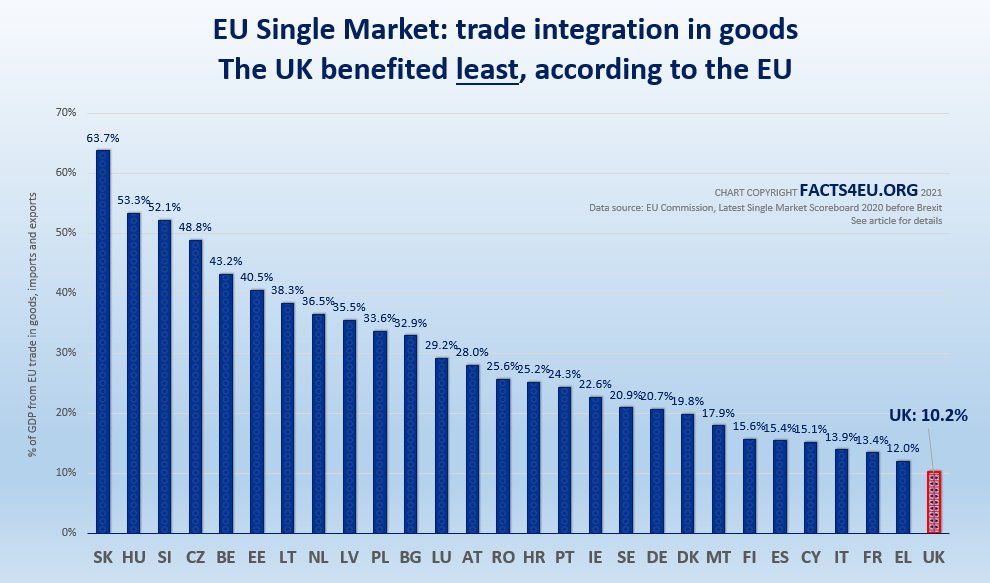
Brexit Impact Tracker – 3 July 2021 – Financial Service ‘No Deal‘ & State Subsidy Rules: The Frankensteinian Monster of Johnson’s Populist Toryism

This has been a momentous week in the (still ongoing) Brexit process.

July 1st, 2021 marked the six month anniversary of ‘actually existing Brexit.’ It also marked the deadline for EU citizens to apply for settled status in order to retain their rights to live in the UK. July 1st was also going to be the expiration date for the grace periods on the export of chilled meats from Great Britain to NI. Fortunately, an extension of this grace period has now been mutually agreed.

There was also the usual stream of news about the economic impact of Brexit, which is turning out to be as bad as most economists had predicted. There is talk of threats of food shortages – among other things due to the lack of lorry drivers – and decline in trade with the EU. There were also some reports of positive impact of Brexit in the pro-Brexit papers though. The Telegraph celebrated the UK moving up in a ranking on the ease of doing business. More materially, Nissan announced its decision to invest in a new plant in the UK – arguably in order to be in line with the rules of origin spelt out in the Trade and Cooperation Agreement (TCA), which can be interpreted as a positive economic effect of Brexit (on how to interpret whether Nissan’s decisions shows that Brexit is working, readers may want to check my earlier post).

Two legal challenges - For and against Brexit

There was also a very significative ruling by the Belfast High Court on the incompatibility of the Northern Ireland Protocol (NIP) with the 1800 Act of Union. The ruling confirmed that the NIP did indeed conflict with the Act of Union, but at the same time ruled that, by voting in favour of the NIP, Parliament had – implicitly – repealed parts of the Act of Union. The ruling was considered a blow to the Unionists - who had brought the case –by some, but labelled ‘politically significant’ by the new DUP leader.

Another Brexit related legal challenge that was decided this week was the case brought by British Sugar plc. against the government’s decision to unilaterally lower tariffs on raw sugar imports. The High Court ruled that the company had the right to request a judicial review of that decision. The significance of this ruling is twofold: For one, it is a test for the aggressive  - and some (including myself) would say reckless – international trade strategy that the Department for International Trade has adopted under the leadership of Liz Truss. For the other, it is also a test of the impact of the NIP on the UK government’s ability to use state subsidies. That link may be less obvious: The case was brought by British Sugar on the basis that the unilateral lowering of the tariffs constituted a de facto subsidy for the US-owned Tate & Lyle Sugars. Tate & Lyle is the UK’s largest – indeed only significant – refiner of imported cane sugar. British Sugar, on the other hand refines home-grown beet sugar. By lowering the price of imported cane sugar, Tate & Lyle would benefit from a de facto state subsidy. This subsidy, so the argument ran, disadvantages not only British Sugar, but also EU sugar exporters to the UK. That’s where the NIP comes into play: British Sugar argued that the subsidy would constitute an unfair disadvantage for EU sugar producers who export to the UK and therefore be in breach of the NIP and the TCA. The High Court did not rule on these claims, but found them plausible enough to allow a judicial review. The decision may lead to the courts setting important precedents around the governments post-Brexit trade and subsidy strategy.

Beyond these events, two very significant developments in the areas of financial services regulation and state subsidies rules are to be reported. Taken together, they provide clues about what the government’s post-Brexit economic plan for the UK is.

Financial services – ‘no deal’ it is!

 In financial services, another hugely important – albeit unsurprising – piece of Brexit news this week was the confirmation that it will be a no-deal Brexit in terms of financial services. The stalling of negotiations on a comprehensive financial service settlement between the EU and the UK – which would have maintained UK financial service firms’ passporting rights to serve clients inside the EU single market – means that the City of London’s only hope for access to EU market will be a unilateral ‘equivalence’ recognition by the EU.

 This will most likely mean that divergence of the UK from EU standards in financial services and – possibly –  the ‘Indo-Pacific tilt’ (set out in the Integrative Review) will be accelerated. This will likely spark more regulatory competition in financial services and a race to the bottom in terms of financial regulation. Indeed, Sunak’s reform plans for financial regulation and listing requirements, also set out this week, clearly indicate that that is the intended direction of travel.

 Partly, this is already happening and having and impact.  Indeed, another piece of Brexit news this week was that London reclaimed first place in equity trading in Europe, after having lost that spot to Amsterdam earlier in the year. This is to an important part due to the re-admission on the London Stock Exchange of Swiss stocks. Swiss stocks are banned from trading on EU stock exchanges after the EU Commission refused to extend its recognition of Swiss financial regulations as equivalent two years ago. Post-Brexit, the UK has benefitted from this situation by admitting Swiss stocks to the London Stock Exchange, which has helped boosting trading volumes. The divergence from EU rules seems to pay dividends here. But ultimately they are precisely the sort of start to a race to the bottom, which – as we know from 800 years’ experience - will inevitably be the breeding ground for the next financial crisis.

The ‘No Deal’ in financial services also has a political side: Tellingly a Financial Partnership agreement with Singapore was signed earlier in the week. This can be seen as another sign of the ‘Indo-Pacific tilt,’ but also of an increasing reliance on good relationships with authoritarian regimes due to the turning away from Europe.

 The new state subsidies rules – towards a new industrial policy?

A somewhat less obviously momentous event was the introduction by the government of its plans for post-Brexit state subsidies rules in the form of the Subsidy Control Bill. This may sound like a boring technicality, but state aid was of course one of the main sticking points in the negotiations of the Trade and Cooperation Agreement (TCA). Plus, it is a very revealing piece of legislation that can tell us more about the government’s plan for the UK economy – if there is any – than the posturing and rhetorical grandstanding that we are now used to.

What emerges is that the UK government seems to plan on creating a state aid regime that partly satisfies the EU’s claims in this area. Thus, state subsidies will be divided into three categories: unproblematic, ‘of interest,’ and ‘of particular interest’ and be subject to oversight depending on the level of concern. Moreover, unlimited government guarantees and subsidies to insolent companies will be banned. This means that the UK will continue to have some restrictions on subsidies and some oversight over their handing out. Something the EU will be happy with.

Furthermore, while no statutory regulator is created to oversee the regime, a new ‘subsidy advice unit’ will be set up within the Competition and Markets Authority. That’s partly in line with what the EU asked for regarding the level playing field (i.e. there is some oversight). However, the unit can only offer advice on whether a subsidy is fair, but cannot block any government subsidy. Any challenge will have to go through the judicial system and will be decided by the Competition Appeal Tribunal rather than the regulator. That would be going less far than the EU’s insistence on a statutory regulator with powers to intervene when the government subsidises industries to guarantee a level playing field.

What was most interesting though, was that Business Secretary Kwasi Kwarteng was quick to reject the notion that this regime would amount to a "return to the failed 1970s approach of government picking winners or bailing out unsustainable companies." That’s one way of describing the pre-Thatcher era approach to state subsidies. Another one is to call it an industrial policy. And that’s what Kwarteng really is rejecting. Yes, state subsides could – and often were – used to prop-up unviable companies (e.g. to save jobs – which may not necessarily be a bad idea!). But state subsidies can also form part of a coherent industrial policy. What the government and its ministers scoffingly call ‘picking winners’ – while not without risks of course – may actually be one of the most successful economic policies in the history of capitalism. Some of the most impressive cases of catch-up industrialisation in the 20th century – such as Japan (as Chalmers Johnson argued in a seminal book on Japan’s industrial success for instance) but also the so-called ‘Asian tigers’ including South Korea and Taiwan – were based on industrial policies that identified strategically important sectors (such as consumer electronics and cars), initially shielded them from international competition, and provided them with favourable conditions (e.g. cheap credit through state-owned banks) to develop and build up industrial capacity.

Yet, Kwasi Kwarteng has made it clear repeatedly that he did not wish the UK government to adopt an Industrial policy. Thus, earlier in the year, he shut down the Industrial Strategy Council against the will of industry. The question then is, in the absence of an industrial policy and hence a clear plan, how will the government use its newfound freedom to subsidies companies?

The answer can be gleaned from the government’s handling of the ‘levelling up agenda’ so far. Thus, the use of the Towns Fund to subsidies constituencies that the Tories consider ‘marginal’ hints at the fact that this government does not want to be constrained by any pre-defined coherent policy-plan that would prevent it from using taxpayers’ money strategically and opportunistically to reinforce its grip on power.

Long-term observers of the Brexit process had warned a while ago that a lax state aide regime may allow “elite decision makers to give state hand-outs to their chums.” If the handling of the public procurement of PPE during the Covid19 pandemic is anything to go by, that will definitely part of it. More strategically, however, a lax state aid regime, unconstrained by any pre-defined policy plan, will also allow the government to strategically support companies in areas that may be electorally important. Indeed, Kwarteng’s statement that the new regime will allow the government to focus on “key domestic priorities” almost sounds like a threat given that the only priority of this government seems to be to stay in power at any costs to the country and its people.

What economic policy?

So, what did we learn this week about the government’s intended economic policy after Brexit? The first thing is that it will hardly amount to a coherent strategy, but will rather be a set of haphazard and opportunistic actions that the government hopes will provide it with positive headlines in the red-top press to generate sufficient popular support to stay in power.

Partly the absence of a coherent economic policy is due to a fundamental and unsolvable contradiction at the heart of the Brexit project: In terms of the international economy, the Brexit project is drawn between a nationalist, protectionist project and a globalist, free trade agenda. Domestically, it contains a similar unsolvable contradiction between a libertarian, deregulatory agenda – in terms of financial services, genetically modified organisms (GMOs), sanitary and phytosanitary standards for instance – and a much more interventionist economic policy based on increased state intervention in various areas (e.g. in the area of state subsidies or in the area of corporate takeovers).

This Frankensteinian mix of libertarian and interventionist economic policies that are characteristic of Johnson’s populist Toryism, may make some political sense: It allows the government to reconcile the interests of the traditional, wealthy Tory donor with the perceived interests of the new Tory voter in the ‘red wall’ constituencies.

It is less clear what the impact of such an incoherent economic policy will be on the UK economy. The comparative political economy literature uses the concept of ‘institutional complementarities’ to designate a national business system that produces positive outcomes based on the productive interplay between institutions in different spheres. Such complementarities do not necessarily have to mean that only a ‘pure’ system that it is based on either a market logic or a state logic in all economic spheres can be successful. There are successful ‘hybrid systems’ that combine state intervention in some areas with fairly free markets in others. However, what the concept of institutional complementarities does point towards is the necessary interdependence of different spheres of a national business system (such as the labour market and the financial system) and the need for some sort of positive relationship between these different spheres.

It seems highly unlikely that the Johnson Government – driven, as it is, by its members’ personal economic interests and political ambitions rather than the public good –, and pursuing a hotchpotch of economic policies will design a plan for the UK economy that will lead to a cohesive national business system. Indeed, Liz Truss’s stubborn pursuit of FTAs at literally any cost, Rishi Sunak’s deregulatory verve, and Kwasi Kwarteng’s wish to arbitrarily hand out state subsidies unconstrained by an industrial policy, will hardly amount to an economic plan that will put post-Brexit Britain on the path of sustainable growth and prosperity.

Brexit Impact Tracker - 25 June 2021 – The Unravelling of the biggest Brexit lie and a lesson in realism

This week was an interesting one Brexitwise. There was of course the fifth anniversary of the referendum. And one increasingly gets the feeling that slowly but surely Brexiteers are running out of excused and explanations for the elusive benefits of Brexit.

For instance, there are the increasingly frequent ‘micro-acknowledgements’ by Brexit Minster Frost and others in the Johnson Government that they did not fully understand what they were doing. Lord Frost in particular is making a habit of openly and publicly acknowledging his lack of understanding of the impact of Brexit on the UK’s economic and political position, seemingly without being aware that that is what he is doing. Most recently, besides acknowledging having underestimated the impact of Brexit on Norther Ireland and on the relationship with the EU, this week, he openly acknowledge that Brexiteers did not understand that negotiating with the EU as a ‘third country’ would be more difficult than being a member. Confirming thus indirectly, the thesis that Brexiteers never expected Brexit to mean Brexit.

Also interesting was the Express’s reporting on a speech by Thierry Breton who – on the fifth anniversary of the referendum – allegedly mocked the UK for its failed attempt to take back control. The interesting bit is not the attack on Breton, but the fact that the Express could not come up with a single element of evidence to counter the argument that the attempt to take back control had failed, and the UK stood increasingly isolated on the global scene. Indeed, other than quoting Johnson’s claim that "[t]his Government got Brexit done and we've already reclaimed our money, laws, borders and waters" and Patel complaining about the treatment of Britons in the EU, the Express had nothing to oppose Breton’s claims.

But there was also an interesting stream of news about the UK governments increasing jingoism. In a move worthy of the worst dictatorship, the government endorsed a campaign that would have school children sing patriotic songs. There was also the incident in the Black Sea where the UK Navy’s destroyer HMS Defender entered what the Russians consider their territorial waters off the coast of Crimea. The Russian reaction was to deploy fighter jets and allegedly fire warning shots at the British vessel (although the Ministry of Defence immediately denied that account).

A move that is probably meant to demonstrate Global Britain’s newfound daring, but one that Tony Brenton, former British ambassador to Moscow, says [time mark 46:57] will negatively impact the chances of finding a solution for the Crimea situation. Indeed, whenever Western countries engage with Putin on his – antagonistic and nationalistic – terms, it tends to strengthen his resolve and his backing in the Russian population. But it would seem that we will have to get used to precisely such antagonistic and nationalist international diplomacy from the UK government too.

It might be a stretch to suggest a direct link here, but it is interesting that while the failure of Brexit is already becoming increasingly clear for everyone to see – to the extent that Lord Frost is forced into micro-admissions of guilt at increasing frequency – , the nationalistic grandstanding of the Johnson Government also seems to strengthen. This starts taking on genuinely worrying proportions now. I have recently written about the Johnson Government’s increasing resemblance to Orban’s government. This week, the Guardian quoted David Boyd, the UN’s special rapporteur for human rights and the environment, as suggesting that the Government’s laws on policing, on surveillance, and the weakening of judicial review were ‘reducing the public space’ and threatening the protection of basic human rights in the UK.

Beyond the realm of symbolic politics, the NIP and the economic consequences of Brexit figured prominently this week.

 NIP

In terms of the Northern Ireland Protocol, other than the fallout of Edwin Poots downfall as DUP leader after just 3 weeks, the big news was that the EU is expected to grant the UK a three-months extension on the grace periods on chilled meat exports from Great Britain to Northern Ireland. Thus, averting an imminent clash at the end of the month.  

This piece of news can be interpreted as the so far clearest piece of evidence contradicting the Johnson Government’s claim that it is the EU that is inflexible about the implementation of the protocol. However, it also shows the difficult position that the EU finds itself in. Without the extension the most likely outcome would have been the UK government once again extending graces periods unilaterally and thus forcing the EU to react. The options the EU Commission would have had would essentially have been three: 1. Taking legal action once again, but accepting in the meantime the de iure violation of its internal market 2. Imposing its own border checks between NI and the Republic 3. Imposing its own border checks between Ireland and the rest of the EU.

All of these options would have been greatly problematic for the EU. The first one would have been interpreted as a sign of weakness or powerlessness and would have constitute a massive short-term victory for the UK government. Presumably reinforcing it in its unreasonable and intransigent approach to all things European. The second one would have been even more damaging, given that avoiding a hard border on the Island of Ireland is considered crucial to Good Friday Agreement and indeed the whole point of the Irish backstop and the NIP was deemed necessary. The third option finally, would have been a major betrayal of the Republic of Ireland and again a victory for the Johnson government. So, granting the extension was always going to be the only option in the short-term. But of course, it does not solve any of the problems around the UK’s refusal to implement the agreement it signed.

Free movement of people and the UK labour market

The economically interesting news this week was the increasing evidence of the approaching unravelling of what is possibly the biggest Brexit lies of them all: Namely that the mass immigration from the EU was responsible for the economic grievances of the British people. It increasingly turns out that quite the opposite is true: it is the lack of immigrants that increasingly poses a threat to the UK economy in a remarkable variety of sectors.

Thus, different sectors are now discovering that the UK economy needs immigrants – including from the Eastern EU member states. Indeed, vegetable and fruit growers, meat producers, construction companies, are already feeling the effects of the absence of that workforce post-Brexit. The Grocer, weekly magazine for the Fast-moving Consumer Goods (FMCG) industry, titled that food shortages were now a certainty due to labour shortages along the value change, from  harvesting, manufacturing and packaging.

Of course, there is truth in the claim that cheap, low-skill workers from Eastern Europe did put pressure on wages in some areas and sectors. Therefore, low-skilled workers had their reasons worry about immigration. But by simply cutting off – or at least drastically reducing – the inflow of workers from the EU, Brexit offered a seemingly simple, but ultimately deeply flawed ‘solution’ to this very real problem. Simply closing the borders to workers that the UK’s economy desperately needs, was never going to solve the problem that was very largely homemade, by decades of underinvestment in people’s skills, by protecting investor rights over worker rights, and by thus locking the country into a low skills, low wage, low productivity equilibrium.

This fact is now becoming abundantly clear, and businesses start feeling the bite. But the Johnson government with its ‘f**k business’ attitude, does not care about the consequences of Brexit for businesses (As is also illustrated by the news this week that the Port of Dover is taking legal action against the government over its refusal to fund post-Brexit check points at the port). Tory peer Dido Harding even campaigns for the position of head of NHS England on a promise to make things worse – namely by promising to reduce the NHS’s reliance on foreign workers. With foreign staff reportedly making up 14% of the NHS staff, it is highly questionable that a reduction of foreign workers could be compensate by training more British doctors and nurses.

But the government and people close to it are still in Brexit campaign mode and willing to ignore its realities – to a large part because these realities increasingly evidently expose their false promises. Indeed, what Brexit and the decline in EU immigration does illustrate is the real nature of the British economy and its – as any modern economy’s – reliance on other countries to function. Or as Jonathan Mills aptly put it in a tweet ‘Brexit does appear to be a long education in how Britain really is, as opposed to how many ppl there believed it to be.’

The decline of workers from Europe puts the skills shortage in the UK into sharp relief and shows that the reality is that the UK has neglected for too long to make education affordable for all, promote social mobility, and invest in workers’ skills. Neglecting to do that meant that European integration was akin to throwing domestic workers under the bus without any protection. It is not surprising that they saw little benefit in EU membership. Sadly, Brexit is a cure far worse than the disease. What Britain would need is instead is protection for domestic workers from downward pressures on wages through strengthening union rights, or compensatory social security spending, retraining programmes, and generally equipping British workers to compete more successfully by providing proper vocational education and training. Instead, Brexiteers chose to promote their own political careers by selling to the people a fake solution that created a maximum of collateral damage to the UK economy.

BIT 18 June 2021 – Saturnian Brexit: How Brexit is reinforcing its own causes…and will devour its children

I have always felt that Brexit addressed people’s real and legitimate grievances by proposing fake solutions based on a flawed analysis of what the real problems are. As the first post-Brexit year progresses, it becomes increasingly clear that it is worse than that. Not only is Brexit not providing any solutions for the real problems that caused it, it is actually going to make them worse. Those who voted for Brexit because of their grievances will suffer from its consequences as much – or more – than the rest of us. Or to paraphrase Jacques Mallet du Pan’s bon mot: By feeding its parents, like Saturn, Brexit will devour its own children.

Two news items underscore this ‘saturnian’ direction of Brexit: The agreement in principle on a Free Trade Agreement (FTA) with Australia and the report by the Taskforce on innovation, growth, and regulatory reform (TIGRR), published on Wednesday this week. To see why the Australian (and other) post-Brexit FTA and the TIGRR recommendations would aggravate the issues that caused Brexit, we need to start with these causes of Brexit.

What caused Brexit?

Brexit is a hugely complex phenomenon and as such has multiple causes. Different people voted for Brexit for different reasons. A study by the UK in a Changing Europe research centre finds not only low-skilled workers and pensioners, but also people from the ‘squeezed middle class’ supporting Brexit.

That said, academic research in the area of electoral studies find robust evidence that at the individual level gender, education, and age were the key characteristics determining the Brexit vote: Literally all studies (e.g. this one) find that the older and the lower the level of formal education, the more likely you were to support Brexit, especially if you are male. Conversely, the younger and the higher your educational attainment, the less likely you were to support Brexit, especially if you are female.

However, beyond the individual level, researchers argue that it is important to see these individual factors in the context of regional inequalities in the UK. Here, trade liberalisation and austerity are key determinants of Brexit: Firstly, studies have shown that areas that have suffered more from trade liberalisation-induced de-industrialisation since the 1970s, were more likely to support Brexit than areas with less exposure to trade-induced and hence deindustrialisation. Indeed, one study shows that this so-called ‘China shock’ – the deindustrialisation of regions of Britain due to the massive increase of imports of cheap Chinese products – has led to declining living standards in the industrial heartlands of the UK, which then turned to support the Brexit idea. Secondly, studies have also shown that areas particularly affected by the austerity measures imposed by the Coalition government since 2010 following the global financial crisis, were also the areas that most strongly supported Brexit.

These regional factors are important to understand the Brexit vote, because they help us explain why it was not only the so-called economically ‘left-behinds’ (the unemployed or workers who have seen their real wages decline, and pensioners who are struggling to make ends meet) who voted for Brexit, but also well-off middle-class voters. The latter may not have suffered directly and materially from globalisation, but they are confronted with the economic decline of their area. This may have caused worries about the future of the region or the country in general, which has led people to support Brexit regardless of their material interests (a phenomenon called sociotropic voting by political scientists).

In a nutshell – and arguably put a bit bluntly – the two root causes of Brexit were trade liberalisation (which caused the “China Shock”) and financial market liberalisation (which caused the global financial crisis of 2007-8 and then austerity). The Brexit-related news this week clearly show that on both accounts the Johnson Government is going to make things worse rather than better.

The ‘Bonfire of Regulation Task Force’

The first important event this week was the publication on Wednesday of a report by the Task Force on Innovation, Growth and Regulatory Reform (TIGRR) composed of Iain Duncan Smith, Theresa Villiers, and George Freeman. The report contains few surprises, but a lot of cause for concern. It is based on the simplistic and ideological libertarian assumption that any piece for regulation is one piece too many. Regulation is interpreted as the product of overzealous bureaucrats who want to constrain our freedoms for no reason other than justifying their own job. There is no acknowledgement that regulation is key to any highly developed, technologically advanced, civilised society.

As a result, the great benefit of Brexit according to this report is simply that it is a ‘”one-off” chance for UK to escape EU red tape.’  The 100 recommendations reach from reforming rules on clinical trials for drugs (arguing that UK would become world leader in medicine with a lighter-touch regime while of course ignoring the fact that having its own rules may mean UK drugs may not be approved in other countries), lowering data protection standards, allowing pension funds to invest in riskier assets, to reduce capital requirements for insurance companies certain put in place after the Global Financial Crisis (so-called Solvency II regulation).

Let me focus on the area of financial regulation (pp.32ff). In this area, the proposals essentially boils down to moving away from cautionary, prudential regulation towards a more risk-driven approach to regulation. This is explicitly stated on p.13 where the report blames the EU regulation as based on  “excessive caution that is often disproportionate to the associated risk.” (Many of the arguments are ultimately based on the century old – but deeply flawed and romantic – notion of a superiority of the Anglo-Saxon common law over continental civil law).

Two concrete proposal towards riskier financial regulation concern defined contribution (DC) pension funds and insurance companies. The report argues that allowing pension funds to invest in riskier businesses would provide new sources of finance for small and scaling-up companies (proposal 2.1). This could be achieved by changing the rules about the charge cap for fees and administrative expenses that currently seek to protect savers from overly risk and expensive investment options (such as private equity and venture capital). The report states that:

“The charge cap (0.75%) on the fees and administrative expenses that can be borne by savers is a sensible investor protection measure in principle, but in practice has driven many schemes towards passive investment to keep the charges well within the cap. UK savers therefore have limited exposure to high-performing illiquid assets, including private equity and venture capital that tend to outperform public markets.”

The report does not say, of course, that the trend towards passive investment strategies has been a global phenomenon since the GFC and has partly happened for good reasons: Actively manged funds are risky, expensive in terms of management fees, and often do not outperform cheaper, less risky, passively managed ones. That is not to say that passive investing is without problems, but simply allowing pension funds to invest in riskier assets without increasing (prudential) regulation is a recipe for disaster. Indeed, the pension fund industry has explicitly warned the government against lifting or removing the charge cap. But as always, the Johnson Government ignores practitioners from the industries concerned.  

From the pensioners point of view lifting the cap from .75% to 1% could mean that the amount of money from their pension pot that is paid to people in the investment industry for managing their savings would nearly double (from around £92,000 to £170,000 over their life time according to the Department for Work & Pensions), while it is unlikely that the increased risk and fees would actually lead to increased returns.

Proposal 2.2 suggests lowering capital requirements for insurance companies set out by the Solvency II directive. This directive determines how much own capital insurance companies need to hold to prevent insolvency. According to TIGRR, lowering the requirement would mean that insurance companies could spend more of their capital investing, thus increasing supply of finance to the economy. The most worrying aspect of this proposal is that TIGRR seems completely oblivious of the reasons why this regulation was deemed to be necessary in the first place. Namely, the biggest financial crisis the world has experienced since the great depression in 1929. Indeed, there is a large amount of academic evidence that shows that financial crises are invariably preceded by a phase of financial liberalisation that is not accompanied by the establishment of ‘prudential regulation.’ Carmen Reinhart and Kenneth Rogoff have provided evidence from 800 years’ worth of historical data on financial crises. Similarly, the Global Financial Crisis (GFC) has hit precisely those Anglo-Saxon countries hardest who liberalised rigorously in the 1990s, but neglected to establish financial market regulation with teeth. IDS and his fellow TIGRRs now propose that we should go back to a pre-Global Financial Crisis area and let financial service firms take more risks. Of course, these are just highly aspirational proposals. But they do indicate what the dominant approach in the Tory party is.

FTAs – A race to the bottom

The second big news story this week was the announcement of an agreement-in-principle with Australia on a Free Trade Agreement. This was hailed as significant – actually ‘historic’ – news by the Johnson Government.

The reality seems to be a wholly different one. The UK farmers’ strong opposition can be shrugged off as an ‘interest group’ protecting its rents. Yet, it is more difficult to ignore the fact that both trade experts and UK businesses seem lukewarm at best about the deal. There are many reasons why the UK-AUS FTA will only provide limited benefits to the UK economy and they have been discussed before (including on this blog). Australia is simply too far away to compensate for lost trade with the EU. Also, which UK products precisely Australians will buy more of is unclear. The Express mentions whiskey, biscuits, ceramics, and cars. The contribution of these goods – with the exception of cars – to UK GDP are of course marginal. As for cars, the FTA is very unlikely to lead to a significant increase in demand for UK-produced cars. The vast majority of cars produced in the UK are part of global brands, owned by foreign companies who also have manufacturing plants closer to Australia.

What is remarkable, though, is the way in which this deal came about – against resistance within the cabinet, against resistance of UK farmers, without consultation of business (who reportedly had to rely on information of their Australian and Norwegian partners to obtain information that the UK government withheld from them!) and without any say for elected Members of Parliament (sovereignty versus unelected bureaucrats anyone?) who have now asked for a change in the rules about Parliamentary scrutiny for trade deals.

While economically the impact of the Australia deal will be small, its effect on UK trade policy may be big. The Australia FTA sets a precedent for other trade deals, and thus potentially weakens the UK’s negotiation position. Many commentators have noted that the zero-tariff agreement for Australian agricultural products is something other countries may ask for too. It will be difficult for the UK to refuse that. So, this deal with Australia is at best a useless, but quite possibly a bad deal – not just because it allows access to the UK market to meat produced in horrific conditions – but also because of its impact on future trade deals. A test for this hypothesis is already looming: New Zealand has signalled interest in concluding a deal with the EU, the UK and others to counterbalance its dependence on China. According to the FT, NZ trade minister Damien O’Connor said any “New Zealand-UK deal would probably be similar to the UK-Australia trade agreement”, which implies “[t]ariff cuts on New Zealand farm exports including dairy, lamb and beef would be among Wellington’s demands.”

However, like I wrote many times before, FTAs have become completely reified and ‘superwoman’ Liz Truss and the Johnson Government conclude them regardless of their content. As Chris Grey underscores in today’s Brexit & Beyond blog, the Australia FTA is purely symbolic. UK businesses have urged the government to adopt a more cautious, long-term approach and stop concluding bad FTAs just to score political points.

An alternative or perhaps complementary (economic rather than political) interpretation would be that Brexiteers actually blindly believe in the benefits of free trade that any FTA is better than none. A statement after the conclusion of the trade deal with Island, Norway, and Lichtenstein (which has given rise to quite some ridicule and disappointment) by International Trade Minister Ranil Jayawardena summarises this perfectly: "More trade and more investment will drive growth and support jobs in every corner of our country."

That statement is provenly false. The research on the impact of the ‘China Shock’ in both the UK and the US clearly show that trade liberalisation creates winners and losers. This is why trade liberalisation needs to be accompanied by compensatory measures if it is not to produce large numbers of discontent people in a country.

Such a system of trade liberalisation with domestic compensatory mechanisms through welfare transfers or selective trade barriers was in place for much of the post-War period and was referred to ‘embedded liberalism.’ This embeddedness has been eroded ever since Margaret Thatcher and Ronald Reagan came to power in the late 1970s and early 1980s respectively and spread their ideology around the globe. It is this ‘disembedding’ of markets that has exposed workers to competition from low-wage countries, to a stagnation and even decline in real wages and thus to the discontent that has led to a populist backlash against the EU and globalisation in general.

There is no evidence whatsoever that the government’s post-Brexit policies will do anything to address these problems. To the contrary, according to the FT, the Trade Remedies Authority (TRA) already scrapped “safeguard” tariffs in more than 50 areas since the UK left the EU,” which means UK manufacturers are more exposed to unhampered foreign competition. This – together with the ‘zero-tariff approach’ to new trade deals – indicates that the Johnson Government’s vision for a post-Brexit Britain is one of disembedded liberalism – thus reinforcing the causes of Brexit.

Singapore on Thames or not?

In an interesting piece published yesterday, Alex Dean of the Prospect magazine stroke a rather optimistic tone about the direction of travel of post-Brexit Britain. He argues that the fear of post-Brexit Britain becoming a nirvana for laissez faire, free market libertarians was misplaced. According to him, post-Brexit Britain has moved in the opposite direction. The basis for this claim is the ‘levelling up’ agenda, the end of austerity, the public spending during the Covid19 response, but also the discussions of changes (increases) to the taxation of multinational firms around the G7 meeting.

I find this optimistic argument entirely unconvincing. I do not think the Chancellor’s Covid response is anything to go by to predict what the future post-Brexit economic and budgetary policies will look like. Covid sure was a once in a lifetime crisis (well, hopefully!). The exceptional interventionist measures that the Chancellor adopted will soon be wound down and the pendulum will swing back into a more conservative approach to public finances. This may not mean a return to open austerity as under Osborne. Dean rightly argues that this policy would go down very badly with the newly won ‘red-wall conservatives’ in the Midlands and the North of England. But cuts to public spending will take subtler (such as a smaller than expected pay rise for NHS staff) or less domestically controversial forms (such as cutting the foreign aid budget).

Similarly, the government’s ‘levelling up’ agenda for now involves some spending on underprivileged areas of the country. Yet, partly this money is redirected from other areas (e.g. the moving of parts of the civil service out of London) or is infrastructure spending (such as the environmentally disastrous HS2 project). While some public money will be spent on such projects to maintain electoral support for the Tories, this in itself is hardly a sign that the ‘Singapore on Thames’ vision of post-Brexit Britain is off the table. Indeed, the TIGRR report already contains suggesting that the financing of the levelling up policy and of other infrastructure spending should become an opportunity to encourage private investments (cf. proposal 2.3 by TIGRR). In other words, levelling up may soon become an opportunity for privatisation of infrastructure projects.

Same for the G7 global tax reform: It took only a few days after the G7 meeting for the UK government to undermine its spirit by pushing for an exemption for financial services.

More generally, the fact that there has not been an actual ‘bonfire of regulation,’ does not mean that deregulation is not happening. Believing that the post-Brexit ‘Singapore on Thames strategy’ would consist of a quick, radical reduction in the size of the state or regulations was always a naïve believe. But small changes – such as lifting the cap on management charges for pension funds – are enough to fundamentally transform and further disembed the UK variety of liberal capitalism. Yes, in some areas there is more regulation (at the borders notably), but the regulatory reforms that TIGRR and without a doubt Sunak’s and Kwarteng’s Cabinet ‘Better Regulation Committee’ will be driving still can trigger a race to the bottom in standards.

Incidentally, it is also wrong to claim that the second ‘Thatcherite revolution’ has not happened, because the state has not shrunk significantly in the past year. In actual fact, under Thatcherism too, ‘shrinking the state’ – outside of welfare cuts – has always only ever been rhetoric.  Thatcherism was not a small state project – state spending grew by an average 1.1% a year under her premiership. Even though that is less than under other governments, it’s hardly evidence for a libertarian ‘drowning the state in a bathtub’ approach. Indeed, Andrew Gamble used the title The Free Economy and the Strong State to characterise Thatcher’s policies. Thatcherism was definitely anti-welfare and anti-public interest, but it was anti-state only in rhetoric. In reality, Thatcherism is very much pro strong state. Indeed, this is another way in which Singapore seems to continue to inspire the Johnson Government and other Brexiteers: Not only is Singapore a case of fairly unregulated capitalism, but also is it politically an undemocratic, authoritarian regime. Like I wrote last week, that is indeed something the UK government also seems to be aspiring to.

The wrong kind of vision – the wrong kind of competition

While the deregulation may not have taken off yet, the fact remains that inside the Tory governing circles it is the only game in town. From the infamous Britannia Unchained book – co-authored by no less than four current cabinet ministers – to the discourses by the PM himself and the – of course aspirational but possibly not uninfluential TIGRR report –, it is evident that the current Tory leadership cannot think about economic matters other than in very simplistic libertarian terms. The mistake of underestimating the ruthlessness and determination of Brexiteers to pursue their vision – however absurd – has been made before.

The UK government is stuck in a 19th century understanding of capitalism and liberalism and it will ruthlessly pursue that vision. Their favourite model is a Manchester capitalism-style system of laissez faire that is hugely profitable for producers and owners, but disastrous for everyone else. The only plan is to compete with the EU for FDI by lowering standards and regulations and thus making it cheaper for companies to produce in the UK. The only way Brexiteers can conceive of competition is in terms of cost competition: You beat your competitors by producing more cheaply and offering cheaper products – not better-quality ones. Colin Hay has warned of this dangerous obsession with cost competitiveness nearly a decade ago. Competing on quality rather than cost - and thus selling your products at higher prices – is what allows you to pay higher salaries and thus avoid the downward spiral of ‘beggar-thy-neighbour competition,’ which causes the discontent that led to Brexit. There are no signs that any of the post-Brexit strategies point in that direction.

The hyper liberal laissez faire capitalism of the 19th century eventually broke down with the 1929 stock market crash and was blamed for the rise of fascism in the 1920s and 30s. Various political movements from left and right - including the US Democrats under Franklin D. Roosevelt, William Beveridge in the UK, and the post-War German ordolinerals around Christian-democratic Minister for the Economy Ludwig Erhard - understood that markets need to be embedded through social policies, welfare states, and market regulation. Neo-liberalism was born out of the insight that free markets require embedding and compensation of the losers of competition to not constitute a ‘social explosive’ (as the German neoliberal Wilhelm Röpke put it). Of course, neoliberalism has since been perverted by neo-classical economists and turned into its contrary. But the fact remains that after the 1930s people had understood the disastrous effects of ‘unchained markets.’ The UK government has not understood. As long as the UK government does not learn that lesson, Brexit will always only have one ultimate outcome: It will devour its children.

Brexit Impact Tracker 13 June 2021 – The “Sausage Wars” and the increasingly worrying features of the Johnson Government

This past week was all about Brexit in the British media – illustrating once more for everyone to see that Brexit is far from done! The big event overshadowing everything else this week was the fast approaching end of another ‘grace period’ on border controls on goods traded between Great Britain and Northern Ireland. This time the goods concerned are chilled meats. As a third country, Great Britain will no longer be allowed to export chilled meats to the EU after July 1st, 2021. The Northern Ireland Protocol (NIP) implies that Ireland remains within the EU customs union and single market, meat products exported from Great Britain to Northern Ireland will now have to be frozen. While this has been – or should have been – clear to everyone ever since the NIP has been agreed on by the UK government and the EU, senior members of the UK government now consider this effect of Brexit to be ‘bonkers.’ With the first meeting of the Partnership Council, which overseas the manage the Trade & Cooperation Agreement (TCA), taking place on Wednesday and the G7 meeting later in the week, the disagreements around the implementation of the NIP led to unprecedented tensions between the EU and the UK – which the tabloid press was quick to label ‘sausage wars.’

Maros Sefcovic, European Commission vice-president, used rather undiplomatic language to clearly tell the media that the trust in the UK government had all but gone and warned the UK government against any further unilateral action (such as unilaterally extending the grace period on chilled meats). Conversely, an oft-cited article signed by Lord Frost published in the FT continues to insist that the EU should show more flexibility  – by which the minister evidently means that the EU simply accepts that the UK follows its own rules without guarantee that they are compatible with EU rules, but should still be allowed to export without constraints into the single market.

There has been a great amount of commentary on the issues surrounding the NIP this week and the upcoming end of the ‘grace period’ (e.g. Chris Grey’s Beyond Brexit blog, Tony Connelly’s analysis, and the FT’s Brexit Briefing). So, its not worth that I summarise this once more. Rather, I want to focus on what the UK government’s handling of the NIP situation tells us more broadly about this government and possibly the future of the country.

In my day job as a Professor of International Management & Political Economy at Loughborough University, I mainly study the democratic backsliding in Central Europe and especially Hungary (and the impact this has on multinational companies’ strategies). So far, I have resisted the temptation to compare the Johnson government to the government of Victor Orbàn, which I’ve been studying together with my colleague Dori Sallai literally since Orbàn came back to power in 2010. But it becomes increasingly difficult to ignore the striking parallels between the steps Orbàn took to entrench his power, leading to significant ‘democratic backsliding’ in Hungary. These steps include a reform of the electoral system, high-level corruption to create a clientele that will support the governing party, and bringing the national media in line. Last week, I was struck to find signs of all three of these anti-democratic populists mechanisms at work here in the UK.

Electoral Reform – Gerrymandering to retain power

Gerrymandering designates the practice by a governing party of redrawing the boundaries of electoral constituencies to increase the likelihood of winning the next elections. This practice has been widely used by Orbàn in Hungary after 2010, which assured him a massive electoral advantage over the opposition and has secured him large parliamentary majorities ever since.

There is increasing concern that the UK government is attempting exactly that. Labour has warned for some time that the current reform of electoral boundaries is an attempt to entrench the conservative’s grip on power. But political scientists – like Victoria Honeyman – too are expressing concerns over the current conservative attempts to redraw the electoral map.

The suggested changes to constituency boundaries would affect contested constituencies such as Bately and Spen in West Yorkshire (where, incidentally, Kim Leadbeater – sister of murdered MP Jo Cox – will defend a labour seat in a by election on July 1st 2021). According to the conservatives’ plans, this constituency would be integrated with Hipperholme – a firmly conservative area – and thus increasing the Tory’s chances of gaining or holding this seat at the next General Election.

Institutionalised Corruption

There is now also ample evidence that the current government is highly corrupt. This week the High Court rule in favour of the Good Law Project’s case against the government over a contract awarded to a market research firm Public First, whose bosses had personal relationships with Dominic Cummings. This ruling means that Michael Gove – as minister responsible for the Cabinet Office when the contract was awarded – acted unlawfully. More generally, there is an increasing amount of evidence showing that coronavirus contracts were awarded to companies and people with close ties to people inside the government. The Good Law Project speaks of ‘institutionalised cronyism’ in public procurement. I do not see much difference with what we call institutionalised corruption in our research on Orbán’s Hungary.

The current government’s corrupt behaviour is not limited to public procurement, but also affects the use of public funds to generate support amongst the population for the government and the governing party. Like I discussed before, the ‘levelling up’ policy has already been shown to be essentially as pork barrel scheme whereby the government channels taxpayers money to constituencies it considers marginal seats in the next elections. That too is an instrument often used by Orbàn and other anti-democratic populist governments to increase popular support.

Another parallel is that the high-level corruption has not legal consequences for the government, which is driven by ‘nepotistic corruption’ as Peter Kreko and Zslot Enyedi put it. Indeed, despite two rulings already judging that senior figures in the UK government – Matt Hancock and Michael Gove  – have acted unlawfully, there is no sign of any consequences for these politicians. This is a government that has prove time and again that it does not care about the legality of its actions or the rule of law. It considers itself above the law and thereby signals to citizens that compliance with laws is voluntary – at least of those with money and power. Needless to spell out what such an attitude will do to trust in our public institutions in the long run.

The Government’s Media

The third worrying parallel between the UK and the Hungarian case was the way in which the BBC seems to have started to uncritically adopt the government line on the Northern Ireland issue. Andrew Marr’s interview with Maros Sefcovic last Sunday was heavily criticised for suggesting that a clear majority of people in Northern Ireland ‘hated’ the NIP. Moreover, in a shocking interview by Evan Davis with Thomas Byrne – the Irish Secretary of State for European affairs – on Radio 4’s PM programme on June 9th, Davis uncritically insisted on the point that British sausages do not pose any health threat to EU citizens, implying therefore that the EU’s approach was unreasonable. He insisted on the question: ‘What is the danger to any European of a British sausage smuggled into the EU single market via Northern Ireland?’ The whole interview suggested that the EU not accepting UK food standards as equivalent was simply based on a stubborn insistence on applying the rules for the sake of it. That is terribly close to the government’s recurring – and wrong – accusation of ‘legal purism.’ Such uncritical reporting on why the EU has the rules it has, clearly fuels unreasonable and unjustified anti-regulation attitudes that have played an important role in the history of Brexit.

Bryne’s completely ineffectual answers that missed the broader point (that the EU giving in to UK’s current demands would undermine the basic principles on which the whole single market is based) did not help of course. But the point is that presenting the problem in the terms Davis did means accepting the government’s discourse, when it should be challenged, not reproduced by journalists. Instead, the BBC increasingly sounds like a government channel. The simplistic and biased way in which the NIP issues were covered in the Andrew Marr Show, on PM, and on other BBC programmes implies that the BBC simply accepts the government’s interpretation of the situation.

I may be overreacting and reading too much into some isolated examples of bad journalism. Nevertheless, observing the toothless reporting of the BBC about crucial Brexit issues alongside what can only be seen as political appointments to key positions at the BBC in the past year (Richard Sharp – a former banker, advisor to Rishi Sunak, and large Tory donor – as chair of the BBC and Time Davie – a former Conservative politician – as Director General) does remind me of how Orbàn and other authoritarian leaders in Central and Eastern Europe try to bring the national media under control to better serve their goals.

Readers may consider this an exaggerated comparison and I am not suggesting the UK’s democratic system will quickly crumble like the Hungarian did. At the same time, there are few things I would put past this government. And foreign leaders seem to increasingly become disillusioned with the UK government too.

Signs of lost credibility

EU officials and political leaders of EU member states seem to increasingly drop any diplomatic pretence and openly voice the loss of faith in the UK government as a viability partner. This week European Commission President Ursula von der Leyen lectured the UK government on one of the most basic principles of international politics, namely ‘pacta sunt servanda’ – treaties have to be respected. French President Emanuel Macron explicitly questioned the seriousness of the UK government stating that “I think this is not serious – to want to have another look at something in July that was finalised in December after years of discussions and work.”

The UK government, however, seems rather to follow Johnathan Swifts bon mot that promises are like pie crust, made to be broken.” The government continues to insist on ‘flexibility,’ ‘common sense,’ and pushes back against ‘legal purism,’ to try and get an arrangement whereby EU rules do not apply to the UK. The only arrangement it will accept are either unilateral recognition by the EU of UK rules as equivalent or a mutual recognition solution where both countries accept each other’s standards as equivalent. The UK also insists on a ‘risk-based approach’ whereby the EU simply accepts that the risk to EU citizens from food imports from the UK  - without guarantee that the UK will maintain its current standards. Such a level of trust in UK standards after Brexit may be difficult for the EU to muster, especially given that the memory of the BSE crisis in the 1990s has not completely faded. But independently of that, the problem is that the UK essentially asks the EU for a paradigm shift in its approach to safeguarding the integrity of the single market, by exempting the UK from following the rules that all 27 member states have to follow to be part of the single market.

Some had hoped, the G7 summit this week in Cornwall might provide an opportunity to overcome the impasse in Northern Ireland through the intervention of US president Joe Biden.

Uncle Joe and the ‘special relationship’

Indeed, the UK government seemed worried about Biden potentially weighing in in the dispute, accusing the EU of trying to use American pressure to solve the issues. Biden, of course, has been very outspoken about protecting the Good Friday Agreement – both because of the US’s role as a broker of the agreement and for personal reasons. The US’s most senior diplomat in the UK – Yael Lambert – is reported to have formally reprimanded the UK over its stance on the NIP that – according to the Americans – ‘inflames’ tensions in Northern Ireland.

This puts the government into a difficult position. Post-Brexit, the US was meant to be a key ally for the UK notably by agreeing to a new free trade agreement that would help compensate for the loss of access to the EU single market. Yet, it increasingly looks like the US government under Biden agrees more with the EU than with the UK over the interpretation of the NIP.

What does this tell us about the relationship between the Johnson government and the Biden administration?

Interestingly, the Prime Minister was recently reported to have objected to the term ‘special relationship’ between the US and the UK, which he finds ‘needy and weak.’ In the current context, the announcement by Biden that he would be meeting with Prime Minister Boris Johnson to affirm the special relationship between our nations” may indeed almost sound like a threat.

Johnson’s dislike for the ‘special relationship’ and his willingness to portray himself as the leader of a Global Britain that has regained its independence and self-confidence does contrast quite starkly with his behaviour during the meeting with Biden at the G7 this week. His response to a joke Biden made about their marriages was ‘I’m not going to dissent on that one. I’m not going to disagree with you there or indeed on anything else, I think highly likely’. This does not sound like the PM affirming Britain’s new-found ‘sovereignty,’ but rather like cringe-worthy submissiveness. But then, of course, Saturday evening’s defiant statements by the PM about the NIP was a clear indication that Biden’s intervention has not changed much in the government’s attitude.

Moreover, whatever happens to the NIP, the US is likely to eventually pursue an FTA with the UK. Such an agreement would fit the US current international strategy to counter Chinese influence around the world by strengthening its ties with Western allies. Perhaps Biden’s suggestion this week that an agreement between the UK and the EU on Sanitary and Phyto-Sanitary (SPS) standards would not jeopardise the UK’s chances of sealing a trade deal with the US is not just trying to provide a solution to the NIP issues, but also preparing the ground for future trade negotiations.

What’s going to happen next?

It seems very unlikely that the UK government will back down in the dispute over the chilled meat rules. Once again it has adopted a bellicose and intransigent attitude that leaves little room for compromise without losing face domestically. That may very well mean that the UK government will go ahead and unilaterally extend the grace period beyond July 1st. That in turn would leave the EU no other option than taking retaliatory actions as defined by the Withdrawal Agreement and the TCA. The problem with that, of course, is that such action may take a long time to take effect, lengthy mediation processes and possibly a court ruling. In the meantime, the integrity EU single market will be de facto breached. This has led to some reports that the EU is considering an emergency solution, namely imposing checks on trade between the Republic of Ireland and the rest of the EU. Needless to say that this would be a major change in the EU’s approach to Brexit and would cause massive objections from the Irish side. Naomi O’Leary talked about the return of the ‘colonial nightmare,’ because such an arrangement would imply that the Republic of Ireland would be cut off from the EU single market and would de facto become part of the UK’s domestic market.

There is little chance of such an emergency plan to become reality. Nevertheless, given the UK government’s bellicose approach it does seem difficult to imagine any possible solutions to overcome the impasse. It is extraordinary to see the stubbornness with which the UK insists on an ‘equivalence’ or ‘risk-based solution,’ while not even complying with the basic requirements need for such a risk-based solution to be viable (namely sharing data about the movement of goods imported into NI from Great Britain). This is a clear sign of what Chris Grey called the Brexiteer’s refusal to accept that ‘Brexit means Brexit’. Indeed, it becomes increasingly clear that Johnson’s Brexit government believed that even after exiting the EU, the UK would receive special treatment from the EU and hence the commitments made in the NIP and TCA would not actually have to be respected.

An interesting possible solution to the impasse is described by Raoul Ruparel in a Politico article, which he calls ‘managing divergence.’ This solution would take advantage of the fact that after 40 years of EU membership, the UK and the EU are currently aligned in terms of regulatory standards. This makes it possible to adopt a light touch approach to checks and border controls, until the UK actually decides to deviate from its current standards and regulations. This is indeed the basic mechanism that underlies much of the TCA, which contains non-regression clauses that makes the current market access conditional on both parties not reducing labour and environmental standards below current levels.

This currently looks like the only solution that might be acceptable to both parties. Although, this arrangement would only kick the can down the road, as the problem of border checks in the Irish Sea would re-emerge as soon as the UK decided to indeed diverge (or rather regress) from current standards.

More importantly, perhaps, it is not clear at all whether the UK government is actually interested in any solution that might look like a compromise. Rather, the Johnson government seems to be willing to simply hold its tough line, extend the grace periods unilaterally, selling it domestically as a sign of strength and sovereignty, and then blame any negative effects – including the potential of renewed violence in NI – on the EU’s ‘legal purism.’ Indeed, Johnson’s intransigence after a week of continuous pressure from the EU and the US is remarkable. On Saturday night, after talks in the margins of the G7 meeting, he threatened that “[i]f the protocol continues to be applied in this way, then we will obviously not hesitate to invoke Article 16” (which would suspend the protocol).  There does not seem to be any willingness to find a solution to preserve peace in Northern Ireland.  The government seems to simply bank on the EU not following through on its threats of retaliation – which is another parallel with anti-democratic populists in central Europe. The government simply does not seem to take the threat to peace in Northern Ireland seriously. Its childish and cavalier approach to the very serious issues was perfectly illustrated by  Lord Frost who reportedly wore union jack socks at the G7 meeting. With Biden’s intervention seemingly ineffectual, it seems increasingly doubtful that anyone can reign in this childishness and safe the Northern Ireland agreement.