Spending the summer at home in London with the occasional day trip to the sea- or countryside sounds like a super relaxing way of spending one’s summer holiday.
It is not. At least not when you decide to travel by train. What is meant to be a 49min direct trip turns into a 3h journey with last minute train cancellations, two interchanges, and a lot of time waiting on hot platforms and in stuffy waiting rooms. Or else, leisurely interchanges turn into sprint exercises due to delays and lack of coordination between railway companies.
Luxury problems? Perhaps. But then, what I experienced occasionally during a holiday is a daily struggle for millions of commuters (I was quite shocked by one sign at a station that declared in a very defeatist and fatalist way that normally only standings places were available on a particular train!). Worse still, the very day we were on a Southern train in East Sussex, one of their trains derailed seriously injuring at least two people. And that’s only a few weeks after a train driver was killed on another network due to a missed red signal. So, perhaps not a bad thing to get a little upset about the state of Great British trains?
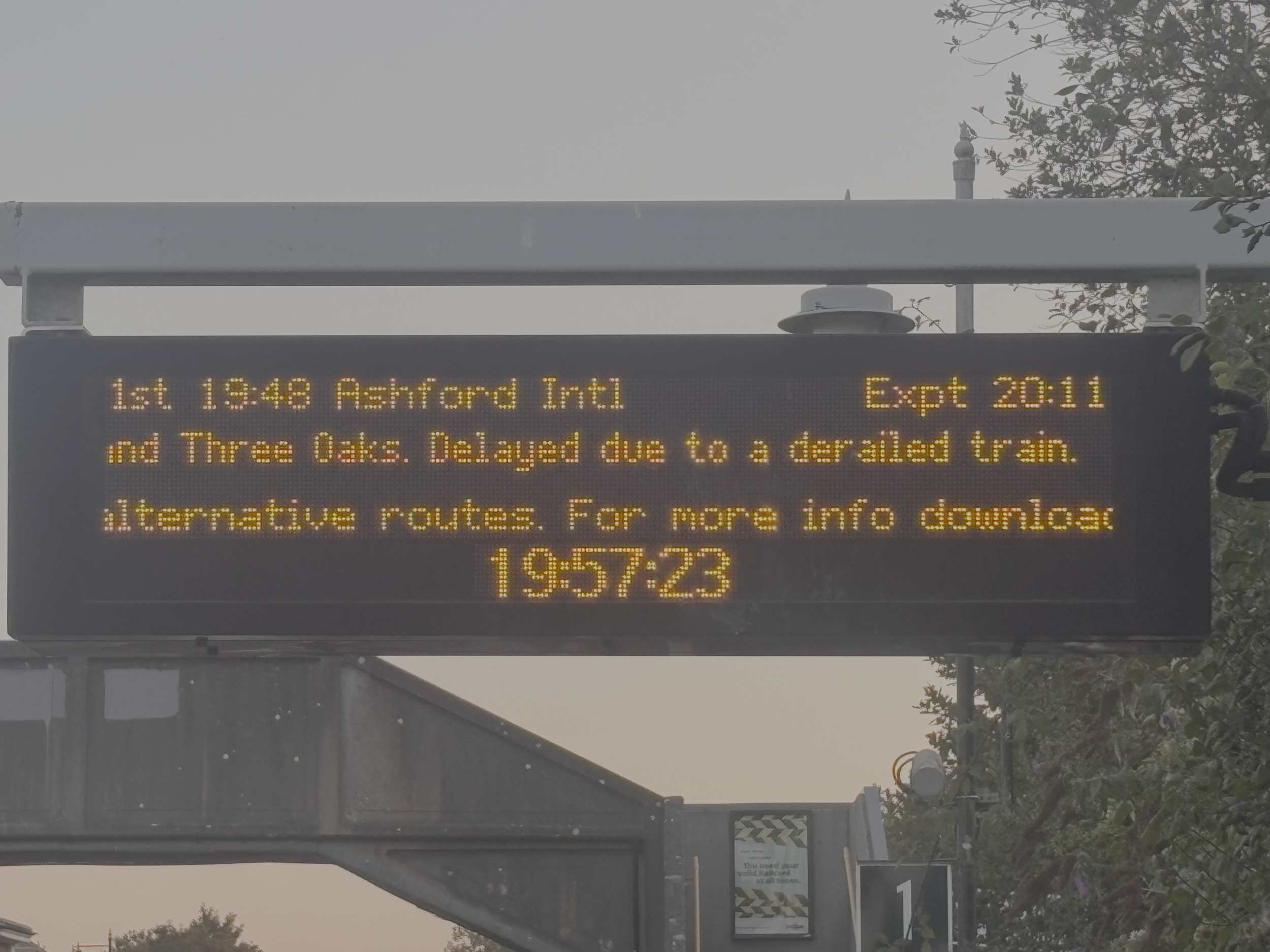
Delays and accidents - Rye
I am genuinely puzzled by why the British public accepts the state of its once world-leading railway system. And this is despite the fact that many Brits do travel abroad and can see that a different system is possible (I am particularly thinking of France and Japan who have probably the most developed and best run railway systems in the world).
My explanation is that the British public has been convinced by various actors that this is as good as it gets. More specifically, the argument that has convinced Brits that this is the best we can get is an economic one: we simply cannot afford anything better.
The cancellation of the HS2 project – and the really rather limited upset about this frankly rather shocking and embarrassing decision for one of the wealthiest countries in the world – is the latest illustration of the view that Britain cannot do what France or Japan (or indeed now China) did with their high-speed trains systems. Namely investing massive amounts of public money into building and maintaining it. Indeed, Brits have been convinced a long time ago that the British state cannot afford to build or run railways. That’s why they were privatised.
A key argument for privatisation is that private investors have deeper pockets than the state and therefore can invest more in services. Except that once public services have been privatised, the imperative of maximising shareholder value leads to a strategy of maintaining the minimum competitive quality of the service (in the case of rail franchises these are determined in the franchising contract with the state, but may of course still be below the level of what is acceptable to or good for people). So, now deep pockets have turned into a competitive imperative to limit expenses and maximise returns to investors. Instead of striving to reinvest and improve quality, private operators try and minimise reinvestment to a level that makes them not fall short of the contractual obligations (often unsuccessfully) while disbursing a maximum of their profits back to their shareholders.
The shortcomings of a fragmented privatised railway system is why the Labour government decided to create state-owned Great British Railways (GBR) and take passenger rail back into public ownership after the expiry of current franchising agreements.
Yet, it would be too easy to blame all the ills of British railways on privatisation. It is more complicated than that. The other day, I was on a train that was late so that we would miss the connecting train by just two minutes and would have to wait for an hour for the next (and as a result completely packed) one. The ticket inspector explained that unfortunately he could not tell the connecting train to wait, because it was operated by a different company. So, it didn’t wait. My first thought was that this was typical of a privatised rail network and the frictions created because of the need for coordination and lack thereof across multiple providers. Turns out both train companies involved – Southern and SouthEastern – are stated owned, although one of them only for a few months. SouthEastern was re-nationalised in 2021 following a breach of the franchise agreement while Southern was re-nationalised in May 2026 as part of the Labour government’s renationalisation plan.
While it may be unfair to judge the government’s performance in running railways after just a few months, the fact is that state ownership alone will not fix the broken British train system. In fact, having state owned railway companies only helps if it means better coordination and more investment. Often problems with big infrastructures like a national railway system result from underfunding – which can be done by both the state and ‘the market.’ Germany’s Deutsche Bahn (DB) constitutes a good example of a state-owned passenger railway system that is failing due – among other things – to underfunding by the state.
It would take a lot of optimism to believe that the UK government once it is in control of passenger train operations in the country will not be at risk of going down the DB route. Britain just like Germany is adhering to the ‘sound public money’ ideology that brought us austerity and tells us the state needs to ‘live within its means’ (and that those means are necessarily very limited so as not to scare off rich individuals and organisations who do not want to pay taxes). That ideology will also put a very strict limit on how much the government will invest in its railways. Whether or not that will be more or less than shareholder-value maximising private stock corporations are currently doing is hard to tell. Some optimism may be warranted given the experience with renationalising railway infrastructure: Some may argue that state-owned Network Rail has done a better job at maintaining and developing railway infrastructure than its private, stock market listed predecessor Railtrack plc. which was renationalised in 2002 after a series of accidents and government bailouts.
But what needs to change is not so much ownership – although taking shareholders out of the equation may help increase reinvestment in operations so as to improve services and safety – but the British public’s attitude that our country cannot afford a better railway system and that our government cannot do anything to make that happen. That attitude is the expression of the very odd belief that the British state is powerless and just has to accept whatever private investors are willing to offer or what the austerity ideology tells us is ‘reasonable.’ It is this myth of the powerless state that is at the heart of many of the failings of public services in this country – from railways, to the NHS, to water. It is also this belief in the powerless state that makes many people so despondent and angry about their life – because the self-imposed impotence of the state is felt by every citizen as their own impotence. When people ‘want their country back’ – many think primarily about their local services – including public transport and their ability to get around reasonably cheap. So, having trains run on time may have benefits beyond people missing trains and not getting to the sea side in time for high tide.
